
974 LP / TACET’s Beethoven Symphonies: nos. 1 – 9
Description
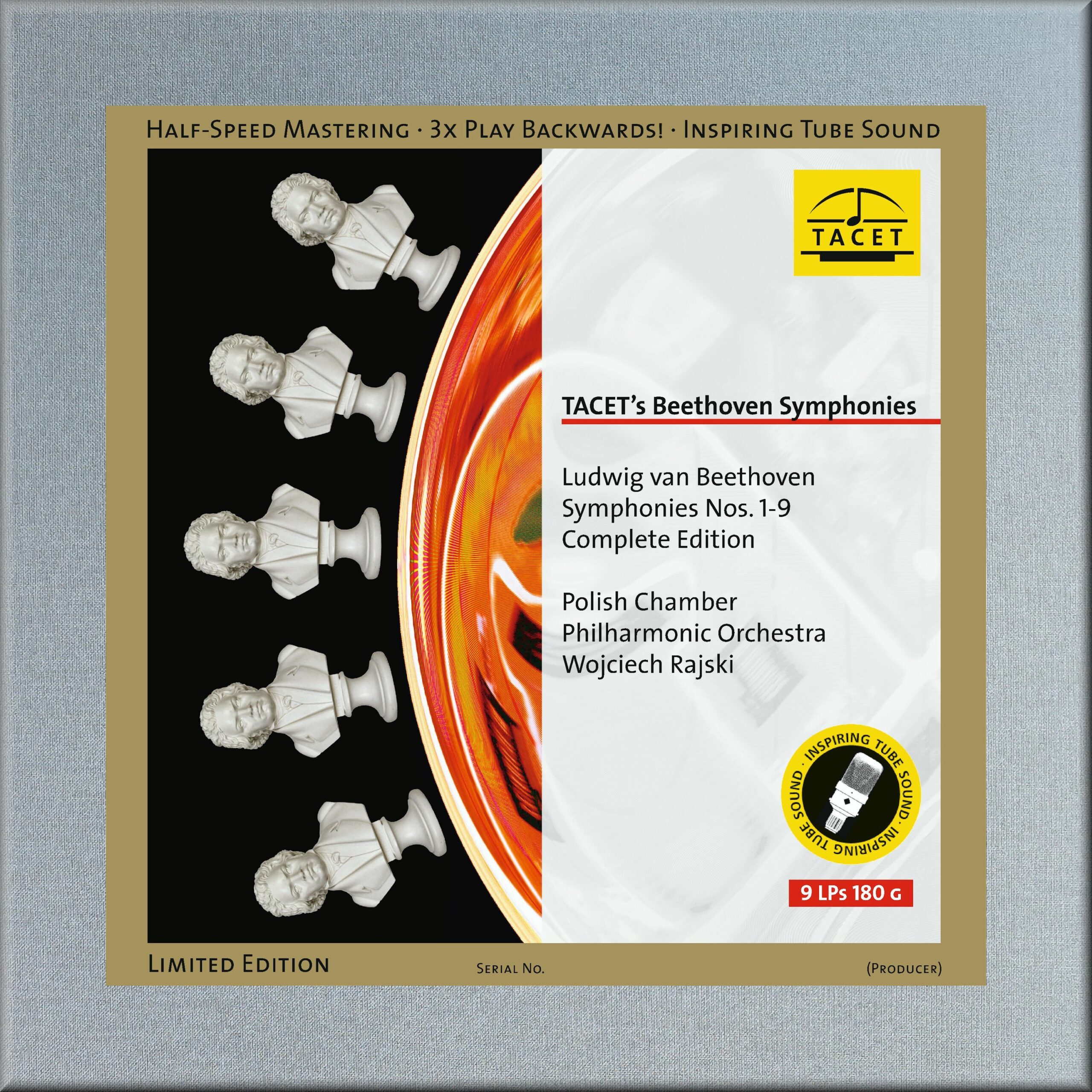
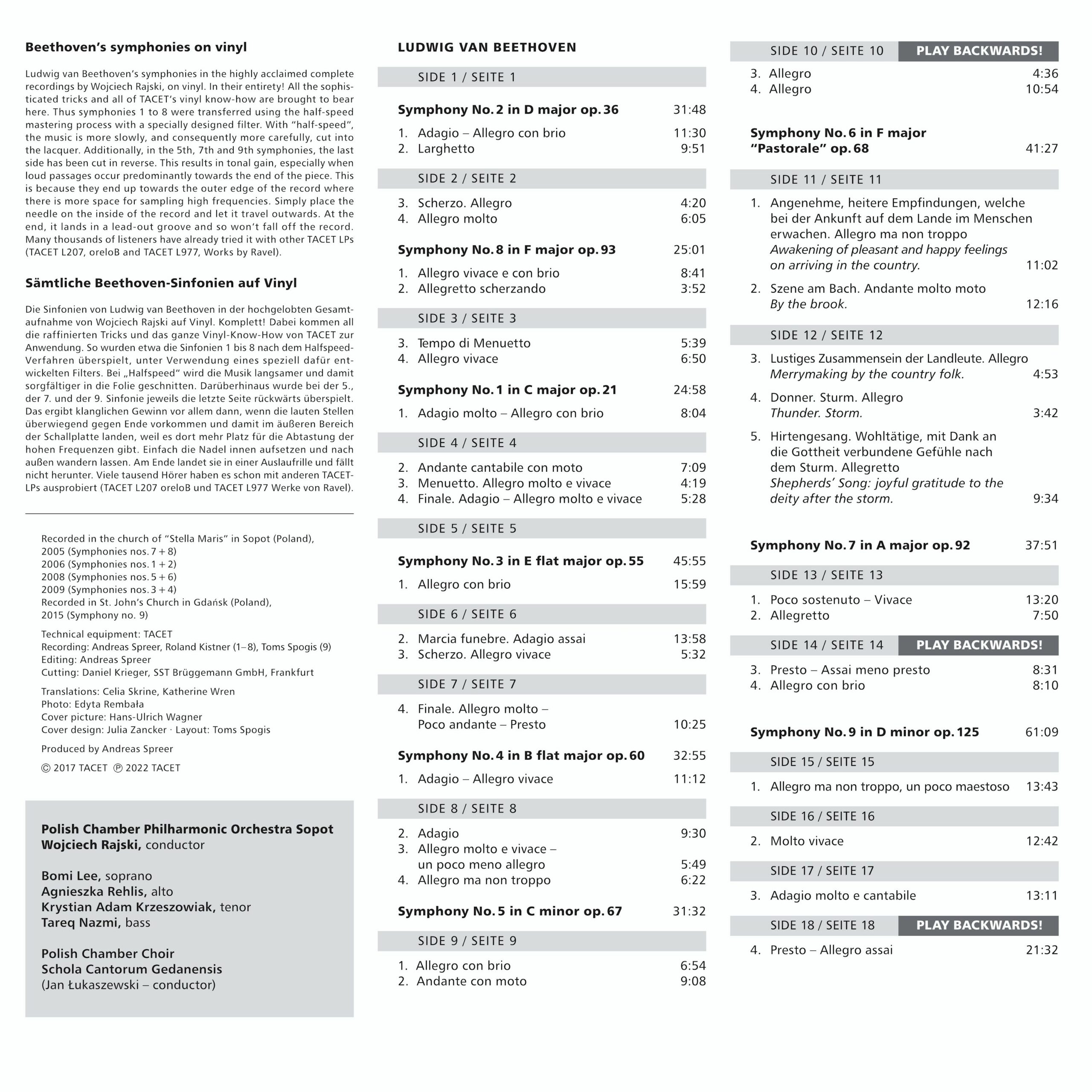
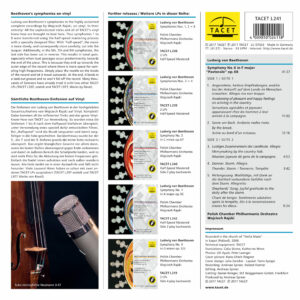
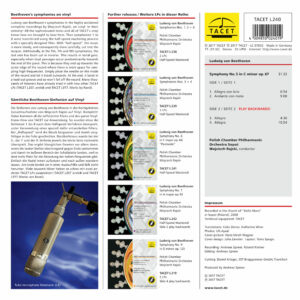
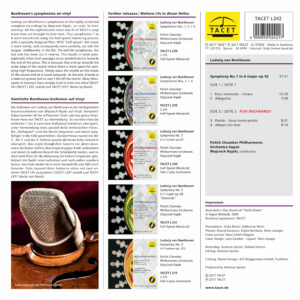
A Beethoven cycle that is fun from the first to the last note! Wojciech Rajski guides us through the sheer inexhaustible wealth of ideas energetically and sensitively, humorously and dance-like, with radiant elegance. And he brings to light details that have never been heard before. Pleasure without pathos. The highly acclaimed series was created between 2005 and 2015 in Sopot (Poland) and in St. John's Church in Gdansk. It has so far been released on CD, SACD, Bluray and also LP in individual editions. But Rajski's Beethoven not only has musical qualities that go far beyond the "normal", it also sets recording standards. TACET's Inspiring Tube Sound, for example, continues to find new enthusiastic fans. That's why the series is now being released once again, as a limited LP box set for exclusive collectors. "Half-speed" mastered, the suitable sides in the legendary "play backwards" mode (also a TACET development), 180g pressings, in a particularly high-quality presentation with gold edging, in a linen-covered box and with serial numbers (total edition of 1000) as well as signed by the producer.
3 reviews for 974 LP / TACET’s Beethoven Symphonies: nos. 1 – 9
You must be logged in to post a review.
Ähnliche Produkte
-
209
- Sold out
- Inspiring Tube Sound, Vinyl LPs
241- Sold out
- Inspiring Tube Sound, Vinyl LPs
-

Klassik heute –
--> original review
Artistic quality: 9 out of 10
Sound quality: 10 out of 10
Overall impression: 10 out of 10
The current LP edition of Beethoven’s symphonies under Wojciech Rajski is rendered with complete clarity, maximum tonal comprehensibility, and excellent cohesion. The round, sometimes warm, sometimes direct, yet always transparent orchestral sound is particularly advantageous for listeners who do not favor overly dry or glassy tones: the recordings are based on the acoustics of Polish church architecture (Stella Maris in Sopot; only the 2015 recording of the Ninth Symphony used a different location). In rests, a two-second reverberation/shadow of sound is audible, placing us at the upper, still meaningful limit. Yet the crisp articulation of the Polish Chamber Philharmonic Orchestra Sopot counteracts the reverberation or integrates it in such a way that the listener remains engaged throughout the movements.
The First Three Symphonies
The harmonically intricate, ambiguously centered opening of the First Symphony is dynamically smartly guided, and the following first movement simply lifts the mood with delightful wind blends and fresh playing joy, which advantageously carries almost the entire edition.
Particularly noteworthy is the introduction to the finale of the First Symphony: tentative, searching, suspenseful, initially hesitant, then moving with freshness. In the slow movements of the first two symphonies, I miss a little of the “refined cantability and tonal beauty” attributed to the slow movement of the Second Symphony—meticulously described in the historically accurate liner notes by Thomas Seedorf.
In listening to the Eroica, the musicians sensitively awaken and respond to the composed motifs; nearly everything is perceptible, and with convincing logical coherence (Richard Wagner, after all, heard the first movement as a continuous melody). The final minutes of the Marcia funebre are accomplished almost magically, without any pathos. However, one could stumble over the phrasing of the finale theme: emphasizing the four-bar group (or “leading phrase”) with the silhouette es´- b´- b- es´ on the last es´ (I degree) as engraved here contradicts my basic sense of tonal tension. More convincing thematic treatment can be heard from Horenstein, Klemperer, Skrowaczewski, Bernstein, Barenboim, Celibidache, Thielemann, Muti, Vänskä… After all, the pure fifth ascends actively and extrovertedly, and its return to the tonic works best when the latter is held back with dignity—something also taught by Beethoven’s pupil Carl Czerny. Further remarks could be made on the phrasing and variation of this theme in Beethoven’s piano variations, op. 35, under various pianists.
The Fourth, Sixth, and Eighth Symphonies as Highlights
Rajski and his musicians enrich the catalog with an excellent Fourth, a fabulous Sixth, and a very good (though in a few spots slightly angular) Eighth Symphony. As Peter Cossé wrote about the CD releases: everything sounds “airy, explored in brisk tempos, in healthy abundance.” Doubts or reservations arise only occasionally, for example, when “Rajski and his Sopot musicians push the chamber-orchestral tube extremely in the final movements.” A touch more restraint in tempo would enhance brilliance, whirling intensity, and precision in the fast passages of the upper strings. Overall, however, this is a convincing, sonically exquisite recording that deserves a prominent place among competing productions.
On the Perpetual Tempo Question
If Christof Jetzschke has noted that some passages “pass by the listener with sometimes inexplicable tempo choices and often insufficient internal tension” and “barely stick in the memory” (as cited by P. Cossé in Klassik heute online), this can indeed be disadvantageous in a few angular movements, where conductor and orchestra drag us into haste and superficiality—particularly in the minor-key Scherzo of the Ninth, which drifts toward cartoonish effects compared to earlier good interpretations, merely pleasant but not truly Beethovenian.
Beethoven’s Seventh Somewhat Disappointing
At the end of the first movement of the Ninth, as well as near the conclusion of the Seventh, Beethoven composes chromatically threatening passages in the strings. Unfortunately, under Rajski these form only a (dynamically underemphasized) background rather than a dissonantly spiced orchestral dramatic tension. This may seem a minor detail concerning voice leading and “expression.” Overall, the Seventh Symphony is also not entirely satisfying.
Even though I find Richard Wagner utterly unacceptable both as a person and as a racist, his words about the Seventh Symphony remain relevant: “The surpassingly glorious A major Symphony.” He speaks of the “blissful exuberance of joy” and understands the Seventh as “the apotheosis of dance itself: it is dance in its highest essence… sometimes with elastic, delicate suppleness, slender and lush… sometimes sweet, sometimes bold, sometimes serious, sometimes playful, sometimes pensive, sometimes jubilant.” Rajski, however, realizes too little of these dimensions in the fast movements in A major.
Wonderfully Realized Pastorale
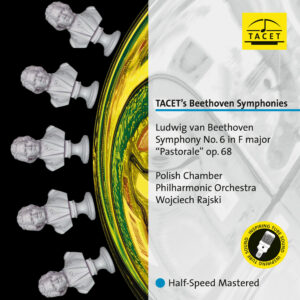
Rajski’s Beethoven is never “artificially dramatic,” as Ramus van Rijn noted years ago. Indeed! Especially in the Pastoral Symphony, this ensemble leads “into a world of exquisite delicacy, where neither the seismograph-like sequences in the first movement nor the broad waves or thundering impacts of the multicolored storm” disappoint. This interpretation already received a Klassik heute recommendation on DVD-Audio years ago, which I fully endorse.
The Ninth
Inside the Ninth, the Adagio is beautifully realized (although in LP history some conductors were able to explore qualities such as gratitude, resignation, and espressivo even more deeply). The first movement is widely worth hearing, but above all, the finale is excellently executed, with remarkably good singers performing happily. The phrasing of one of the most famous themes (today associated with the European anthem) is among the many fully convincing features. To specify: the increase in tension beginning on the tonic d, leading to the dominant A, and returning to d, is realized by Rajski without added weight or artificial tension. This approach frees the theme from routine, banality, and clichés; the subsequent passages also sound natural, rounded, and lively. Played like this, the final movement as a whole convinces—excellent!
Conclusion
This Polish ensemble brings Beethoven’s optimistic, joyful side close to the listener. The musical forms’ brio comes fully to the fore without being artificially “roughened.” Some passages, for example in the Fifth Symphony, may feel rushed and slightly rattled, distant from the appropriate speech-like character, limiting deep emotional impact.
Yet most of this production is convincing and enriches the performance history of Beethoven, a musical giant whose work remains profoundly relevant today.
Dr. Matthias Thiemel
image hifi –
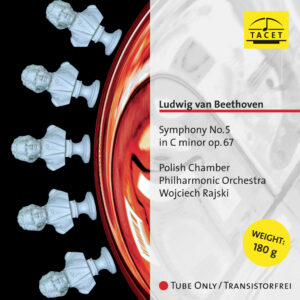
Wojciech Rajski and the Polish Chamber Philharmonic Orchestra recorded all of Beethoven’s symphonies for TACET. Now, for the first time, these recordings have been compiled in a single edition: all nine on vinyl.
Why should vinyl listeners care? It’s probably not hard to find a Beethoven cycle on LP—flea markets, record fairs, and the internet abound with Bernsteins, Böhms, and Karajans. Used, of course. Complete recordings for connoisseurs—Leibowitz or Kegel, to name two—require more searching. But they can be found.
Investing in TACET’s Beethoven package (299 euros) has clear merits: the LPs are impeccably pressed, sound excellent, and are unplayed. Used vinyl can sometimes match the first two points, but rarely the third. Popular symphonies like the Fifth and Ninth, or the Eroica (No. 3) and the Pastoral (No. 6), often show wear, while the others sometimes appear untouched. And then there is the music itself—the interpretation. Wojciech Rajski, born in 1948, was no longer young when these recordings were made (2005–2015), but one can hear how closely the orchestra follows him. At the same time, he was still a generation or two younger than the heroes of the LP era that analog enthusiasts hunt for. Sure, Rajski’s Fifth and Seventh may lack the expressive fervor of Carlos Kleiber, the Ninth the shaping power of Erich Kleiber, the Eroica the might of Otto Klemperer, and the Pastoral the superbly balanced wind sections of Böhm’s Vienna Philharmonic. But Rajski counters these singular achievements with a consistently high-level, decidedly modern Beethoven. His interpretations hold their own. The only musical alternative on vinyl would have been the Bremen Chamber Philharmonic under Paavo Järvi from 2010 (Acousence Records DDKB LP1), now out of print and, like the TACET set, limited to 1000 copies; one of Järvi’s boxes currently sells online for a staggering 940 euros.
Choosing a chamber orchestra is itself a statement. Historically informed practice has often noted how small orchestras were at premieres—for example, only 28 musicians performed the Third Symphony in 1804 at Palais Lobkowitz. Though larger in number, the Polish Chamber Philharmonic achieves its concentrated power less through mass than through cohesion: it plays so precisely that the music remains transparent, yet at key moments truly energetic. Rajski grades the dynamics carefully and tends toward brisk—but never extreme—tempos, a point on which he aligns with Järvi. While Järvi’s interpretations may seem more nuanced and transparent, the Polish ensemble counters with directness. Rajski gives the impression of a conductor without vanity—focused purely on Beethoven. Across all nine symphonies, this impression becomes striking. On modern instruments, Rajski’s phrasing is crisp and clear, allowing rough edges where they naturally occur, without succumbing to the pathos typical of the 1970s, before pioneers like Gardiner or Harnoncourt had reshaped symphonic interpretation. Overall, Rajski and his 1982-founded orchestra have produced a complete Beethoven cycle whose clarity, power, and avoidance of any “tricks” continue the tradition of interpreters like Szell, Kegel, or Zinman.
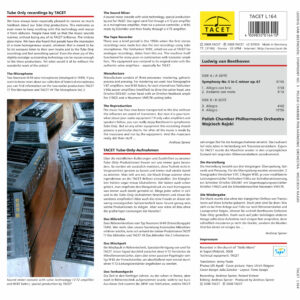
But what about the sound—especially compared to the individual releases? Using the first movement of the Pastoral for comparison between the earlier “tube only” version and the new mix, I was frustrated to see how often notes fell into cliché, though one strives to avoid that as a reviewer. Still, the individual release feels butterier, rounder, warmer, with a fuller, weightier forte at the same base level. The finer inner dynamics and sharper delineation of the new edition, however, draw me more—despite my fondness for the older pressing. Taste? Perhaps, but also more: the new pressings allow a deeper insight into the music. In the Sixth Symphony, the winds play a central role: when two clarinets, oboes, or horns play in parallel, the new version makes them easier to perceive as distinct sources. The strings also sound airier. Long crescendos show clearly how precisely Rajski opens the volume, revealing interpretive nuances that could get lost in the harmonious, rich sound of the first edition. In both cases, we are dealing with superb vinyl.
The earlier edition may even have sounded “more analog,” if one indulges clichés, but the new one reproduces exactly what happened in front of the microphones. The difference isn’t so vast or clear-cut that I would sell all my individual releases to upgrade—but the new complete edition receives a strong recommendation: the best Nine currently available on vinyl, and a Beethoven cycle worth hearing regardless of format.
Heinz Gelking
Audio –
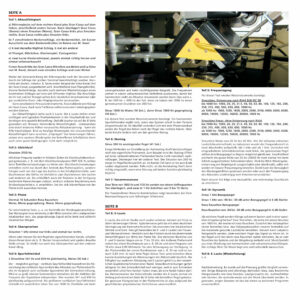
Die Veröffentlichung fasst nun alle neun Beethoven-Sinfonien in einer festen Schatulle zusammen, nachdem die Einzelschallplatten bereits in AUDIO 7/17 und 8/18 rezensiert worden waren. Der Zyklus mit der Polnischen Kammerphilharmonie Sopot unter Wojciech Rajski, aufgenommen zwischen 2005 und 2015, überzeugt interpretatorisch vollständig: Die sportliche, energische und rhythmisch akzentuierte Spielweise kommt Beethovens Werken zugute. Das sehr diszipliniert agierende Orchester macht großen Spaß beim Hören, selbst in der Neunten bleiben Solisten und Chor konkurrenzfähig. Für diesen streng limitierten, handnummerierten Zyklus wählte Andreas Spreer Produktionen aus seiner „Inspiring Tube Sound“-Serie mit Röhrenmikrofonen – die noch puristischeren „Tube Only“-Einzel-Vinyls sind offenbar ausverkauft. Klanglich beeindrucken die Aufnahmen durch zahlreiche Details, nuancierte Raumdarstellung und herrliche Dynamik. Für die Finali der 5., 7. und 9. Sinfonie, mit ihren lauten Schlusspassagen, ließ Spreer die Rillen von innen nach außen schneiden („playing backwards“). So muss sich das Fortissimo nicht in die engen Innenrillen quetschen, sondern kann den größeren Platz außen nutzen. Das Verfahren funktioniert zwar nicht bei Automatik-Spielern, läuft aber problemlos mit Tangentialtonarmen – und sorgt für ein vollendetes Hörvergnügen.
Lothar Brandt