
e28 CD / Wilhelm Petersen
Description
Wilhelm Petersen (1890-1957) was one of the 20th century composers who pursued a path away from the avant-garde. Although he went along with the revolutionary beginnings of expressionism with understanding for the need for new forms of expression, around 1925 after an experimental phase on the fringe of tonality he arrived at a tonally centred an formally clarified tonal language. His interest lay not so much in reviving romantic subjectivism as rather in finding the essence of tonal language by returning to what he called "basic musical qualities". Bruno Walter wrote about Wilhelm Petersen’s work (letter dated 11th February 1958): "... real musical invention, mastery of creation and depth and wealth of feeling... I am firmly convinced that the originality and significance of the master’s musical language will gain these works the fame which they deserve.“
2 reviews for e28 CD / Wilhelm Petersen
You must be logged in to post a review.

Rondo. Das Klassik & Jazz Magazin –
What can one still encounter after having engaged since early youth with the art song repertoire of the nineteenth and twentieth centuries, and possessing a large collection of scores and recordings as well as ample experience? Song albums from the first half of the last century, to be found in antiquarian bookshops, contain an endless amount of trivial material that survived its time of origin by only a few years, and in his Liedführer (Reclam) Werner Oehlmann conscientiously listed the names of the associated composers alongside many others now forgotten.
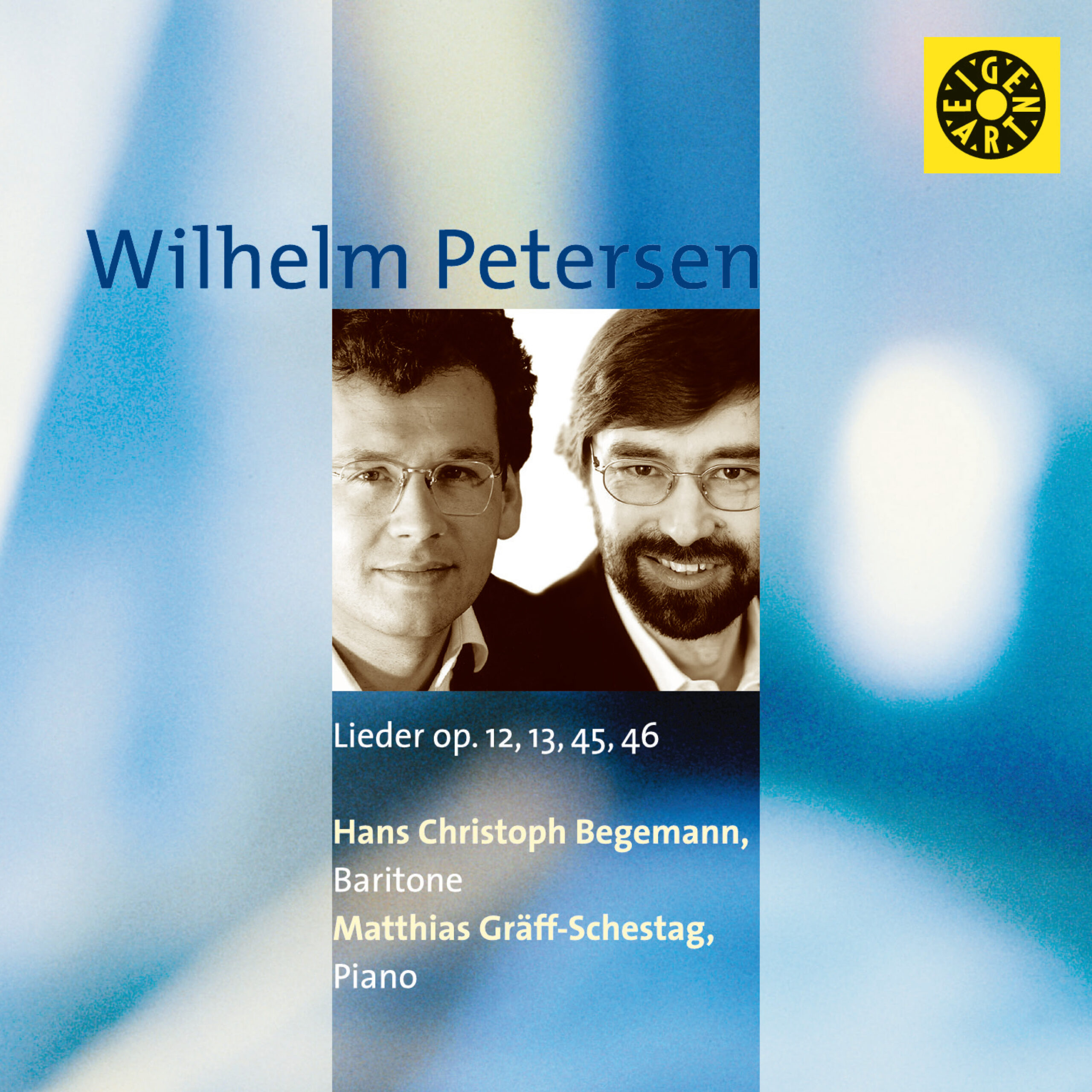
The name on the cover of this CD, however—Wilhelm Petersen—I searched for in vain both in my CD shelves and in Oehlmann. In a self-produced release, the baritone Hans Christoph Begemann and the pianist Matthias Gräff-Schestag present several songs by this composer, born in 1890 and deceased in 1957. And what emerges from the loudspeakers is fascinating from the very first bar.
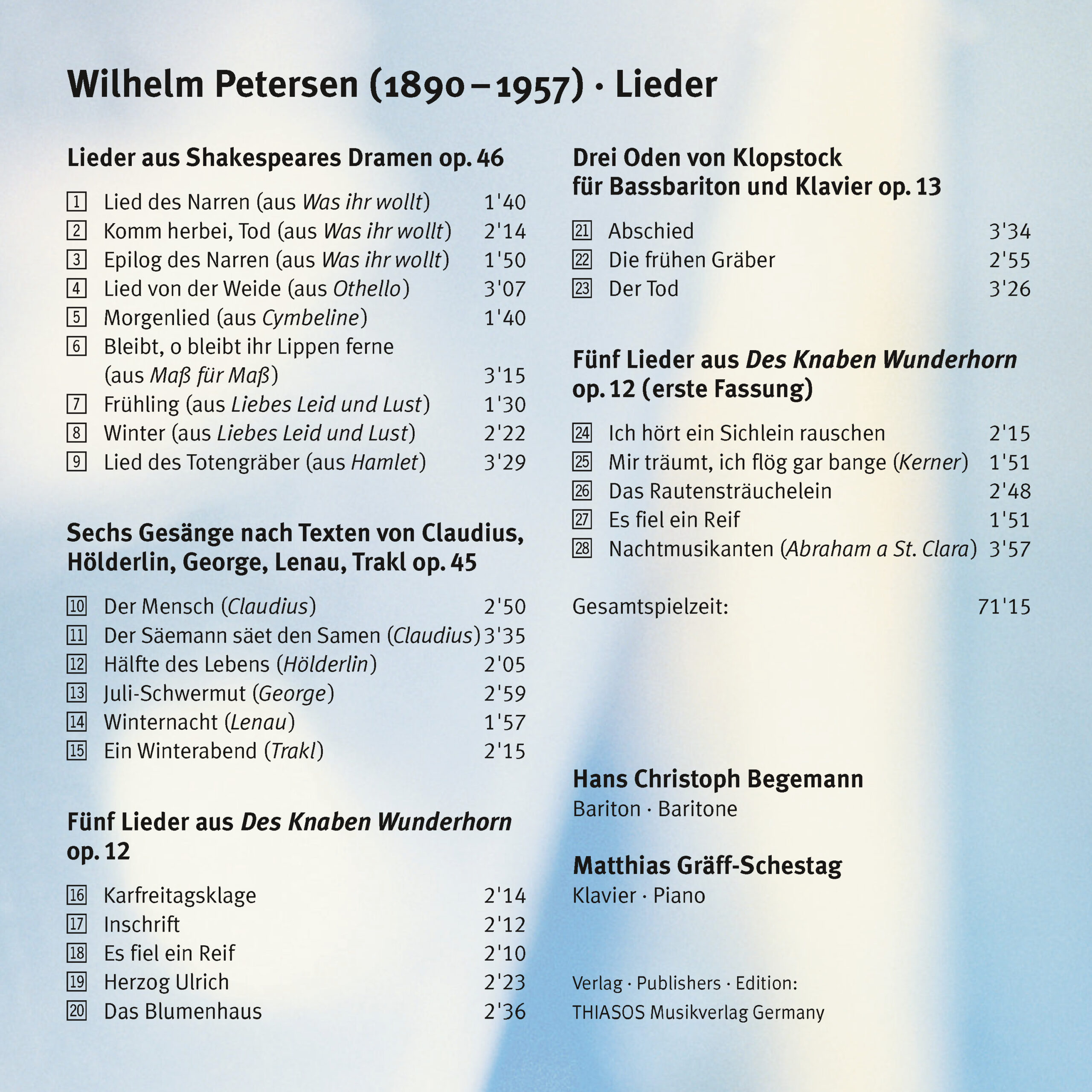
Petersen found an entirely individual musical language for texts from Shakespeare’s plays, from Des Knaben Wunderhorn, as well as from collections of poems by Klopstock and other poets. His style of writing always remains tonal, yet makes use of expanded harmony and a richly imaginative, text-oriented motivic work that is not in the least epigonal, but instead extraordinarily appealing. A deep seriousness, a moving expressive power and communicative force permeate Petersen’s songs even in their lighter moments.
Begemann and Gräff-Schestag approach the task with the utmost commitment, and succeed in conveying these unknown works in exemplary fashion. Begemann commands a dark, powerful baritone voice, from which he can draw numerous nuances and colors, from a full forte even in the middle and lower register to a delicate head-voice sound in the upper range. Gräff-Schestag accompanies with sensitivity, technical impeccability, and inspired shaping.
And Petersen himself? Unfortunately, the booklet reports on his life only fragmentarily. A few lines are to be found in Riemann and in the MGG: he completed his studies in Munich, among others with Felix Mottl, and his main occupation was presumably as a composition teacher at the Mannheim Academy of Music, which he left two years before his rather early death. Further details await rediscovery—together with further works by Petersen.
Michael Wersin
Fono Forum –
Exceedingly subtle
It is, of course, obvious—but also a little malicious—to draw an immediate comparison, when encountering the Wunderhorn songs of Wilhelm Petersen (1890–1957), with the one composer who towers above all others in this repertoire. Petersen is certainly no Mahler—for that his songs lack a distinctive stylistic profile. Even so, an encounter with his oeuvre is well worthwhile, especially when it is presented with such commitment as it is here.
As a contemporary of Expressionism, Petersen engaged intensely with the currents of the avant-garde and, well into the 1920s, composed very much in their spirit. During this period, himself gifted both literarily and musically, he stood close to the circle of poets around Stefan George, whose attention the seventeen-year-old had attracted with his volume of poetry Träume und Rätsel. Around 1925, however, a stylistic turning point set in, which Petersen described as an attempt “to let personal expression recede in favor of objective shaping.” Many earlier works were subsequently revised, often radically simplified; for Petersen now sought salvation in simplicity and immediacy. This led to some very striking settings, notably of Claudius and Shakespeare; other pieces, by contrast, can in the long run seem somewhat bloodless.
The two interpreters of this superbly recorded CD, however, counteract such an impression with all their might. Hans-Christoph Begemann demonstrates exemplary sensitivity to the text, and the interplay with his accompanist Matthias Gräff-Schestag is exceedingly subtle and atmospheric, especially in the early odes after Klopstock.
Christian Wildhagen