
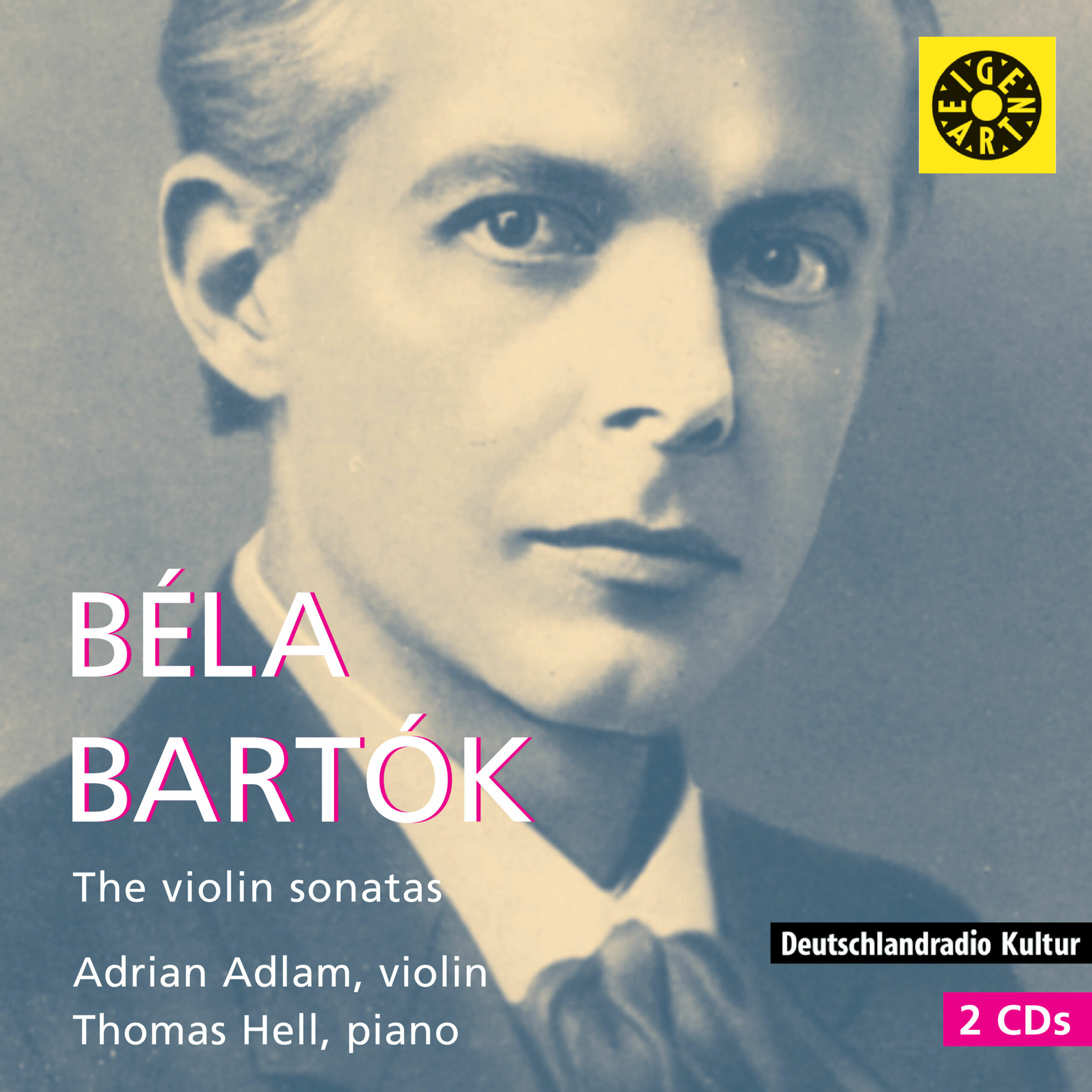
e40 CD / Béla Bartók: The Violin Sonatas
Description
In Bartók's music, the rhythmic element plays a greater role than with other composers. It does not tolerate rhythmically imprecise, only half-exact renditions, which unfortunately do not occur infrequently. Adrian Adlam and Thomas Hell play very rhythmically precise and, moreover, take Bartók's tempo indications rather strictly as well. They play through a kaleidoscope of clear, transparent and yet unfamiliar, uncompromising sounds that grab the listener and pull him/her forward. Dissonances as far as the ear can hear, far more than a random generator, simply stringing together arbitrary intervals, would produce. Thus the listener can perhaps get an idea of what went on in the listeners' minds in the following scene.
Über eine Aufführung der ersten Sonate mit der Geigerin Jelly d’Arányi und ihm selber am Klavier, bei der u. a. Ravel, Szymanowsky, Strawinsky, Milhaud, Poulenc, Honegger und Roussel zugegen waren, schrieb Bela Bartók an seine Frau: „…Ravel saß rechts von mir und hat geblättert, links von mir blickte Milhaud in die Noten. Es herrschte großer Enthusiasmus, aber nicht nur für die Sonate, sondern auch für Jellys Spiel… Sie hatten Jelly so gern, dass sie sie fast auffraßen. Jelly sagte auch, dass diese illustre Gesellschaft – mehr als die Hälfte der brühmtesten Komponisten der Welt – sie so inspiriert habe, dass wir so schön spielten wie noch nie. Von der Sonate haben sie erklärt, dass „c’est une merveille“, und es ist die schönste Violinsonate der gottweißwievielen Jahre (natürlich, die Franzosen sind ein wenig freigiebig mit ihrem Lob). Ravel und Poulenc gefallen der 2. und 3. Satz am besten, Milhaud der erste, Strawinskly der 3. …“
Zusätzliche Informationen
| Marke | Edition EigenArt |
|---|
5 reviews for e40 CD / Béla Bartók: The Violin Sonatas
You must be logged in to post a review.

image hifi –
(…) Adrian Adlam has now recorded the solo violin sonata in a stunning performance as part of a complete recording of all Bartók’s violin sonatas, captured in superb sound quality by TACET director Andreas Spreer. In the case of the violin and piano sonatas—also central works in Bartók’s chamber music—Adlam has an excellent pianist at his side in Thomas Hell. The duo, well rehearsed through joint concerts, pushes the music to its dynamic limits, immerses itself in the striking rhythms, but also consistently highlights the melodic qualities of the music. Bartók loved the violin as much as the piano—and Adrian Adlam and Thomas Hell remind us of this with this wonderful recording. The premiere of Violin Sonata No. 1 in 1921 in Paris was met with enthusiasm by none other than Ravel, Poulenc, Milhaud, and Stravinsky. Listening to Adlam and Hell, one understands why. (…)
Heinz Gelking
Audiophile Audition –
(...) Both musicians deserve congratulations for putting together this difficult, but formidable collection.
Zan Furtwangler
Klassik heute –
When two take up the bow, it need not be the same. One takes the paper bow, the other the one with horsehair—and this distribution is as logical as that of the quill, under which the precision mechanic understands something different than the poet and the goose. In other words: as extraordinarily moved as I was by the musical performances of the violinist Adrian Adlam and the pianist Thomas Hell, I was barely stirred by the rather confusing accompanying texts spread over the trilingual booklet, despite the continued interest I gladly gave to the sonatas collected here, excellently realized from first to last. But fortunately, one can close printed material without having to worry, for example, about where exactly Bartók Béla supposedly sounds like expressionist Arnold Schönberg in the first movement of the first sonata. The utterly unique sound rush, with the faintest cimbalom, with the sublimated Lombardisms of Hungarian language and music, the lines that fade and yet are repeatedly gathered—these can, at most, be superficially mistaken for the perpetually dissatisfied Viennese, since a completely different personality directs the first of a total of eight immense complexes. Whether I should crown the slow movement of the first or the eloquent Molto moderato of the second duo sonata, the thundering, gripping detonations, or the partly misty, partly delicate textures, I cannot decide—perhaps in the end the crown belongs to the solo sonata, which in its very first chord condenses the “whole of Johann Sebastian Bach” and, under Adlam’s hands, overwhelms me with all its suggestive power. Further listenings will reveal that. Until then, I will simply treat this excellently recorded double album as a complete artistic whole of the highest edifying value.
Rasmus van Rijn
Ensemble –
Bartók’s music for violin and piano is a stroke of luck in 20th-century violin repertoire—though still far too little appreciated. It is therefore gratifying that the violinist Adrian Adlam, together with his long-time duo partner Thomas Hell, has now tackled the task of uniting all of Bartók’s violin sonatas on two CDs. Even the first violin sonata of 1922 demonstrates Bartók’s distinctive treatment of the violin, despite the reception of European music at the time. Bartók treats the instruments as equals, while maintaining his melodic-rhythmic demand for precision, which, if not met, can easily cause the structure to fall apart. Adlam and Hell are fully aware of this, but can draw far more from the music, synthesizing the structural demands with the deeply felt emotional content, allowing the listener to fully experience it. In doing so, they never lose the breath of Bartók’s musical language—the uniquely expressed grief and melancholy, the exuberance. One knows that the technical demands on the two instrumentalists are enormous: Adlam succeeds as well as his partner Hell. Only occasionally might one wish for a bit more freedom in interpretation or naturalness in expression. But this is criticism at the highest level, as overall this is a thoroughly recommendable recording.
Carsten Dürer
Pizzicato –
Communicative
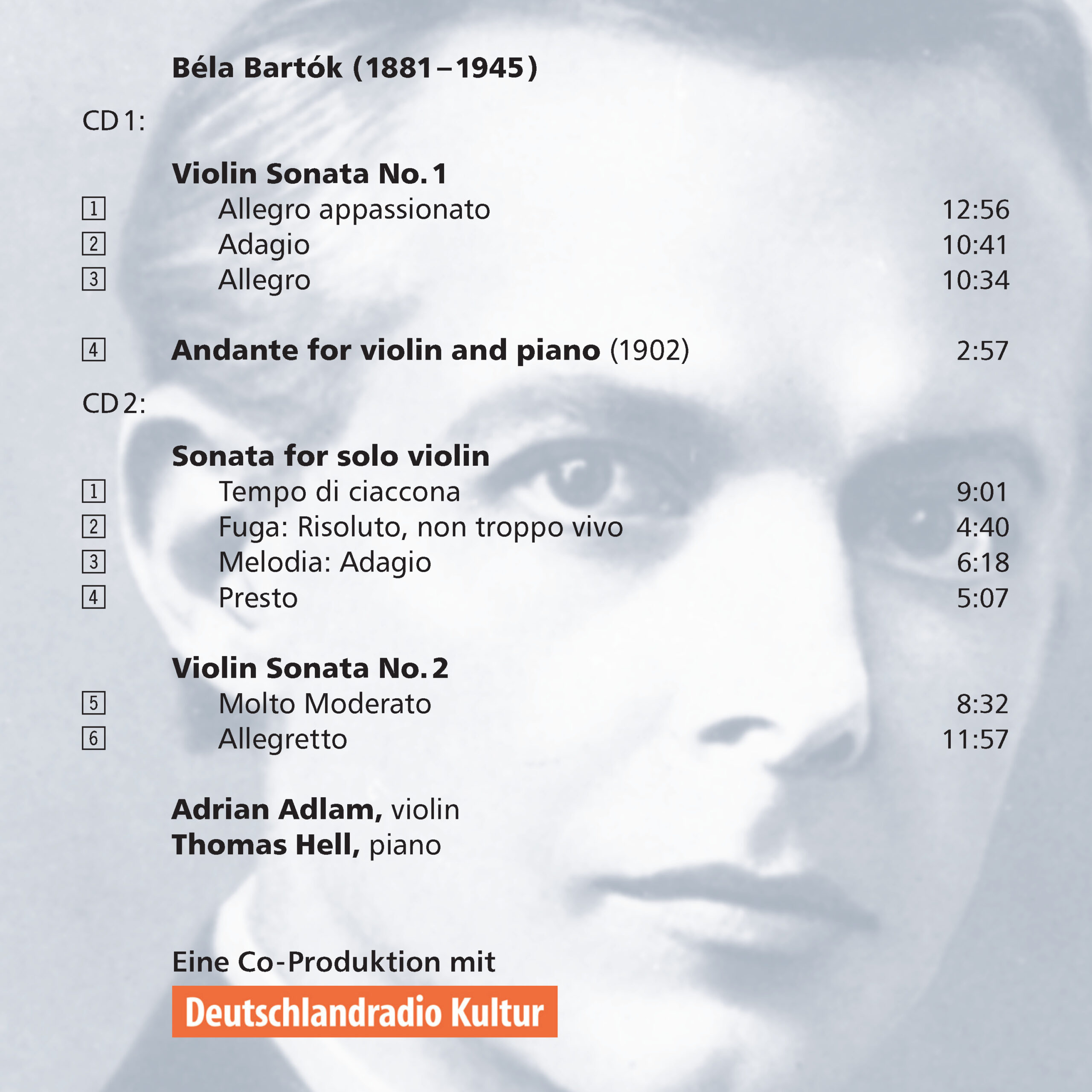
Béla Bartók’s two violin sonatas for violin and piano, as well as the sonata for solo violin, rank among the most exciting compositions in their respective genres. Here, they are presented in excellent interpretations, with the short Andante for violin and piano from 1902 serving as a filler enriching the first CD.
The four works are played by Adrian Adlam and Thomas Hell with confidence and communicativeness. The recording balances both instruments perfectly in the soundscape, allowing the individuality of each solo part—and the resulting tension—to come across as utterly compelling. And yet, one never gets the impression of a battle being fought. We are far from the aggressive contrasts that other performers have brought to these works. I also don’t believe that such opposition was Bartók’s intention, since he composed the sonatas for himself and the violinist Jelly d’Arányi, primarily seeing them as playful technical challenges.
Thomas Hell plays without any brutality—highly virtuosic and very musical—while Adrian Adlam brings a palette of colors and expressive means that span the full range of Bartók’s music, from saccharine sweetness to edgy roughness. The brilliant effects Bartók uses occur entirely spontaneously and naturally, never sounding calculated or forced. The solo sonata, which Bartók wrote for Yehudi Menuhin, is performed by Adrian Adlam with breathtaking bravura, absolutely effortlessly, with a superiority, intensity, and stylistic assurance that does full justice to the sudden dynamic accents and passion as well as the tender passages. Adlam’s playing is physically substantial enough to serve Bartók’s music without any forcing!
Interesting contributions from the performers in the booklet further enrich this highly recommendable release.
Rémy Franck