Um Ihnen ein optimales Erlebnis zu bieten, verwenden wir Technologien wie Cookies, um Geräteinformationen zu speichern und/oder darauf zuzugreifen. Wenn Sie diesen Technologien zustimmen, können wir Daten wie das Surfverhalten oder eindeutige IDs auf dieser Website verarbeiten. Wenn Sie Ihre Einwillligung nicht erteilen oder zurückziehen, können bestimmte Merkmale und Funktionen beeinträchtigt werden.
Die technische Speicherung oder der Zugang ist unbedingt erforderlich für den rechtmäßigen Zweck, die Nutzung eines bestimmten Dienstes zu ermöglichen, der vom Teilnehmer oder Nutzer ausdrücklich gewünscht wird, oder für den alleinigen Zweck, die Übertragung einer Nachricht über ein elektronisches Kommunikationsnetz durchzuführen.
Die technische Speicherung oder der Zugriff ist für den rechtmäßigen Zweck der Speicherung von Präferenzen erforderlich, die nicht vom Abonnenten oder Benutzer angefordert wurden.
Die technische Speicherung oder der Zugriff, der ausschließlich zu statistischen Zwecken erfolgt.
Die technische Speicherung oder der Zugriff, der ausschließlich zu anonymen statistischen Zwecken verwendet wird. Ohne eine Vorladung, die freiwillige Zustimmung deines Internetdienstanbieters oder zusätzliche Aufzeichnungen von Dritten können die zu diesem Zweck gespeicherten oder abgerufenen Informationen allein in der Regel nicht dazu verwendet werden, dich zu identifizieren.
Die technische Speicherung oder der Zugriff ist erforderlich, um Nutzerprofile zu erstellen, um Werbung zu versenden oder um den Nutzer auf einer Website oder über mehrere Websites hinweg zu ähnlichen Marketingzwecken zu verfolgen.


WDR –
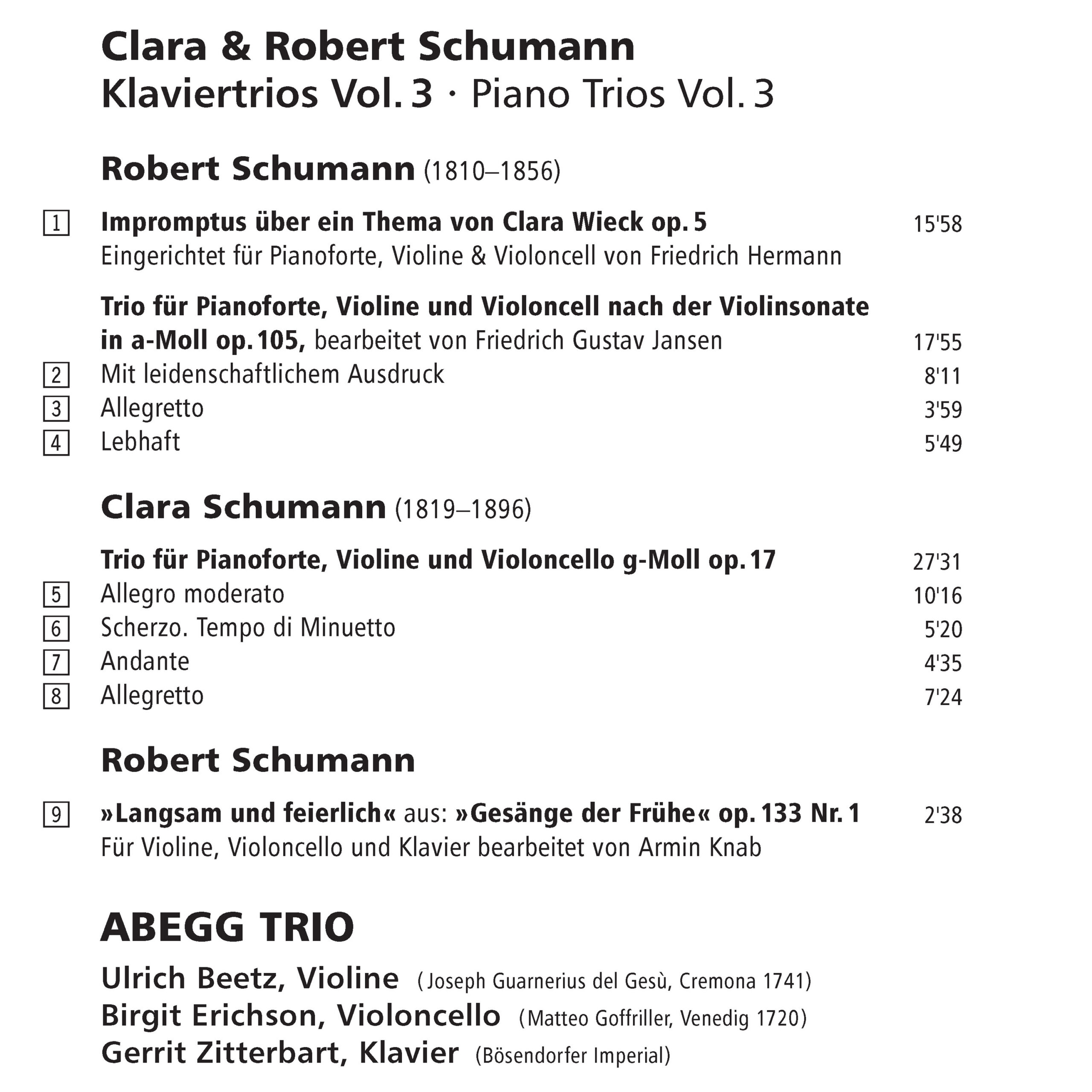
Musikbeispiel: Gesang der Frühe op-133,1. Musical Example: Gesang der Frühe, Op. 133, No. 1. This movement descends into almost sacred realms: marked Langsam und feierlich (Slow and solemn). It is the first of Robert Schumann’s Gesänge der Frühe, Op. 133, originally written for solo piano but heard here in an arrangement for piano trio. Composed in mid-October 1853, these pieces are among Schumann’s final works, reflecting the profound impression made on him by the early piano works of the young Brahms. The addition of violin and cello in this arrangement allows the tranquility and sublimity of these few measures to unfold even more expansively.
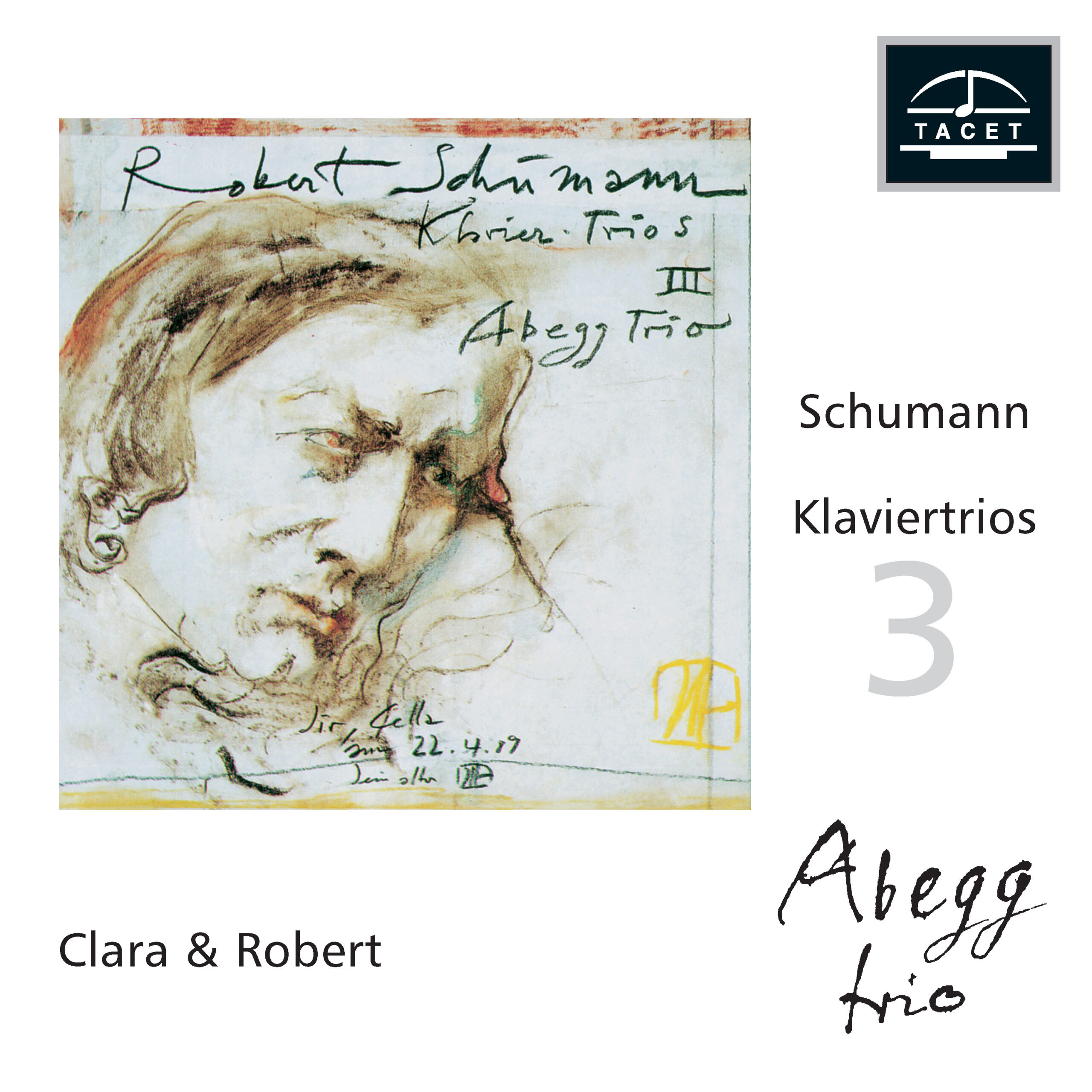
This piece concludes the new CD by the Abegg Trio, which features chamber music by Clara and Robert Schumann. From Robert, the program includes arrangements for piano trio: alongside Gesang der Frühe, the Violin Sonata in A minor and the Impromptus on a Theme by Clara Wieck. From Clara, the trio performs her grand Trio in G minor, Op. 17. The CD is released by Tacet.
Clara Schumann wavered between euphoria and deep resignation regarding her G minor Trio. While her prowess as a pianist was beyond question, she repeatedly doubted her own compositional talent. “I played this evening,” she wrote in her diary on November 18, 1846, “I played Robert’s Piano Quartet and my Trio, which seems to me, the more often I play it, all the more innocent.” The Abegg Trio—Ulrich Beetz (violin), Birgit Erichson (cello), and Gerrit Zitterbart (piano)—does not see this supposed innocence and naivety. Instead, they explore the contemplative, poetic sounds that permeate the Trio, especially in its finale: Musical Example: Clara Schumann, Trio in G minor, Op. 17, Finale.
The trio has deliberately placed this work at the heart of their new recording. The dramatic arc of this CD mirrors the subtly strained, near-breaking relationship between Clara and Robert Schumann: there is the passionate, self-sacrificing love of the young Robert, who wore himself out in long battles against Clara’s father. The CD opens with a tender declaration of love from Robert: the Impromptus on a Theme by Clara Wieck. It then spans an arranged violin sonata and Clara’s Trio, culminating in one of the Gesänge der Frühe, which evoke Johannes Brahms, who shared a lifelong intimate bond with Clara.
In the chamber music of Clara and Robert Schumann, the Abegg Trio finds sounds that continually turn inward. They avoid anything extroverted or showy. With fine, delicate lines, they trace the musical contours. Nothing is overstated; nothing veers into sensationalism. This approach is the result of a sophisticated recording concept: according to the booklet, producer and sound engineer Andreas Spreer used just two microphones for the recording—a stark contrast to producers who might employ up to six. Spreer prioritizes naturalness and an open soundstage. The recording took place in Frankfurt’s Festeburgkirche, whose slightly resonant acoustics complement the trio’s poetic interpretive approach: Musical Example: Robert Schumann, Impromptus, Op. 5. The piano works and violin sonata by Robert Schumann on this CD have been arranged for piano trio with great respect for the original, yet also with deep empathy for the possibilities and limitations of the trio setting. Naturally, the balance shifts when, for example, the A minor Violin Sonata is reimagined with an added cello line, “invented” alongside the violin. Friedrich Gustav Jansen, who arranged the sonata, allows the cello to emerge almost imperceptibly from the piano part—sometimes coloring the accompaniment, sometimes highlighting passages in dialogue with the violin. The Abegg Trio masters these new constellations with skill. As musicians, they navigate a tightrope: no longer a sonata, but not quite a trio either.
Michael Krügerke
Die Rheinpfalz –
Mature Musicianship
The Abegg Trio has already demonstrated its expertise in Schumann with a compelling recording of the piano trios (on Intercord). Now, with a program of rarities curated by the Karlsruhe musicologist Dr. Joachim Draheim, the musicians present lesser-known works by Schumann alongside Clara Schumann’s only piano trio. By including the Impromptus on a Theme by Clara Wieck, Op. 5 (arranged by Friedrich Hermann), and the A minor Violin Sonata (arranged by Friedrich Gustav Jansen), the Abegg Trio revives a tradition—whether driven by commercial publishers’ interests or the desire to make underappreciated works accessible to a wider audience in popular piano arrangements is ultimately beside the point.
The arrangements never sound like mere transcriptions; they are both technically and musically convincing. Pianist Gerrit Zitterbart, violinist Ulrich Beetz, and cellist Birgit Erichson draw on their wealth of chamber music experience. Every detail is finely tuned, and the balance is impeccable, even if some passages might benefit from a touch more dramatic drive. The excellent recording quality further enhances the experience. This positive impression carries over into Clara’s Trio in G minor. The compositional maturity finds its match in the trio’s performance.
gt
Stereo –
In the 19th century, as the instrumental genre of the piano trio flourished, many orchestral works and solo pieces were arranged for piano trio to meet the demand for domestic and salon music. Without distorting the original, the Schumann scholar Friedrich Gustav Jansen arranged the A minor Violin Sonata, while the Gewandhaus violinist Friedrich Hermann sensitively transformed the Impromptus on a Theme by Clara Wieck—originally unsuccessful in its solo piano form—into a faithful version for piano trio. What the Abegg Trio presents on their latest CD reveals the quintessential Romantic tone. They evoke the spirit of innovation and a richly colored musical phrasing. Every melodic achievement in Clara Schumann’s Trio in G minor is meticulously savored.
Paul Rein
Stereoplay –
The piano’s dominance over the bourgeois household music of the 19th century fostered the development of the trio genre for piano, violin, and cello, which was established by Haydn. If we set aside Clara Schumann’s early Piano Trio—arguably her most significant work—this culturally and historically fascinating production consists of arrangements, including one of the Gesänge der Frühe by Armin Knab in 1915. The most substantial contribution is likely Friedrich Hermann’s (1828–1907) piano trio arrangement of Schumann’s Impromptus, Op. 5, as it highlights the strongly contrapuntal texture of the brilliant original. Gustav Jansen’s (1831–1910) addition of a cello part to the late Violin Sonata adds less value. The Abegg Trio—Ulrich Beetz, Birgit Erichson, and Gerrit Zitterbart—approaches this music with great commitment, well-balanced sound, and invigorating freshness. Their performance of the Impromptus arrangement stands out as a particularly remarkable achievement.
Alfred Beaujean
Süddeutsche Zeitung –
Today, they rank among the leading chamber music ensembles of our time. They combine homogeneity with soloistic virtuosity. And they are curious, eager to excavate long-forgotten chamber music...
Joachim Kaiser