

e52 CD / Paris. Works by Rameau, Chausson, Puccini…
Description
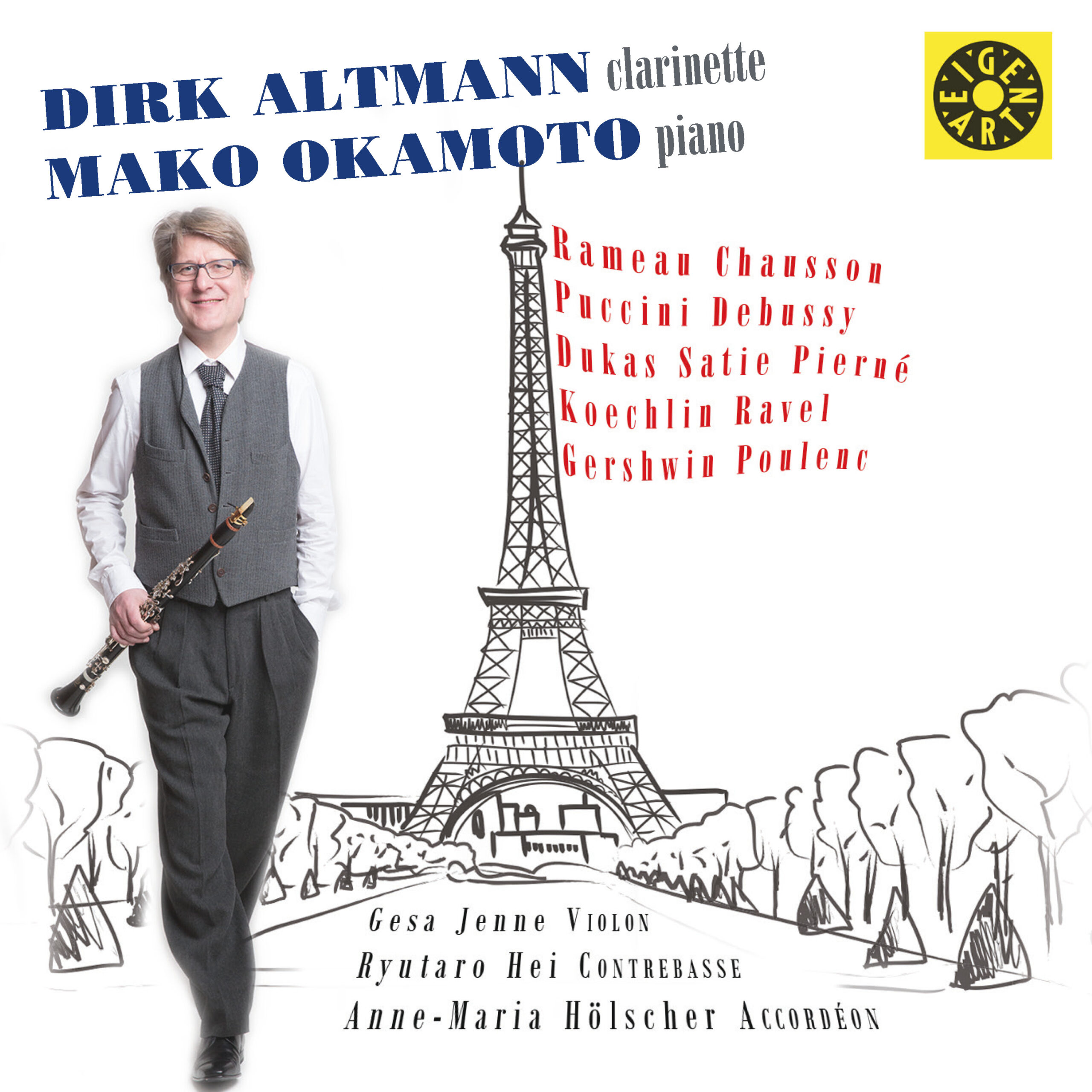
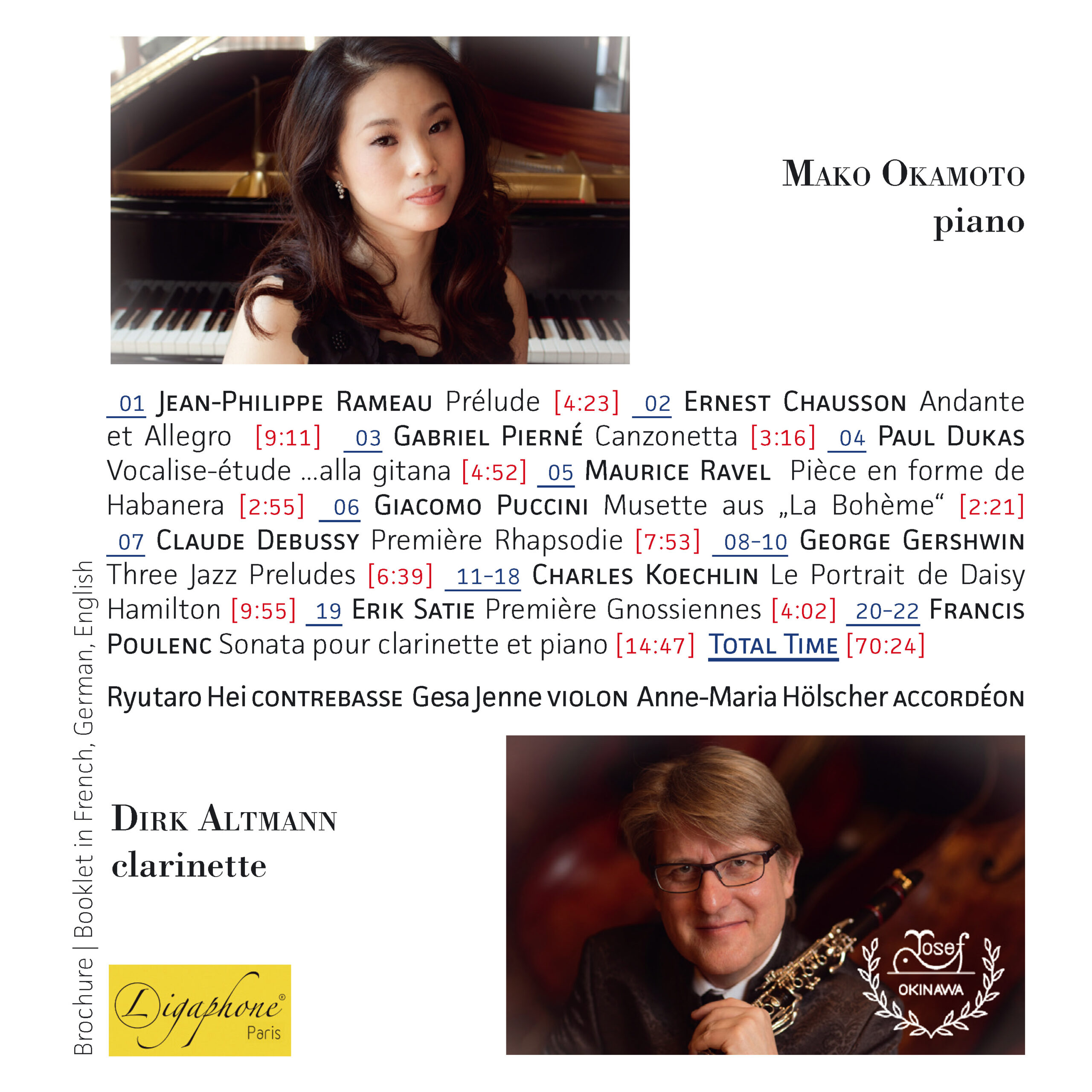
Dirk Altmann plays the French clarinet equally as well as he plays the German instrument. By playing both instruments, this native Hannoverian seems to have fallen in love with the French capital. In a very personal, recital-like compilation of works, all with a connection to Paris, he describes in music what it is that connects him with this large, cosmopolitan city. In a natural, almost child-like manner, and yet at the same time very artistically, he expresses his declaration of love: he even arranges some works himself for his chosen combination of instruments. With such virtuosic yet subtle playing, alongside his colleagues Mako Okamoto (piano), Ryutaro Hei (double bass) and Anne-Maria Hölscher (accordion), time flies for the listener. And so a portrait of Dirk Altmann is unwhittingly gained from a portrait of Paris.
2 reviews for e52 CD / Paris. Works by Rameau, Chausson, Puccini…
You must be logged in to post a review.


Klassik heute –
--> original review
This CD presents an exceptional repertoire: music of French provenance from Romanticism to moderate modernism for clarinet and piano, partly in arrangements but mostly in original versions. What makes this selection exceptional—initially appearing as an unassuming collection of short pieces—is the conceptual idea behind it: Paris as the culmination point of a musical nation, as the musical catalyst of an entire country. In this form, such a concentration was probably only possible because of the centralized state structure of the Grande Nation, from which, however, there were always attempts—artistic ones—to break away.
Together with pianist Mako Okamoto, clarinetist Dirk Altmann has gone in search of testimonies to this very special musical tradition and has produced an immensely exciting and artistically outstanding recording. Everything of rank and name in French music history is represented: from Chausson and Pierné to Poulenc, whose frequently performed Clarinet Sonata is almost unavoidable on such a CD and is realized here with particular distinction. Altmann’s depth of expression is consistently impressive, as is the flexibility of his tone. The especially delicate sound world of French music—this unique combination of musical refinement and tonal magic—is captured here wonderfully, not least in works by Erik Satie and the ever-so-slightly exotic-sounding music of Charles Koechlin.
Altmann is supported by pianist Mako Okamoto, who captures the tonal delicacy of French music with great virtuosity and sensitivity, as well as by a number of other musicians. The result is a CD that is as exciting as it is pleasurable, opening in an unusual but rewarding way for this instrumentation with the forward-looking Prélude from Jean-Philippe Rameau’s Livre de Clavecin.
Guido Krawinkel
Rohrblatt –
Recently, Dirk Altmann—solo clarinetist of the Stuttgart SWR Symphony Orchestra for more than thirty years—described in these pages his encounter with the French clarinet system and his growing sympathy for it (see Rohrblatt 2/2016, p. 85ff.). He now presents a sounding illustration that even more vividly describes the experiences that shape an aspiring clarinetist in learning and making music. In the booklet he recounts the fourteen-year-old’s first encounter with Paris, its scents and its flair, and with the music created and performed in that city, which more than anywhere else allows one to sense the core and essence of a nation. This early encounter with “the French,” including its clarinet system, still shapes Altmann’s playing technique, tonal concept, and enthusiasm for the brilliance that seeks to emerge into the light in the clarinet works of French Romanticism and their continuation into modernity.
For the listener less familiar with the technical differences between the two competing systems—Altmann also liked to alternate between them in his orchestral work and reports in the interview mentioned above on his current instrument, which finally unites the advantages of both systems and their tonal philosophies—this Parisian picture book in sound is a medley of delectable treats conveyed by clarinet and piano, a bonbonnière filled with pralines, fondants, confetti, and other exquisite delicacies. One can savor it like a mousse au chocolat that melts on the tongue and leaves behind a fine aftertaste. Rameau’s Prélude already sets the mood; the miniatures by Chausson, Pierné, Dukas, and Satie form a colorful bouquet with many blossoms. Added to this is the charming waltz earworm from Puccini’s La Bohème, which benefits from an accordion accompaniment, and more substantial fare such as Ravel’s Habanera, presented with wit in an original quintet arrangement with violin, double bass, and accordion; then Debussy’s well-known Première Rhapsodie and Gershwin’s three Jazz Preludes, to which—especially in the blues section—the double bass lends an erotic coloring.
The still little-known Charles Koechlin had a fondness for the new art of sound film; the British musicologist Robert Orledge, who has rendered great service to French composers of the late nineteenth century, lovingly assembled eight miniatures from Koechlin’s œuvre into a ten-minute portrait of Daisy Hamilton—actually a homage to the actress Lilian Harvey (1906–1969), for whom Koechlin is said to have had a crush—delightful musical pen drawings whose titles one should read in the booklet. The crowning touch of whipped cream is provided by the demanding Clarinet Sonata by Francis Poulenc.
All of this reaches the ear like a Chardonnay gliding over the tongue, and the way Dirk Altmann, together with his congenial Japanese pianist, presents these delicacies turns the CD into a feast for the senses. Alongside perfect melodic refinement, the clarinetist repeatedly allows himself refreshingly vehement excursions into the worlds of klezmer and jazz. For this imaginative seventy-minute immersion in French gourmet clarinet art, Dirk Altmann and his collaborators deserve great praise and sincere thanks.
Diether Steppuhn