
e35 CD / Franz Schubert: Piano Trios D 28 & D 898


Description
"The perfected transparency of the harmonious playing (which literally remains play all the way through), the pale, lean sound, the lightweight, flowing, rhythmically swinging motion: all of this reflects a bourgeois culture of past days, the society of clever, enterprising people, to which Schubert belonged or at least was inclined to. But the Trio Vivente offers far far more than merely the faithful copy of a past epoch..." (Wolfgang Stähr)
4 reviews for e35 CD / Franz Schubert: Piano Trios D 28 & D 898
You must be logged in to post a review.

Wiesbadener Anzeiger –
Romantic EigenArt
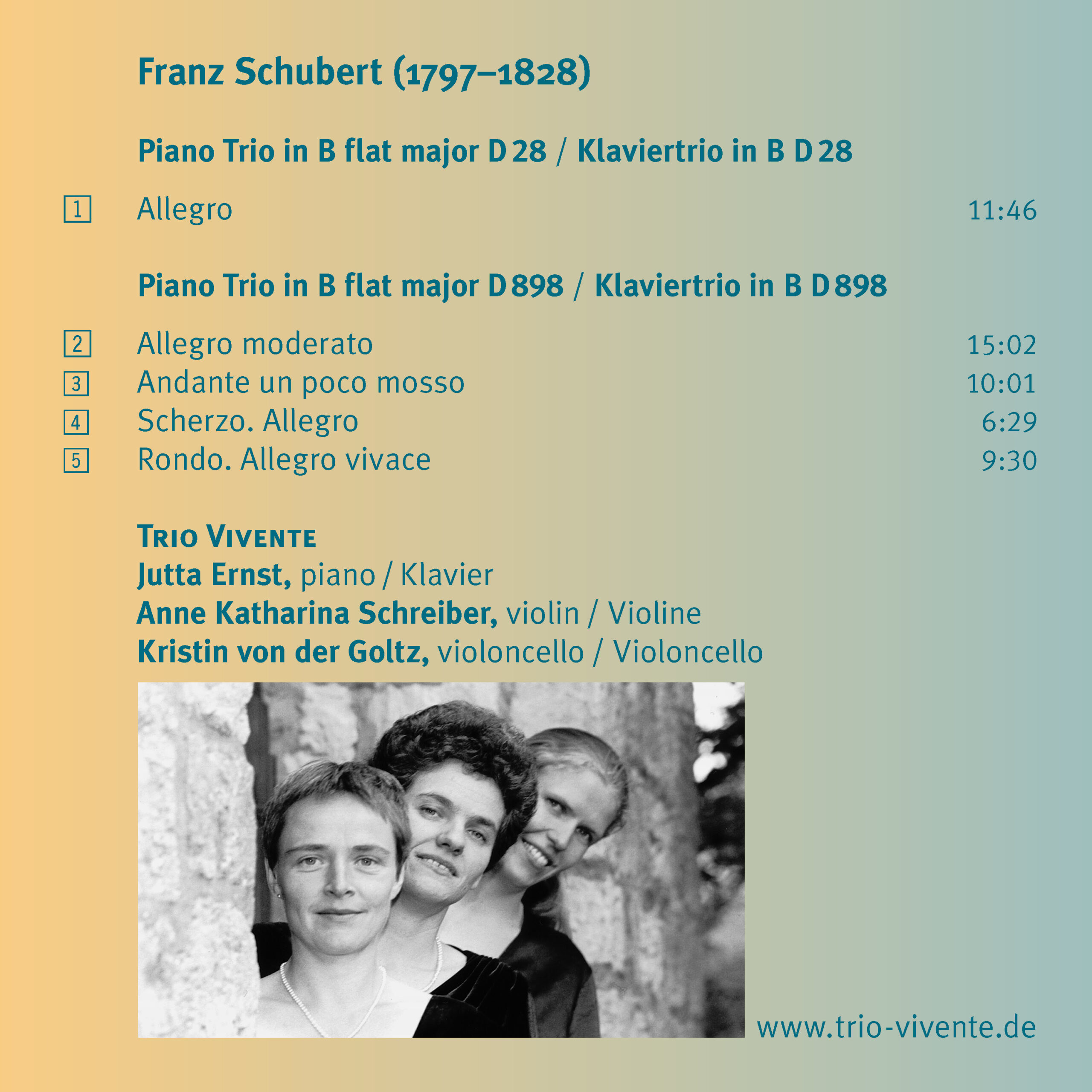
“Such cohesive phrasing and such a refined balance of sound are hard to find among recent chamber-music releases – especially in this particular combination of instruments… A feast for every chamber-music lover,” enthused the reviewer for Klassik heute two years ago, after hearing the first EigenArt CD by the Trio Vivente with Jutta Ernst (piano), Anne Katharina Schreiber (violin) and Kristin von der Goltz (cello). Five piano trios by Joseph Haydn formed the programme of that successful debut, which “reaches far beyond mere pleasant entertainment – not infrequently into Schubertian depths.” (Rondo, 9/2000).
It is precisely these intuited depths that the three artists, who have been making music together since 1992, now render tangible in their second EigenArt production. After scarcely more than ten minutes, the light conversational tone of the little B-flat major Trio D 28 is left behind, and the journey begins through the cosmos of its vastly different, large-scale sister work, written in the same key and for the same instruments, yet sharing nothing with the dainty, almost childlike playfulness of the former: Schubert’s “Rest is gone,” even if he cloaks the inner turmoil here in seeming nonchalance – it is no small art to dance this dance on the thinnest ice in all its ambivalence.
Klassik heute –
Beginning and end, early and late Schubert, a test of talent and a touchstone for every interpreter are united on this CD. Two B-flat major trios: the Allegro movement D 28, inscribed in the autograph as “Sonata,” by the fifteen-year-old schoolboy, and the Piano Trio D 898, probably composed in the year of Schubert’s death in 1828 – an unequal pair. Yet the youthful work by no means pales as a mere “filler” or “apprentice piece,” at least not in the highly impressive recording by the Trio Vivente. The three musicians know how to bring out the naïve charm, the fragile beauty of sound and the buffo-like Mozartian echoes of this Schubertian “Sonata,” and to relish all the subtleties of its phrasing.
Amazingly, they also succeed in preserving this natural, seemingly weightless art of music-making in the late B-flat major Trio – and thus in coming extraordinarily close to the composer and his time, to the chamber-music practice of Viennese soirées and academies. The consummate transparency of the ensemble (which quite literally remains play throughout), the bright, slender tone, the light, flowing, rhythmically buoyant motion – in everything there is a reflection of a bygone bourgeois cultural sphere, the sociable, witty, enterprising milieu to which Schubert belonged, or at least felt himself drawn. But the Trio Vivente offers far more than a faithful image of a sunken epoch: the musicians, thoroughly versed in both early and modern music, discover in Schubert’s B-flat major Trio a sense of time all its own, a temporal experience that most people today believe can be found only in non-European cultures. The endlessly spun cantilenas of the Andante, the repetitive “patterns” of the finale begin to circle and to hover; like a meditation the mind is emptied and expands, the horizon widens, the sensitive playing transcends its limits… until the Presto coda and the abrupt end of the CD return the listener to harsh reality.
Wolfgang Stähr
Pizzicato –
The Trio Vivente, consisting of Jutta Ernst, piano, Anne Katharina Schreiber, violin, and Kristin von der Goltz, cello, has made a wise choice: it places the B-flat major Trio of 1812, an almost twelve-minute Allegro, in relation to the great trio in the same key, composed barely a year before Schubert’s early death. Certainly, worlds lie between the two works, yet even the opus of the fifteen-year-old, subtle music for domestic use, already bears his unmistakable stamp. Behind the apparent lightness of this Allegro one can sense Franz’s melancholy and inner sorrow. Nor should one forget that this work dates from the year of his mother’s death. This thoughtful programming already demonstrates how sensitive the Trio Vivente is. Equally sensitive, but probing far more deeply, is their performance of the Trio D 898, which is very clear and finely articulated, with the voices splendidly balanced against one another. This gives rise to wonderful “conversations” between the instruments. Above all, however, one might feel that it took such a restrained, inward, “feminine” interpretation (cf. the Andante un poco mosso) to experience, in so moving a way, the full extent of Schubert’s multifaceted and ambivalent inner life translated into music.
Ebenso sensibel, aber viel tief schürfender, ist die Aufnahme des Trios D 898, die sehr klar und fein artikuliert ist und in der die Stimmen prächtig gegeneinander abgewogen sind. Das führt zu wunderbaren „Gesprächen“ zwischen den Instrumenten. Vor allem aber: Vielleicht brauchte es eine so verhaltene, zurückhaltende „weibliche“ Interpretation (siehe das Andante un poco mosso), um das ganze Ausmaß von Schuberts in Musik übertragenes vielschichtiges und zwiespältiges Seelenleben auf eine so ergreifende Art zu erfahren.
Crescendo –
I was very curious when I took this CD of Schubert trios in hand, since I knew the violinist Anne Katharina Schreiber and the cellist Kristin von der Goltz as outstanding specialists in Baroque and Classical music, among others from the Freiburg Baroque Orchestra. The first surprise was that they are not playing on period instruments. I would, however, have liked to know which piano Jutta Ernst uses for this recording, for it sounds enchanting. The strings, of course, do as well. The second, even greater surprise came when I put on the disc and first heard the Trio movement D 28, which Schubert composed at the age of fifteen – a piece that is usually not taken seriously and is tucked away at the end of recordings. Here, however, one encounters chamber music of the finest order, not immature at all, but already unmistakably Schubert, with a blissful balance between melancholy and lucidity. The main work is nonetheless the Trio D 898 from Schubert’s final year. Two years ago I already recommended an outstanding Schubert recording in crescendo, then with the Vienna Piano Trio. This one is in no way inferior, but entirely different. It is brighter in timbre, finer, more transparent, less aggressive. While the Viennese shape their interpretation above all through dynamic gradation and agogics, the Trio Vivente captivates particularly through its vivid articulation. At the end of the exposition in the first movement there is a striking passage where piano and strings play triplets against quadruplets. I have never heard it as sparkling as here.
PSa