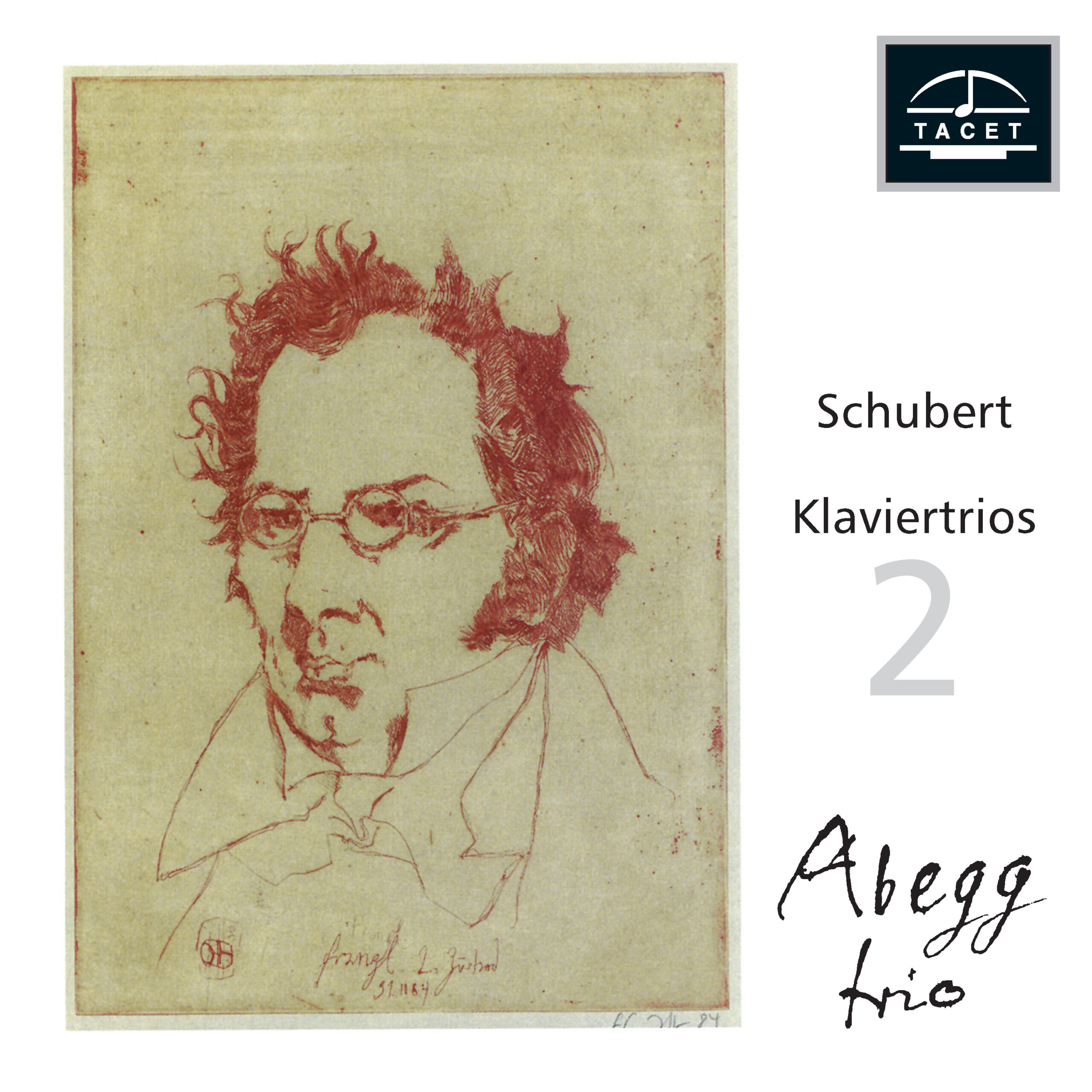
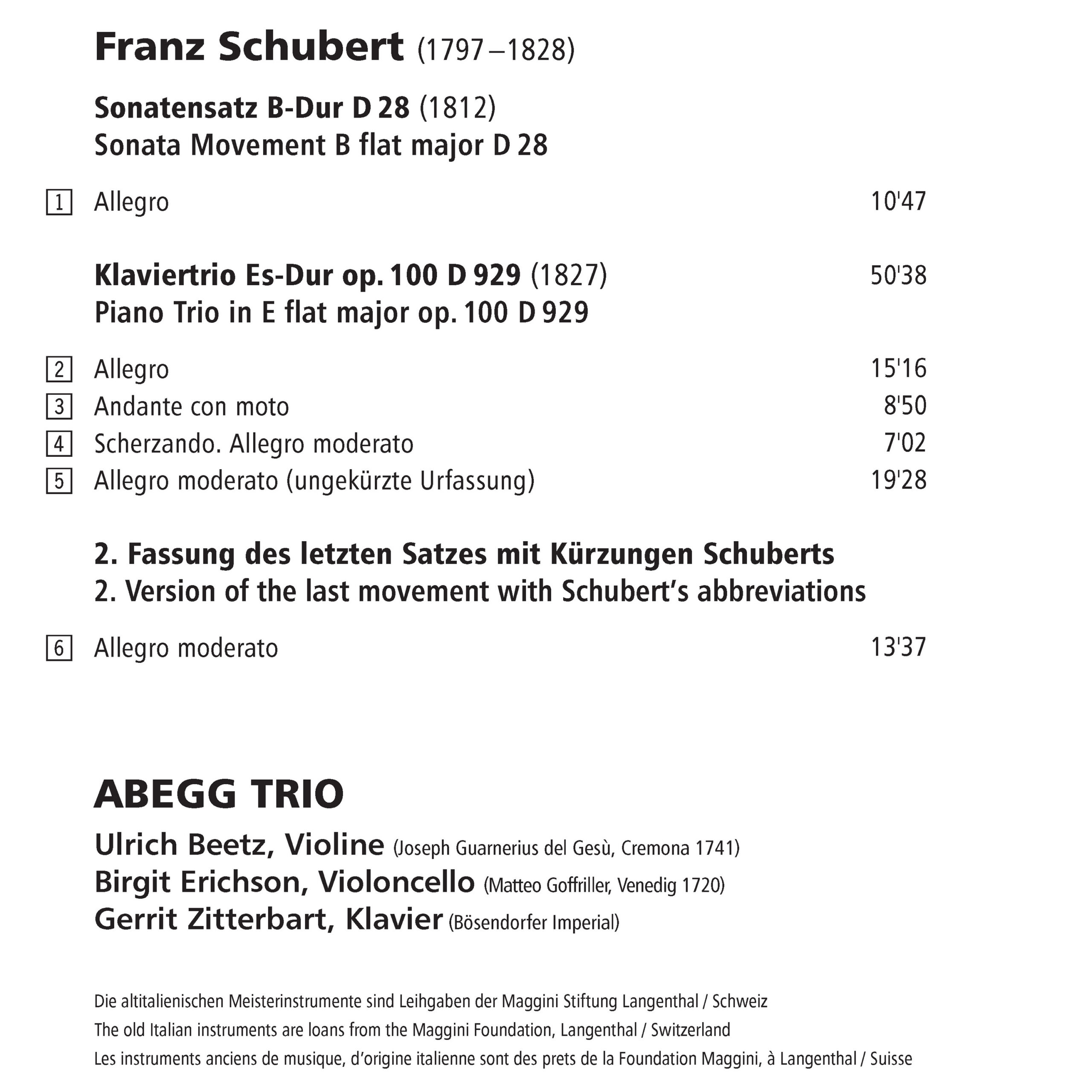
066 CD / Franz Schubert. Piano Trios Vol. 2
Description
"In the finale [The Abegg Trio] plays the hundred bars written by Schubert which impose on the movement a completely different form and – due to the repeated quotation of the sombre slow movement – expression. The fact that the music never loses balance and gains that heavenly length once enthusiastically admired by Schumann, is the best reference one could make to the ensemble; and if anyone does not like this addition, they can listen to the movement in its more usual form as an encore."
6 reviews for 066 CD / Franz Schubert. Piano Trios Vol. 2
You must be logged in to post a review.
Fono Forum –
The musical world lost nearly six minutes—twice fifty measures and an exposition repeat—when Franz Schubert decided to trim the heavenly lengths of his E-flat Major Piano Trio, D 929, significantly shortening its finale. In doing so, he also sacrificed something of the movement’s structural logic, which had woven the Swedish folk song quotes from the exquisite Andante into a sophisticated web of tonal relationships. Why the composer abandoned this achievement remains unclear. Perhaps he yielded to the advice of friends, since in 1827/28, a chamber music movement approaching twenty minutes in length was considered rather unusual. For Tacet, the Abegg Trio has now recorded the original version under their usual excellent conditions (see Fono Forum 10/99, pp. 40 ff.) and included the familiar shortened version as an additional track. The comparison is as fascinating as the interpretation is distinctive. Once again, Ulrich Beetz, Birgit Erichson, and Gerrit Zitterbart impress with their textually precise, transparent, and often deliberately dry, accented playing. In their hands, the great E-flat Major Trio sounds as “active, masculine, dramatic” as Robert Schumann once described it in contrast to the “suffering, feminine, lyrical” B-flat Major Trio.
Christian Strehi
Stereo –
Virtuosic, spirited, disciplined—this is how Schubert’s Second Piano Trio sounds, a crown jewel of chamber music trio literature. And because the Abegg Trio, as an internationally significant ensemble, takes the score so seriously, Franz Schubert shines in all his grandeur. Not as a composer steeped in Biedermeier sentimentality, but as a dramatist who conveys the sense that, despite an apparent lightness, the world remains for him a place without true hope. The result is a Romantic tableau in which the interpreters bring out the contrasting melodic elements with clarity. The two versions of the finale are also revealing: thanks to the Abegg Trio’s dramatic intensity, the excessive length of the uncut version (approx. 19 minutes) is barely noticeable here.
Egon Bezold
Der Bund –
There is no shortage of recordings of Schubert’s four compositions for piano trio, but the Abegg Trio offers a premiere: the finale of the E-flat Major Trio in its original version. The disservice Schubert did to this movement by omitting 100 measures of the development section at the publisher’s behest becomes palpable in the over 19-minute full version, which can be compared to the second, shorter version by a good six minutes…
Handelsblatt –
The Abegg Trio, by contrast, presents Schubert as a Romantic classic in their recording of the Second Piano Trio in E-flat Major, D 929, coupled with the early Sonata Movement, D 28. Here, a lean tonal approach combines with a significantly more restrained rubato, ensuring that Schubert’s expressive richness never obscures the formal architect behind it. This justifies an experiment by the Abegg Trio: in the finale, they perform the 100 measures Schubert cut, which impose an entirely different structure—and, through the repeated quotation of the somber slow movement, a different expressive character—on the piece. The fact that the music never loses its balance and instead gains the “heavenly length” that once astonished Schumann speaks volumes for the ensemble’s skill. And for those who do not care for this added depth, the movement is also included as a bonus track in its familiar, shortened version.
Fanfare-Magazin –
... isn′t actually a set per se, for the discs are available separately and bear numbers that are not sequential. Still, it is hard to imagine collectors purchasing one of them without promptly going after the other. Thanks to Tacet′s series of reissues, the Abegg Trio, still very much a force in European music (although the group has not toured the US for some time), is rapidly becoming a personal favorite.
Part of the reason for this is the overall high quality of the performances. The use of a Bösendorfer Imperial piano doesn′t hurt matters a bit. And the engineering is outstanding, too. The ensemble playing of violinist Ulrich Beetz, cellist Birgit Erichson, and pianist Gerrit Zitterbart is of the highest order, and the interpretations strike me as rock-solid. Their two CDs encompass all of Schubert′s surviving music for piano trio, and a bit more too, for they perform the finale of the Second Trio as it was published in 1828 plus the full, uncut original version. It′s nice to have the former in such a nice reading, but it is hardly unknown, and chances are good that most listeners will opt for the complete version...
The four works presented by the Abegg Trio easily rank among the best modern-instrument performances on record that I have heard - and that picss a great deal of territory....
John W. Lambert
Stereoplay –
„Die Audiophile“
Issues of multiple versions are not unique to Bruckner; they also appear in Schubert’s frequently performed Piano Trio in E-flat Major, though this is less widely known. The composer sent the manuscript to his publisher with instructions to make specific cuts in the finale. These cuts affected not only the now-omitted exposition repeat but also parts of the development section, reducing the movement’s duration from nearly 20 minutes to just 14. Among the excised passages was a second appearance of the thematic quotation from the Andante—a moment whose loss is regrettable due to its fascinating interplay of different rhythmic groups. Only in recent years has musicology discovered that this Andante theme originates from a Swedish song Schubert encountered in 1827. The Abegg Trio now presents both versions of the finale side by side, giving listeners a choice. The decision is not an easy one: while the generally performed final version offers greater formal balance, the original version boasts bold harmonic adventurousness. However, the recording’s significance lies not only in its exploration of the finale’s textual issues but also in its interpretive merits. The two antique Italian instruments blend beautifully with the sound of the Bösendorfer piano. The performance is remarkably subtle and dynamically almost over-differentiated (especially in the Scherzo), which occasionally risks veering into mannerism. On the other hand, it evocatively conveys the precarious, shifting ground on which the late Schubert stands—a parallel to the similarly nuanced interpretation of the G Major Quartet by the Hagen Quartet (75:16).
Alfred Beaujean