
e29 CD / Joseph Haydn: Jacob’s Dream
Joseph Haydn: Jacob’s Dream
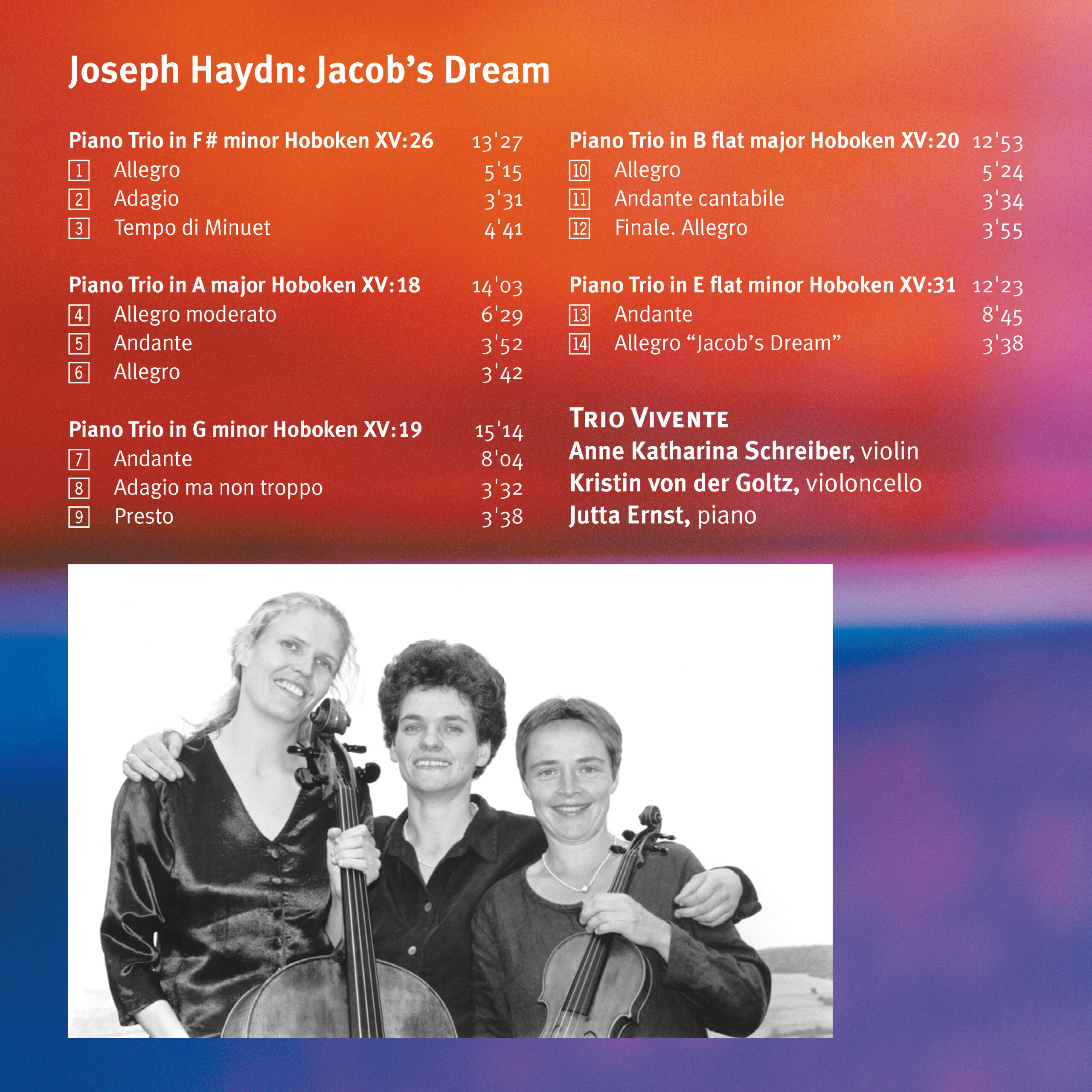
Piano Trio in F sharp minor Hoboken XV:26
Piano Trio in A major Hoboken XV:18
Piano Trio in G minor Hoboken XV:19
Piano Trio in B flat major Hoboken XV:20
Piano Trio in E flat minor Hoboken XV:31
Trio Vivente
EAN/barcode: 4009850102908

Description
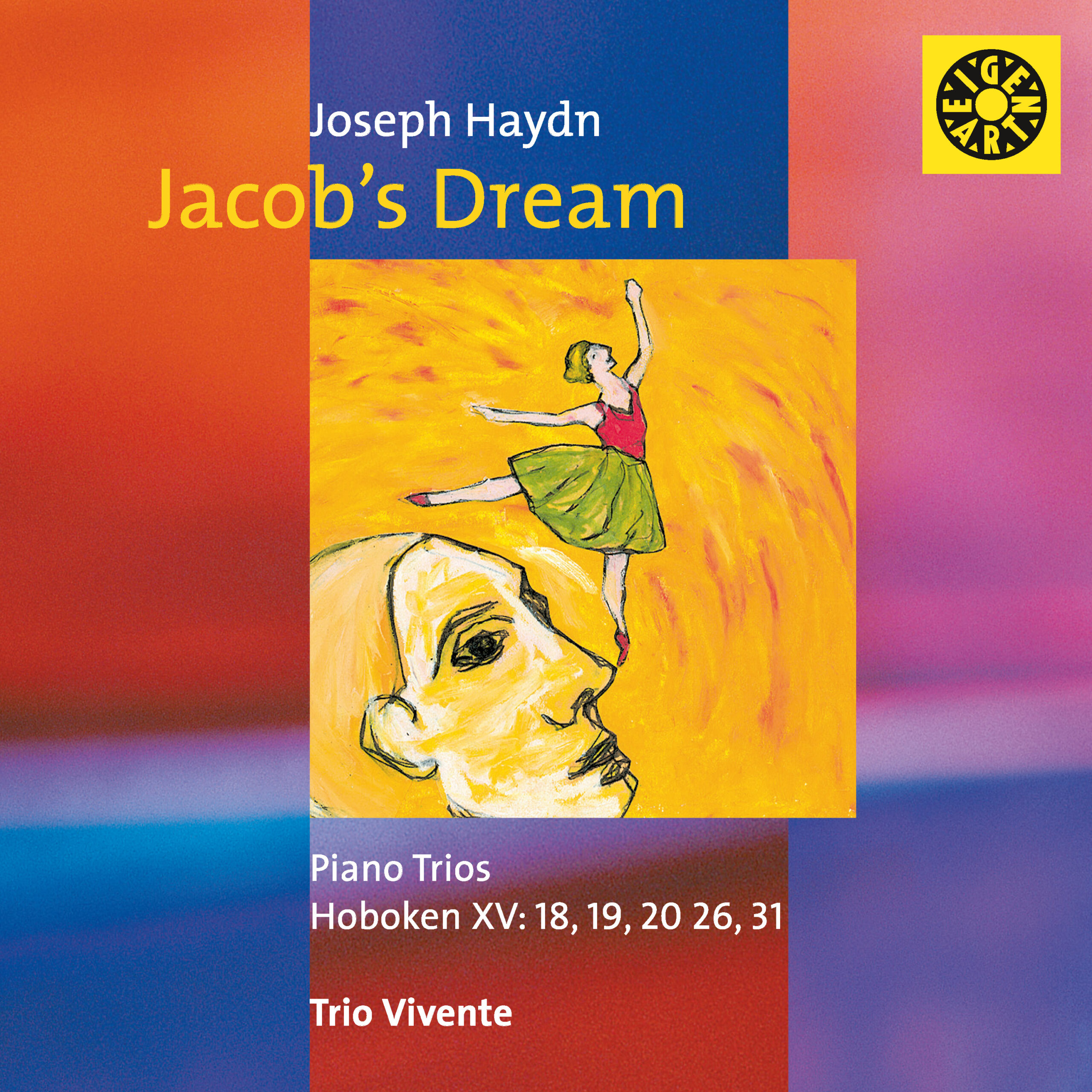
The still young piano trio Trio Vivente comprises three ladies who are not only technically brilliant musicians but also highly witty and charming. So it is not surprising to anyone who knows how often Joseph Haydn is still underestimated that for their first CD they chose some of his piano trios. As soon as you see the cover of the CD entitled "Jacob′s Dream", illustrated with a drawing by Angelika Bartholl, you might detect a certain lack of respect. But who is being disrespectful here? Joseph Haydn? A certain "London amateur violinist"? Or maybe even the three ladies who make up the trio? One thing is certain: no-one is going to crash here....
2 reviews for e29 CD / Joseph Haydn: Jacob’s Dream
You must be logged in to post a review.

Klassik heute –
Haydn’s late piano trios, composed around the time of his second great journey to England in 1794/95, abound with surprises. An expansion of the harmonic vocabulary, rhythmic individuality, and a general sharpening of contrasts elevate these three-movement works—full of unexpected ideas yet also confronting the listener with deep seriousness—to a level that clearly surpasses the divertimento character previously associated with the genre. Equally surprising is the performance by the Trio Vivente: such coherent phrasing and exquisitely balanced sound are rarely found among recent chamber-music releases—especially in this particular line-up. The brilliant, yet never showy, pianist Jutta Ernst and her string colleagues Anna Katharina Schreiber and Kristin von der Goltz, who, with all due respect to the piano part, are astonishingly present in shaping the musical dialogue, achieve (aided by superb recording technology) true miracles of timbral blending between these so very different instruments, offering a prime example of how music can be captivating and lively without any forceful imposition. A feast for every chamber-music lover.
Peter T. Köster
Rondo. Das Klassik & Jazz Magazin –
As an average, everyday music listener, one would hardly expect unique manifestations in Haydn’s piano trios, but would rather imagine pleasant, standardized little pieces to be slipped into the CD player as background babble while cooking or eating. Anyone planning to do the same with the five examples on the Trio Vivente’s first recording is hereby warned: the cooking will end in disaster, for the listening makes one forget the stove.
To be sure, the three ladies cannot (and do not wish to) deny the divertimento character, especially of the final movements; yet what they bring to light in many an opening section and even more so in the slow middle movements, in terms of harmonic richness and expressive seriousness, reaches far beyond any kind of casual entertainment—often down into depths worthy of Schubert. Haydn himself was aware of the quality of this chamber music composed during his two London journeys and even used some movements twice—an extremely rare procedure for him—such as the F-sharp major Adagio from No. 26 in his Symphony No. 102.
Even if the piano part carries more weight than the two string parts, Anne Katharina Schreiber (violin) and Kristin von der Goltz (cello) do not draw the false conclusion of interpretative restraint; on the contrary, as the final Allegro of No. 18 exemplarily shows, their playing brims with virtuosic wit and attention to detail. And how almost perfectly their carefully thought-out phrasing corresponds with that of Jutta Ernst at the piano demonstrates that even a still young trio can already display the most mature ensemble qualities.
Since all three ladies are or were directly or indirectly connected with the Freiburg Baroque Orchestra, one knows where this sparkling vitality of performance comes from. Given the ensemble’s background, only one question remains: why no period instruments?! A fortepiano might have brought even more dynamic shading to Jutta Ernst’s already highly contrasted playing.
Ah yes, the curious English title of the disc: Haydn places it before the rather conventional closing movement of his 31st trio. Let it be said this much: it bears witness to the malicious wit of its creator. That this all-female disc otherwise has much to do with humor and esprit is shown not least by the cover picture. Whether the old Haydn, who dedicated all the trios to ladies at the keyboard, really allowed one of them to dance on his nose, however, must remain an open question. I would not wish it upon the man so damaged by marriage.
Christoph Braun