
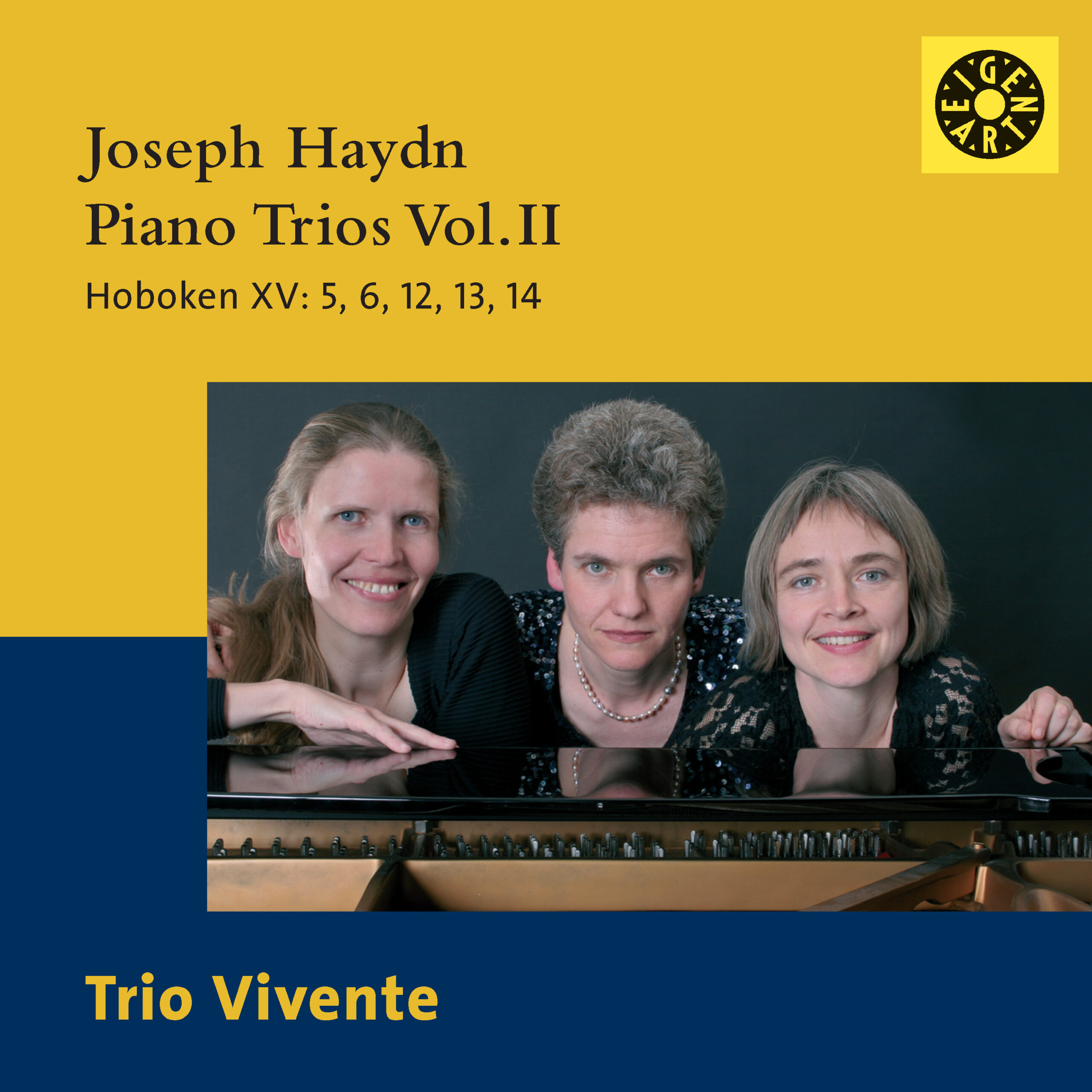
e37 CD / Joseph Haydn: Piano Trios Vol. II

Description
"They really live up to their name: "Trio Vivente" is the name of the ensemble which was founded in 1992 and since then has given guest recitals at leading concert series such as the "Ludwigsburger Schlossfestspiele". If liveliness is to be the stamp to mark this troika’s music, then they could not have chosen a more fitting composer than Joseph Haydn. Even in the second part of this complete recording of Haydn’s more than thirty piano trios, we experience three musicians who are excellent at getting the quantity right: the generally lively, occasionally daring tempo suits the ductus of the music, the dialogue between the three instruments is just right, and the language is transparent." (ensemble 02/07)
5 reviews for e37 CD / Joseph Haydn: Piano Trios Vol. II
You must be logged in to post a review.
image hifi –
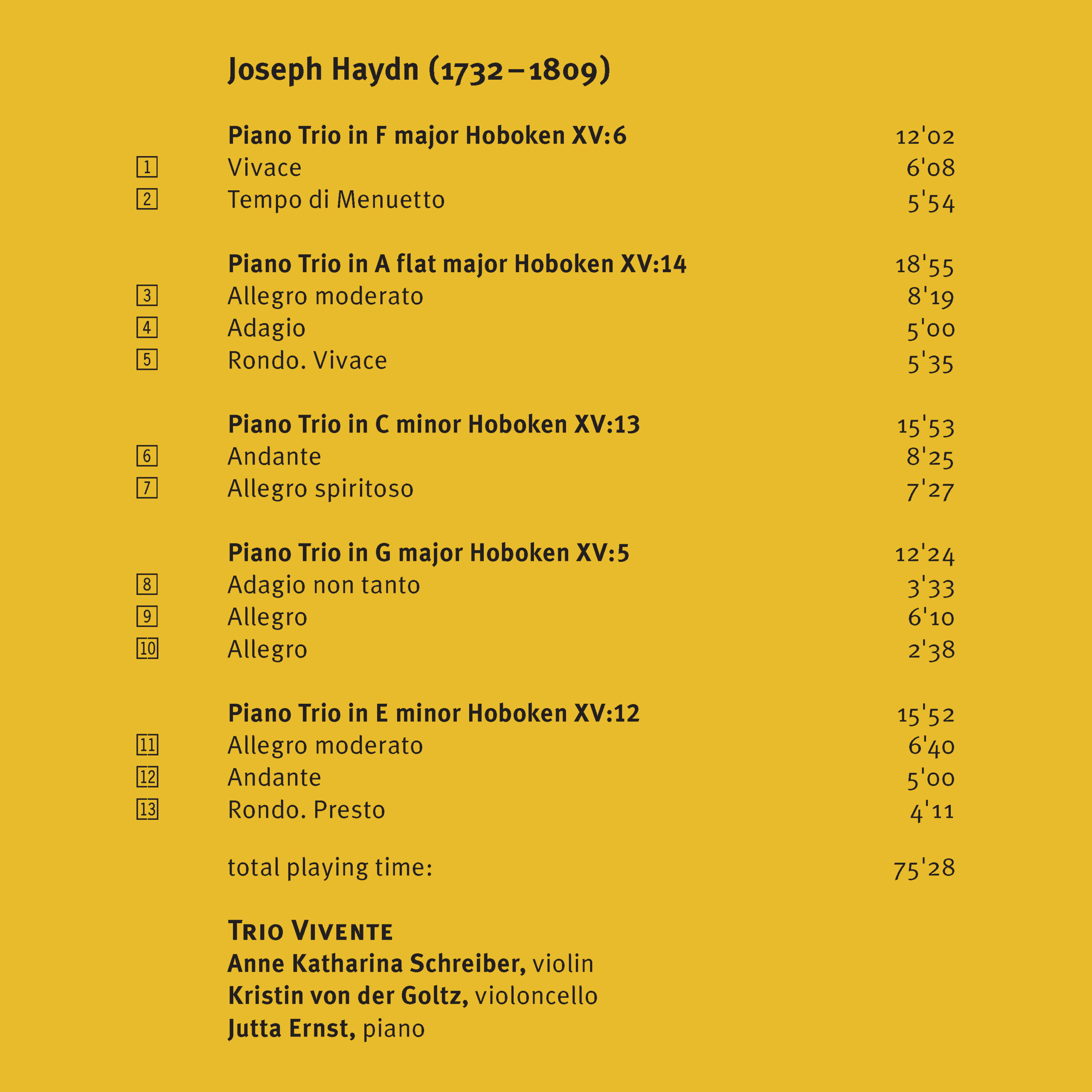
The Trio Vivente, founded in 1992, continues its series of Haydn trios with a new CD (Eigenart 10370). The first disc (Eigenart 10290) contained piano trios from the late period – Hob. XV: 18–20, 26, 31 (“Jacob’s Dream”) – and attracted considerable attention in 2001. Now come the trios composed during the 1780s – works in which Haydn approaches the still relatively new genre with particular experimental curiosity in terms of structure and expressive possibilities (Hob. XV: 5, 6, 12, 13, 14). In the piano trio the composer evidently felt freer than in the highly cultivated string quartet and the publicly prominent symphony. The performers play on modern instruments, although the violinist Anne Katharina Schreiber and the cellist Kristin von der Goltz, as members of Baroque ensembles, have more than just one foot in the door of historically informed performance practice. When a pianist plays as transparently and dryly pointed as Jutta Ernst, and when the trio listens to one another as closely as the Vivente ladies do, a fortepiano is not absolutely necessary. The two string instruments do not have to fight for space here. Thus violin, cello and the (unfortunately slightly unkempt-sounding) concert grand come together in a finely responsive and highly dialogical interplay.
Heinz Gelking
Hessischer Rundfunk, Klassik-Zeit –
What does female power have to do with shade plants? The latter bloom in seclusion and are often among the most beautiful. One might count Joseph Haydn’s some forty piano trios among them. They unjustly lead a life in half-light instead of standing in the full glare enjoyed by many of his symphonies or string quartets. And yet there is no lack here of wit and charm, nor of that oft-cited Haydnesque inventiveness – especially when the music is played as freshly and attentively as by the three players of the Trio Vivente: Anne Katharina Schreiber (violin), Kristin von der Goltz (violoncello) and Jutta Ernst (piano). With their very first CD the three power women already presented an unusually original and witty recording of Haydn trios. Now they offer the second installment of their planned complete edition, once again on the EigenArt label.
(…) Very lively – vivente, as the Italian ensemble name says – and full of a spirit of discovery, they set out through Haydn’s scores. Rarely does one hear phrasing so coherent and a sound balance so finely honed. Founded in 1992, the Trio Vivente has by now become something of an insider’s tip on the chamber-music scene. Alongside Haydn, the musicians produced an album of Schubert trios in 2005 and promptly received an award for it, the Luxembourg Supersonic Award. The new Haydn album (…) comprises the trios from the middle creative period, the 1780s. A spirit of experimentation led Haydn to highly individual results, moving away from the early trio sonata. From harmless amateur or salon pieces that might be described as piano sonatas with accompaniment by violin and cello, true trios emerge, for the participating instruments are now equal partners. In Trio No. 12 in E minor, Haydn initially strikes conspicuously harsh, passionate tones in the opening movement. And before the whirlwind final rondo drives away the last lingering fancies, a Siciliano in E major wafts a little Rococo perfume.
Sensitive, spontaneous and convincing – that is what musical female power sounds like with the Trio Vivente. (…) In their very own way, the three women rediscover Haydn’s witty and roguish chamber music. One imagines “Papa Haydn” delighting mischievously in the bewilderment of his audience, only to return with an air of innocence and a gallant step to the orderly world of Classicism. (…)
Gisela Walther
Classics Today France –
Comparing this second volume of another complete set of Haydn’s trios with that of the Trio 1790 on CPO, one realizes that one can be musically right while being musicologically wrong. True, the piano played by Jutta Ernst did not exist in Haydn’s time, but she uses it wisely, without abusing the pedal and handling it with lightness and fluidity. Since the strings, too, have genuine sonorities (no excessive vibrato), with singing lines and forward momentum, it is clear that the great winners of the enterprise are Haydn himself and the listeners. The Trio Vivente has understood the simplicity, joviality, and conviviality of Haydn’s trios. They find exactly the right way to approach them, without pressing too hard. With the Trio 1790 we had porcelain; here we have Chantilly cream. Lighter, to be sure, but very pleasing.
Christophe Huss
___________________________________
Original Review in French language:
En comparant ce second volume d′une autre intégrale des trios de Haydn avec celle du Trio 1790 chez CPO, on se rend compte qu′on peut avoir musicalement raison en ayant musicologiquement tort. Certes le piano que touche Jutta Ernst n′existait pas du temps de Haydn, mais elle en fait un emploi avisé, n′abusant pas de la pédale et le maniant avec légèreté et fluidité. Comme les cordes ont de vraies sonorités (sans abus de vibrato), avec des lignes de chant et des élans, il est évident que les grands gagnants de l′opération sont Haydn lui-même, et les auditeurs. Le Trio Vivende a compris la simplicité, la jovialité et la convivialité des Trios de Haydn. Il trouve l′exacte manière d′y toucher sans trop appuyer. Avec le Trio 1790 nous avions de la porcelaine. Ici, nous trouvons de la Chantilly. Allégée certes, mais bien agréable.“
Christophe Huss
Pizzicato –
Haydn feminine
If Haydn wished to be regarded as an elegant and witty composer, he has found ideal female interpreters in this recent recording of the Piano Trios. With clear diction, a grace-filled lightness, and a harmonic sensibility that brings a rich variety of emotions, the Trio Vivente remains faithful to the score while bringing to it the experience gained since their beginnings in 1922. The ensemble is perfectly unified; the ever-present, limpid piano does not seek to dominate its partners, but converses with them and, supported by them, shines throughout the virtuoso passages. With taste, the three musicians delight in bringing out the expressive details of these eminently classical scores.
itb
_____________________________
Original Review in French language:
Haydn feminine
„Si Haydn désirait passer pour un compositeur élégant et plein d′esprit, il aura trouvé des interprètes féminines de choix sur ce récent enregistrement des Trios avec piano. Avec une diction claire, une légèreté emplie de grâce et un sens harmonique qui apporte une riche variété de sentiments, le Trio Vivente reste fidèle au texte et y apporte l′expérience acquise depuis leurs débuts, en 1922. L′ensemble est parfaitement soudé, le piano omniprésent et limpide ne cherche pas à dominer ses partenaires, mais dialogue avec elles et profite de leur soutien pour briller au long des passages virtuoses. Les trois musiciennes s′amusent avec goût à faire ressortir les détails expressifs de ces partitions éminemment classiques.“
itb
Ensemble –
Dialog mit Transparenz
They really live up to their name: "Trio Vivente" is the name of the ensemble which was founded in 1992 and since then has given guest recitals at leading concert series such as the "Ludwigsburger Schlossfestspiele". If liveliness is to be the stamp to mark this troika’s music, then they could not have chosen a more fitting composer than Joseph Haydn. Even in the second part of this complete recording of Haydn’s more than thirty piano trios, we experience three musicians who are excellent at getting the quantity right: the generally lively, occasionally daring tempo suits the ductus of the music, the dialogue between the three instruments is just right, and the language is transparent.
Rafael Sala