
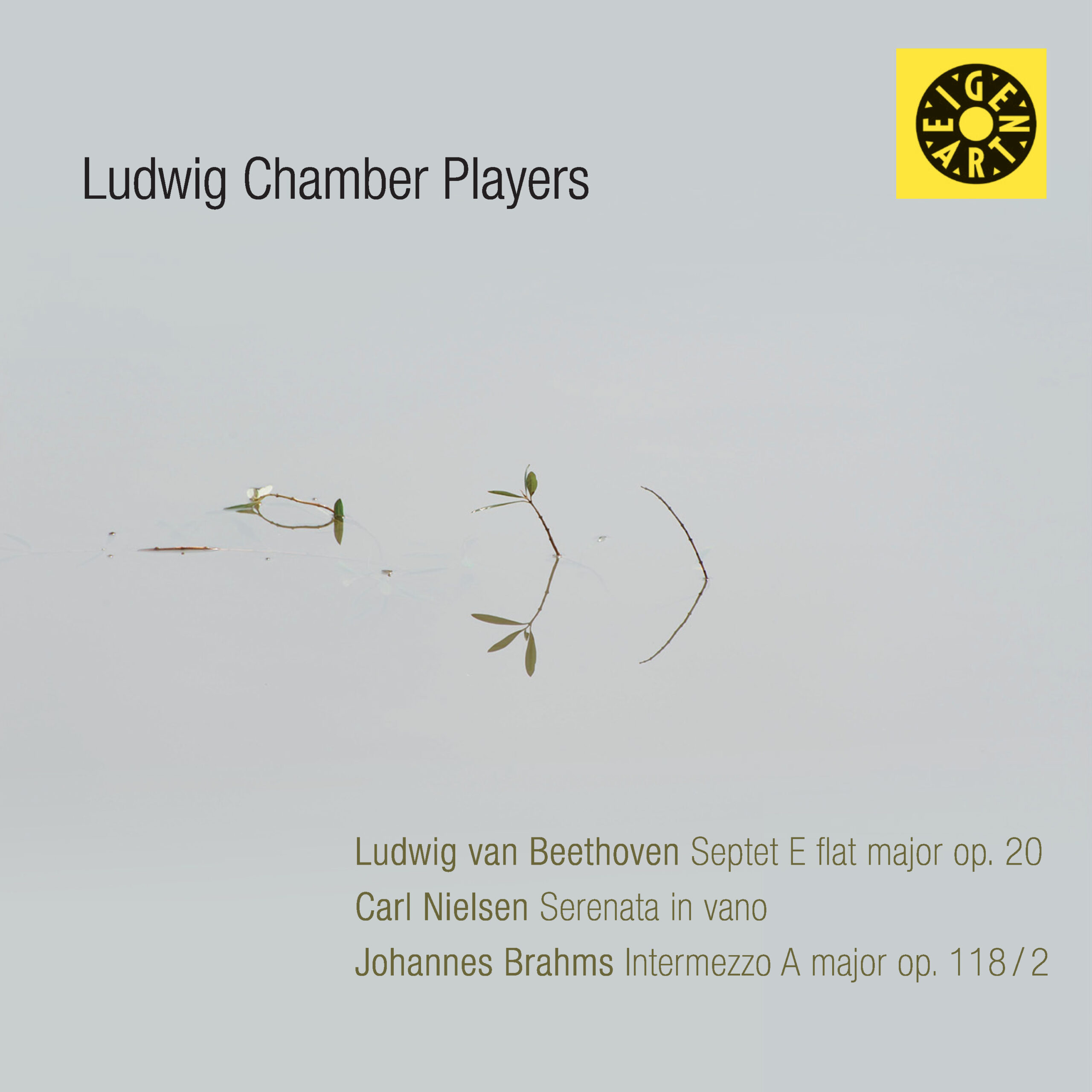
e48 CD / Ludwig Chamber Players
Ludwig Chamber Players
Ludwig van Beethoven: Septet E flat Major op. 20
Carl Nielsen: Serenata in vano
Johannes Brahms: Intermezzo A Major op. 118/2
EAN/barcode: 4009850104803
Description
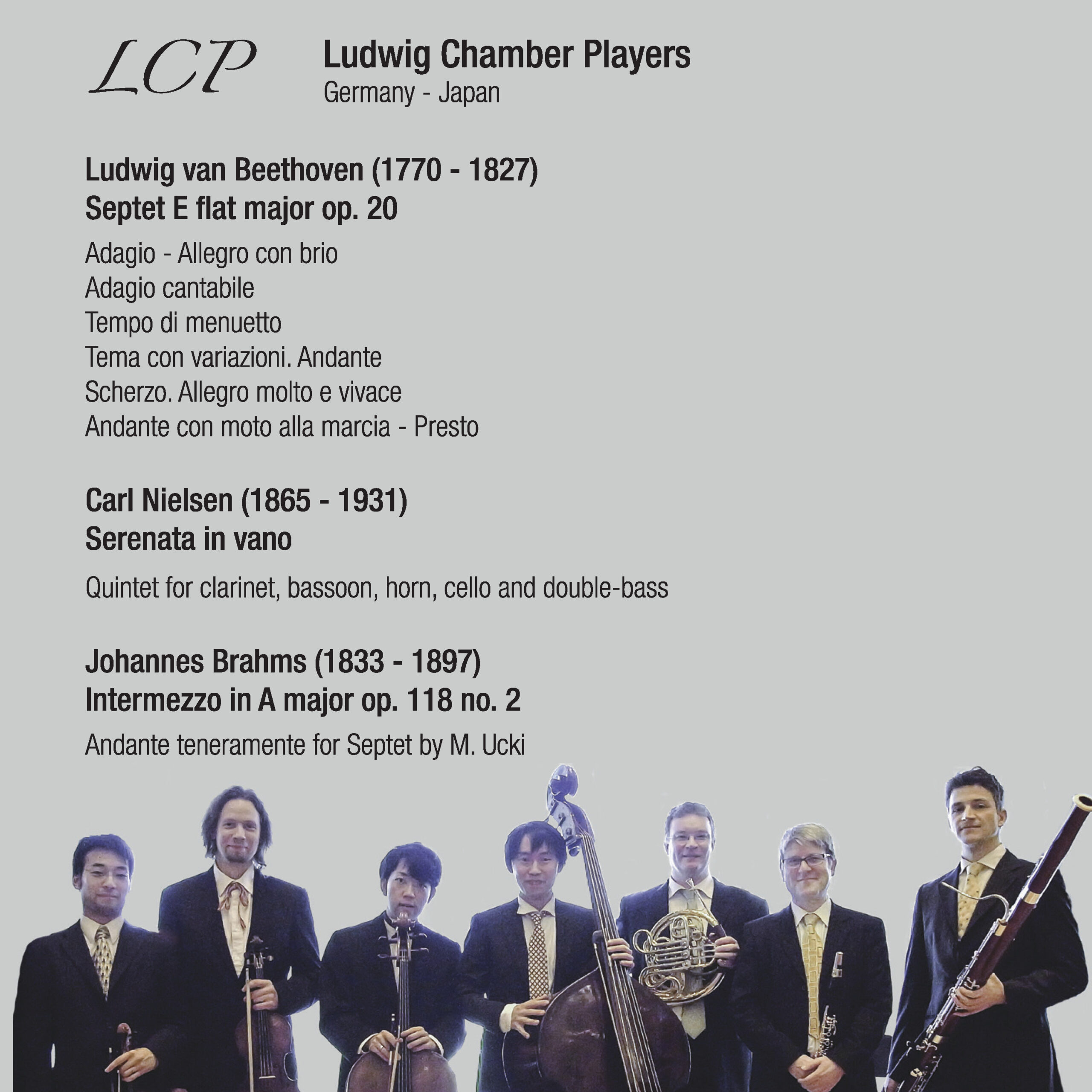
Hats off to this new EigenArt production! The debut CD of the Ludwig Chamber Players convinces listeners with its joy of playing, musicality and precision. Five nations (three Japanese, a Latvian, and players from Lower Saxony, Baden and Swabia) met in Japan one year ago and got along well from the start. One can hear this on their CD, from the first note to the last. The programme is enriched by a very original piece by Nielsen, at that time composed as a complement to the Beethoven Septet, and an adaptation of a Brahms piano piece scored for septet.
2 reviews for e48 CD / Ludwig Chamber Players
You must be logged in to post a review.

Pizzicato –
--> original review
The “Ludwig Chamber Players” are an ensemble comprising German and Japanese musicians, as well as a French and a Latvian player. Their main points of contact are the SWR Orchestra in Stuttgart and the Saito Kinen Festival Orchestra. The “Ludwig Chamber Players” are devoted to the diverse chamber music for mixed string and wind ensembles of the 18th and 19th centuries. On an EigenArt CD, they perform Ludwig van Beethoven’s Septet, Op. 20, Carl Nielsen’s Serenata in vano, and an arrangement of the Intermezzo Op. 118/2 by Johannes Brahms. The recordings are pleasing due to the beautiful harmony prevailing within the homogeneous ensemble. The joy these musicians take in playing together is audible in every moment.
Remy Franck
Klassik heute –
--> original review
The seven musicians of the Ludwig Chamber Players, according to the booklet, first met in Tokyo in April 2013, and after just a few bars of Beethoven’s Septet it was clear to them that they wished to continue working together. They did not just perform the scheduled concerts, but also adopted a name inspired by the famous Septet, and now present their first CD. A very lovely, promising beginning, for all seven not only master their instruments superbly, but are evidently willing to respond to one another, to listen attentively, and in the interplay of ideas find something shared: Kei Shirai (violin), Janis Lielbardis (viola), Gen Yokosaka (cello), Ryutaro Hei (double bass), Dirk Altmann (clarinet), Hanno Dönneweg (bassoon), and Wolfgang Wipfler (horn).
The program presents the ensemble’s foundational work, Beethoven’s long-beloved Septet op. 20 of 1800, along with, as an appendix, Carl Nielsen’s whimsically humorous Serenata in vano for quintet (without violin and viola), a title which can be rendered with reference to Brahms as “Futile Serenade,” as well as a successful, albeit in the arrangement for septet somewhat “alien” to me, M. Ucki transcription of Brahms’s late piano Intermezzo in A major op. 118 no. 2.
In Beethoven, the spark of musical vitality hits us immediately—one that belongs not only to the music itself in the highest degree, but which all the musicians pick up with joy and sensitivity. Everything breathes, the filigree work sparkles under the fingers, subtle differences between staccato, marcato, tenuto, etc., are realized with great care; the tempi are mostly very convincingly felt; attempts are made to follow the flow of modulations; the ensemble is precise, intonation virtually flawless, and the delicate balance between stronger and weaker voices is achieved with empathy and consideration.
What remains to be refined: a more precise realization of the small crescendi followed by subito-piano (especially in the second movement), the avoidance of unnecessary local ritardandi, which tend to appear at phrase endings when the articulation of energy flow is unclear, as well as unnecessary stretches and associated emphases on certain downbeats, and generally the habitual automatic stressing of strong beats (menuet!). Much more attention could also be given to a truly lively piano and pianissimo that clearly distinguish themselves from the middle and higher dynamics, and ultimately to phrasing that always looks further ahead. In connection with this, some subito-fortes lack force—on the one hand, it is highly pleasing that there is no blind pounding as so often happens in orchestral performances of Beethoven’s music; on the other hand, particularly in delicate passages, special courage and practice are required to establish a decisive contrast that embodies precisely the tension of the phrase, that the music moves forward from its own energy.
Overall, then: very fine, and please continue refining, aiming for the larger context that presupposes an interplay of continuity and measured contrast! All of this also applies to the Nielsen performance, where the relationships are, however, much more complex and quirky. The sound picture is appealing in transparency and spatial naturalness, while the booklet could benefit from a more detailed introduction.
Christoph Schlüren