
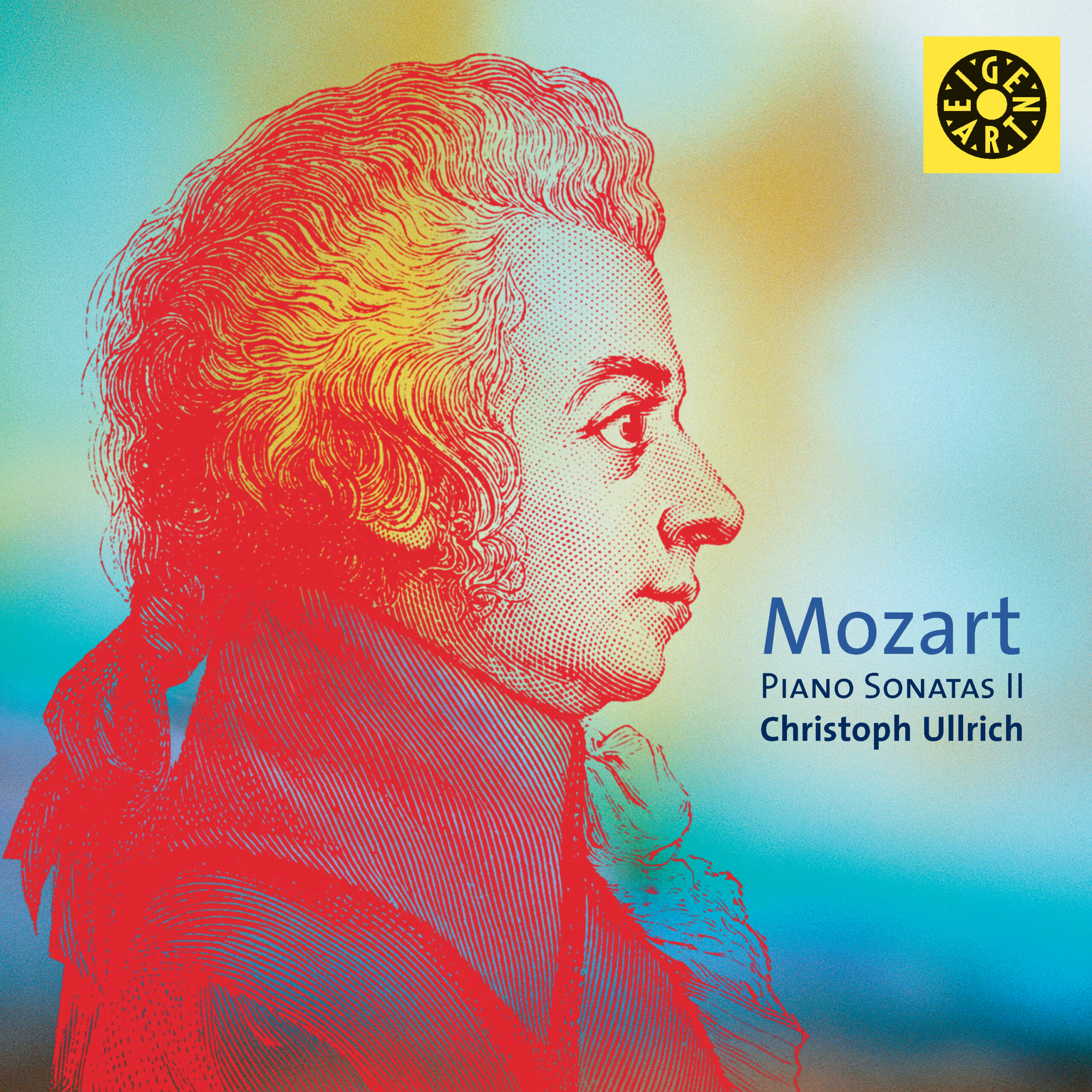
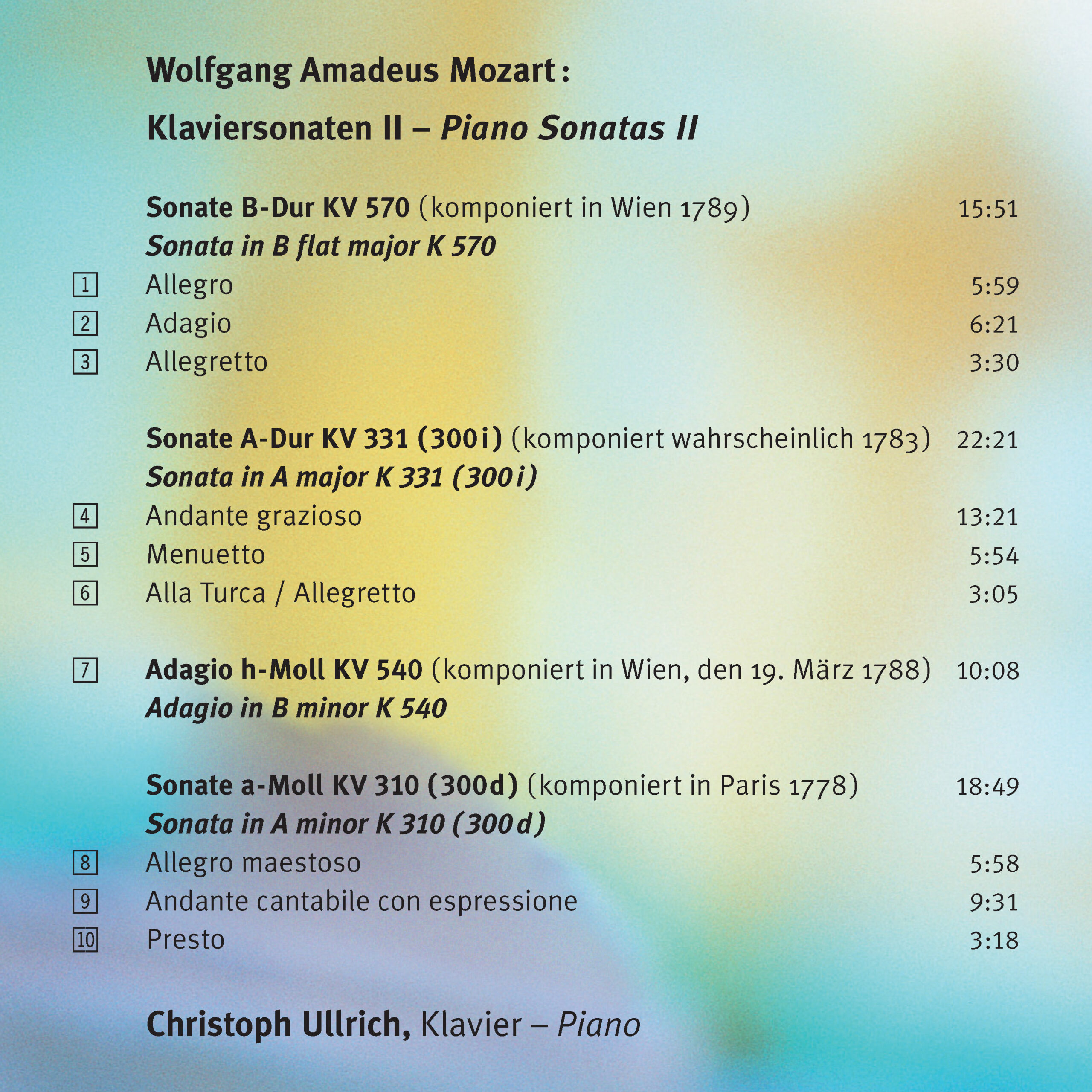
e36 CD / Mozart: Piano Sonatas II
Description
"In Mozart year let the established stars bring out all their glossy products. The most exciting project was the one started by Christoph Ullrich before (and regardless of) jubilee year. [...] This is not only great piano playing: it is also finest interpretational art, and Ullrich is a virtuoso of expression. The Adagio KV 540 takes your breath away. Buy it!" (Heinz Gelking)
6 reviews for e36 CD / Mozart: Piano Sonatas II
You must be logged in to post a review.
Klassik heute –
The Göttingen-born pianist Christoph Ullrich, who studied with Leonard Hokanson, Claude Frank, and Rudolf Buchbinder and has evidently also been well guided in other respects, is no instrumental firebrand striking the imaginary match-heads of Mozart’s sonatas, as they are set almost literally ablaze in the recently released DG edition of rediscovered Gulda documents. Yet Ullrich—to risk another comparison—is by lengths and breadths superior to another colleague of the older generation in terms of manual polish and characterizing variety. Ullrich confirms—very much in the spirit of his label—a healthy measure of “Eigenart” (individual character), without, for instance, overstepping into pianistic ethnography in the “Turkish March” of the A-major sonata. The three sonatas and the austere, for its time almost otherworldly and threatening Adagio (KV 540) sound, in both their flowing and their restrained moments, in an intelligent manner that, in its very unobtrusiveness, becomes almost striking again. The colleague not yet named above is Carl Seemann, whose complete recording of the Mozart sonatas (and some further items from the treasury of fantasies and variations) has just been reissued in the DG catalogue. Seemann now truly fingers his way dryly and as if untouched by all Mozartian eroticism through this repertoire—a professional eternal piano pupil, as it were. I would much rather spend another generous hour in Christoph Ullrich’s company on his Mozart journey, even if in certain crucial moments (such as in the development section of the A-minor sonata’s first movement) the decisive will to break free under the pressure of the enormous musical frictions is lacking. Nevertheless: one of the more important Mozart editions in the first phase of the anniversary year.
Peter Cossé
Classics Today France –
EigenArt is a label created by Tacet in which artists come to propose and finance their own recordings. It works on the same principle as Avie, except that here Tacet provides its technical equipment and, ideally, records on a very well prepared piano.
The self-produced genre is risky, unless the label maintains artistic control. With Tacet, one can have confidence, unlike with other labels such as Gallo, for example, which has at times released just about anything. The purity of Christoph Ullrich’s piano playing sustains the illusion for quite a while on this disc. It is conscientious, beautiful piano playing. Alas, when one reaches the K. 310 Sonata, he really overdoes it and manhandles the first movement with over-articulation in a pre-Beethovenian manner. The Mozartian world of 1778 in Paris does not ask for so much. An altogether very respectable CD, then, but not one of lasting discographic importance.
Christophe Huss
______________________________________________
Original Review in French language:
EigenArt est un label créée par Tacet dans lequel les artistes viennent proposer et financer leurs enregistrements. C′est le même principe que chez Avie, sauf qu′ici Tacet fournit son équipement technique et a, idéalement, enregistré un piano très bien réglé.
Le genre autoproduit est dangereux, sauf si le label garde un contrôle artistique. Avec Tacet nous pouvons faire confiance, contrairement à d′autres étiquettes telles que Gallo, par exemple, à qui il est arrivé de publier n′importe quoi. La pureté du piano de Christoph Ullrich fait illusion assez longtemps dans le disque. C′est du beau piano consciencieux. Hélas, arrivé à la Sonate K. 310, il en fait vraiment beaucoup et triture le 1er mouvement en le surarticulant dans un ton pré-beethovénien. L′univers mozartien de 1778 à Paris n′en demande pas tant. Un CD très honorable donc, mais pas discographiquement marquant.“
Christophe Huss
Classics Today –
Christoph Ullrich opens Volume 2 of his Mozart cycle with a lovely account of the B-flat sonata KV 570. In the first movement he employs subtle and tasteful tempo fluctuations that strengthen the profile of each theme, imparting a vocal quality to the repeated notes. A similar dramatic design informs the Adagio and helps prevent Ullrich′s unusually brisk tempo from sounding glib. You could argue that the Allegretto′s sly wit slackens when Ullrich rounds off phrase endings, taking the edge off of Mozart′s syncopated accents, but that′s quibbling.
The A major KV 331 sonata′s opening variations receive a cohesive and characterful performance to stand with the best. And despite patches of uneven articulation, Ullrich′s impetuous romp through the Rondo Alla Turca makes this too-familiar music seem new, or, as the Brits say, "newish".
Although Ullrich′s fluent and fleet B minor Adagio rightly eschews the droopy melodrama I′ve heard lesser pianists inflict on the music, Horowitz′s similarly paced performance better conveys the music′s tragic underpinnings and fragile lyricism. In the A minor KV 310 sonata, Ullrich′s well-considered if not always spontaneous phrasing yields to Richard Goode′s sharper, suppler fingerwork. The rounding off habit I discussed earlier permeates the Finale to the point where you can predict Ullrich′s ritardandos before they occur, contrasting to the slow movement′s straightforward reserve.
To sum up, Ullrich builds upon the virtues and mostly eradicates the drawbacks of his first Mozart disc for EigenArt, expanding his dynamic palette and making greater use of the sustain pedal. On to Volume 3
Jed Distler
Stuttgarter Zeitung online –
Rund um Mozart – Plattentips zum Jubiläum
Das Mozart-Jahr 2006 naht, und da der 250. Geburtstag des Klassik-Lieblings schon Ende Januar ansteht, haben Platten- und Buchverlage sich längst zur Schlacht um Anteile am großen Jubiläumsgeschäft gerüstet. Wiederaufgewärmte, auf den Anlaß frisierte oder schnell zusammengestoppelte Produkte füllen die Regale, doch mitunter finden sich dort auch echte Perlen. Zu ihnen zählen zwei Platten des Frankfurter Pianisten Christoph Ullrich mit Klavierwerken Mozarts, die jetzt in der Edition EigenArt erschienen sind. Die ebenso souveränen wie behutsam-eigenständigen Interpretationen erweisen Ullrich, der in seinen Konzerten thematisch schlüssige, oft musikalisch-literarische Programme bevorzugt und gern neue, auch für Kinder geeignete Konzepte erprobt, als technisch versierten, intelligent disponierenden Musiker. Der exzellente Tonmeister Andreas Spreer vom Stuttgarter Label Tacet hat die subtile klangliche Tiefenstaffelung von Ullrichs Spiel auf modernem Steinway plastisch eingefangen (EA 10340 und 10360) (…)
Werner M. Grimmel
image hifi –
Let the more established stars deliver all their glossy products in the Mozart Year. The most exciting project, however, was launched by Christoph Ullrich well in advance of, and independently from, the anniversary celebrations (image hifi 3/2005). On his second CD, again recorded by Tacet but produced by himself, he continues to work his way deeper into Mozart’s sonata cosmos. Ullrich looks beyond the notes and makes discoveries by finding vocal lines in the piano texture, being, as he is, closely connected to opera. In setting voices against one another, he departs by thousandths from a dryly precise execution of the rhythm, so that the lines seem to decouple from each other and lead an independent life, like characters. Ullrich frees himself from the mere execution of the written text, sharpens contrasts, keeps tempi flexible, and shows us a Mozart who is more sociable and more solitary, more sensually alive and more withdrawn from the world than we would ever have expected. This is not only great piano playing, but the highest art of interpretation, and Ullrich is a virtuoso of expression. The Adagio KV 540 takes one’s breath away. Buy it!
Heinz Gelking
Frankfurter Rundschau –
Delicate Abysses
One will hear it often in the soon-to-begin Mozart Year: the “alla Turca” movement from the Piano Sonata KV 331. One can hear it freshly and seemingly improvised, as with Andreas Staier on the fortepiano, or nicely Afro-Cuban in rhythm, as with the Klazz Brothers—both newly released on CD in recent weeks. Or one can listen to it as the Frankfurt pianist Christoph Ullrich plays it on his brand-new Mozart CD: brisk, but not too fast; delicate, but not mannered; a little manic-mechanical and edgy, which is probably exactly how it is meant to be.
The Turkish March at the end of this sonata and in the middle of this CD marks, incidentally, a caesura, dramaturgically well chosen: after it, the music moves into the minor, with the Adagio in B minor KV 540, a pure nocturne, and with the darkly throbbing A-minor Sonata KV 310, in whose first movement the bass notes toll like bells. Night and deep darkness in Mozart’s piano music? Yes, they exist—if one plays them with such abyssal beauty, such intelligence and seriousness as Christoph Ullrich does. Exactly one year after his first Mozart CD, the pianist has now released his second, again on the self-run label EigenArt and once more with recording engineer Andreas Spreer responsible for the sound. And he, highly esteemed as head of the Stuttgart-based production company Tacet, has achieved a purist, clear Steinway tone that ideally suits Ullrich’s equally purist playing. The Mozart Year may come—one is well prepared with Christoph Ullrich.
ick