
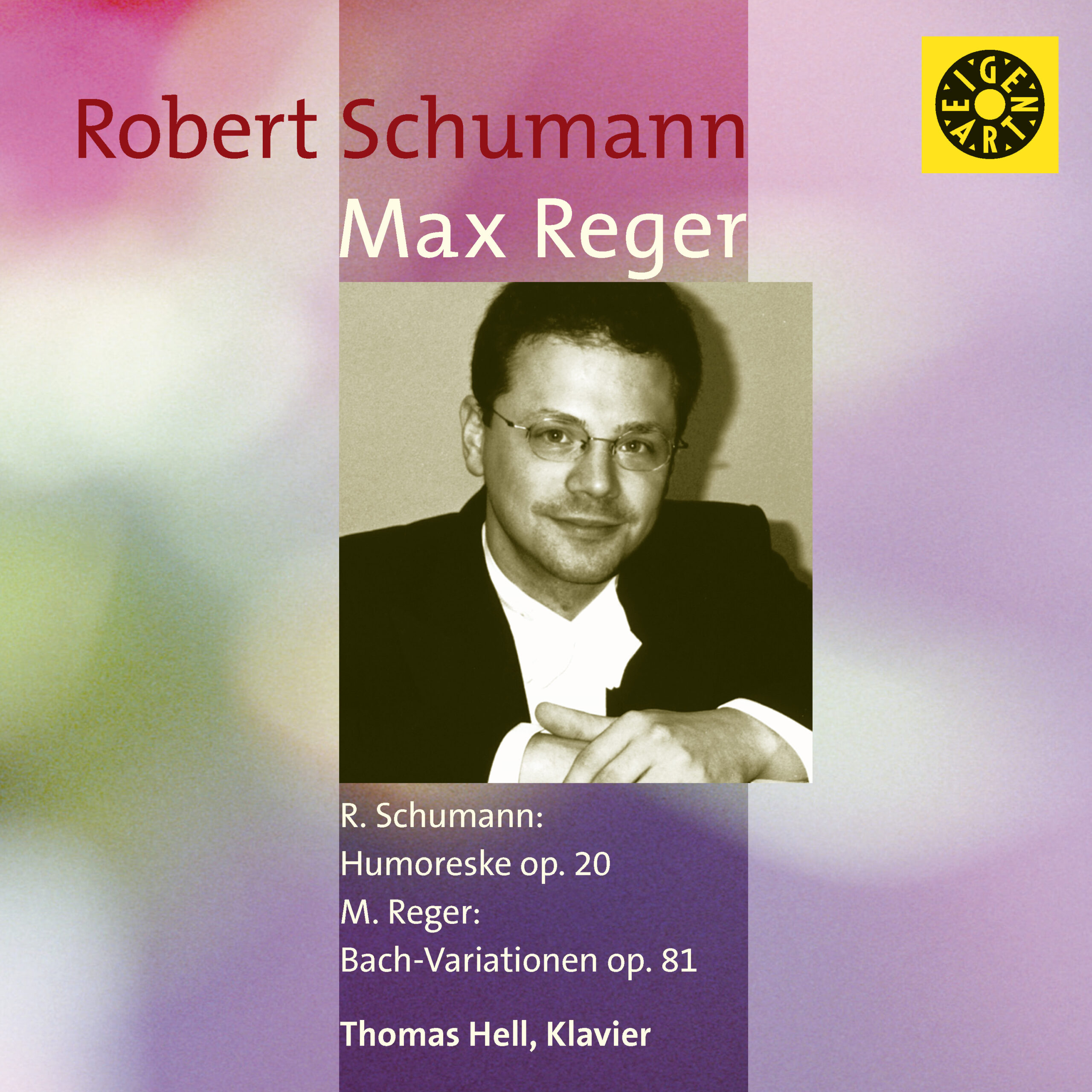
e24 CD / Robert Schumann, Max Reger: Klavierwerke
Robert Schumann
Max Reger
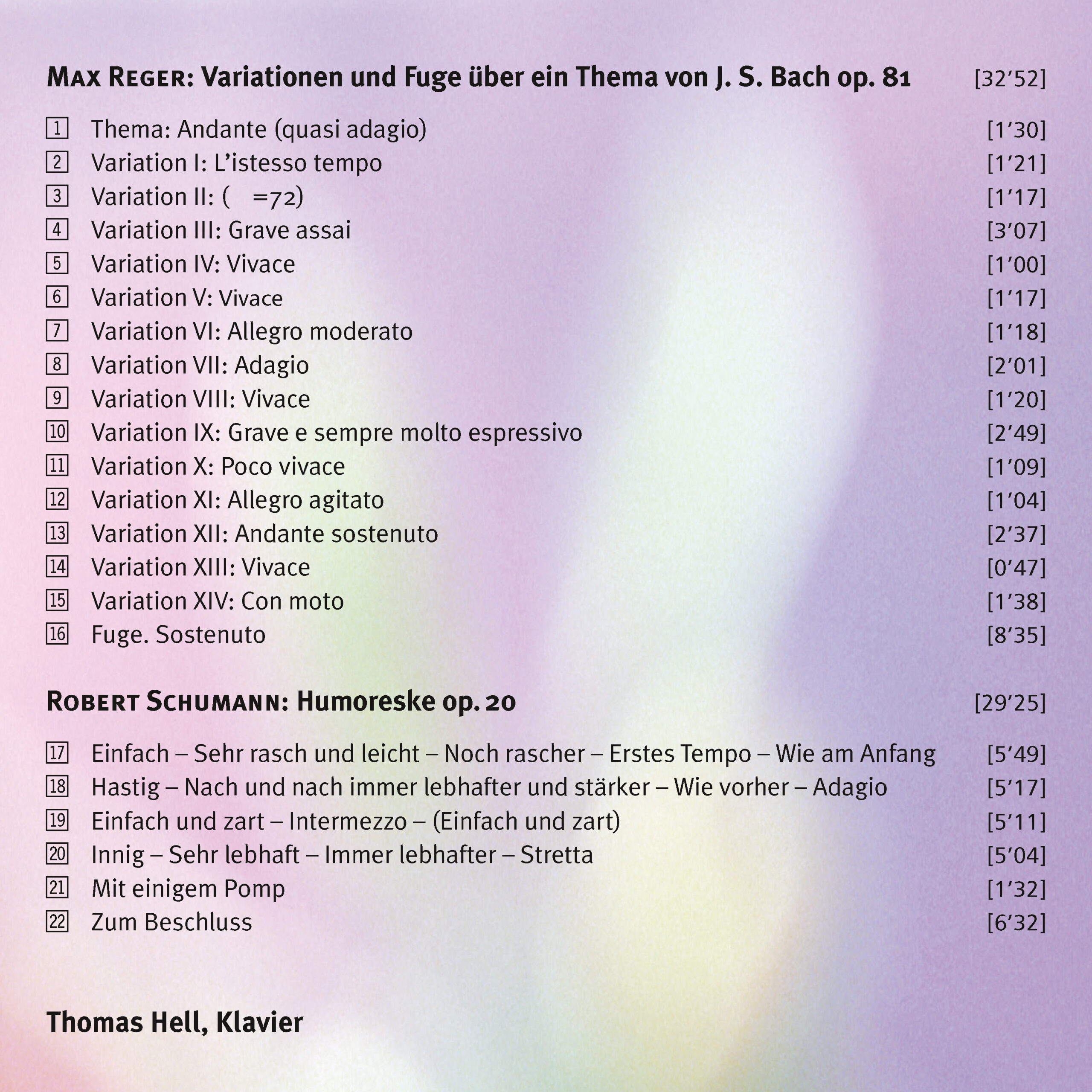
Schumann: Humoreske op. 20
Max Reger: Bach-Variationen op. 81
Thomas Hell, Klavier
EAN/barcode: 4009850102403
Description
"This Schumann/Reger CD by pianist Thomas Hell might seem unspectacular from the outside, but appearances are deceptive. What is very unusual is the fact that Thomas Hell, who was born in 1970, has made his CD debut with two not exactly common, but extremely difficult monumental works of the German Romantic and late Romantic periods, which indicates that here we do not have a show-off but a true piano artist. When you listen to the CD this assumption is confirmed overwhelmingly. [...] So one may well ask why Thomas Hell, who according to the booklet has won the Prix Blanche Seiva and the Prix SACEM Nadia Boulanger, has still not made it to the top ranks of the young German pianists. And besides: when are we going to see his next CD?" (piano)
3 reviews for e24 CD / Robert Schumann, Max Reger: Klavierwerke
You must be logged in to post a review.

Fono Forum –
Exegetical talent: Thomas Hell (b. 1970) here confronts a program that—especially in Reger—is truly packed with physical and intellectual athletic demands. The partly quirky diction of Schumann’s not entirely purely humorous Humoreske calls for imagination in shaping all its shifts of mood. In Schumann’s work, Hell at times captures both audacity and melancholy in a captivating way and finds an authentic Schumann style. At the same time, in Reger he displays exegetical gifts that stand up impressively to these complex challenges as well. His range of expression is enormous; perhaps only now and then he might need to become a little more hardened.
FRA
Klassik heute –
What good fortune for a young pianist to be able to present a CD right away with the sonic differentiation and balance of a Tacet production (this EigenArt recording was produced by Andreas Spreer). Thomas Hell (b. 1970) seizes the opportunity to showcase his high level of musicianship and his pronounced sense of sound. In his Op. 81, Reger worked with a very intimate Bach theme. Thomas Hell succeeds in translating the extraordinarily finely woven, often orchestrally conceived web of Reger’s texture into vivid sound. Moreover, he manages to sustain the long span of more than half an hour in terms of tension: not with bravura display, but in a manner appropriate to the respective texture, also allowing himself (Variation 8) the necessary calm; some compromises in terms of powerful presence are to be made where Hell has to organize massive blocks of chords. He also finds an approach to the very subtle wit (and rhythmic intricacies) of Schumann’s Humoreske that is refreshingly varied and, above all, musically coherent, ranging from disarmingly simple to exuberantly cheeky. A promising debut CD.
Kalle Burmester
Piano News –
This Schumann/Reger CD by pianist Thomas Hell may appear rather unspectacular at first glance, but appearances are deceptive. It is already quite unusual that Hell, born in 1970, should make his CD debut with two far from standard, yet extremely demanding monumental works of German Romanticism and Late Romanticism—a choice that may be read as an indication that we are dealing not with a show-off, but with a genuine piano artist. This is confirmed in an overwhelming way upon listening. In Schumann’s Humoreske, what is particularly impressive is the lucid penetration of the partly bizarre, partly rapturous, partly folk-like characters, whose loose juxtaposition seems to be aufgehoben in a higher poetic unity. Only someone who has truly grasped what is at stake can achieve this. At most, one might reproach Hell for withholding the last ounce of “madness” that may be necessary to penetrate to the innermost secrets of Schumann’s musical poetry. In Reger’s Bach Variations, by contrast, nothing at all is lacking. With a wonderfully sounding Steinway D at his disposal and excellent recording technology to match, Hell sings out Reger’s cantilenas with a glowing, warm tone and breathing phrasing, endows the massive chordal blocks with organ-like fullness, makes thematic progressions clear even in the densest thickets, and leaves nothing to be desired even from a purely technical point of view. In short: here a pianist offers a reading of Reger’s colossal set of variations that is worked out to the last detail, highly cohesive and organic, and one that can hold its own even alongside the interpretations of Becker and Hamelin. One naturally wonders, then, why Thomas Hell—who, according to the booklet, has already won the Prix Blanche Seiva and the Prix SACEM Nadia Boulanger—has not long since been counted among the front rank of the younger generation of German pianists. And furthermore: when will the next CD appear?
Robert Nemecek