
e50 CD / The Sound of Double Bass
Description
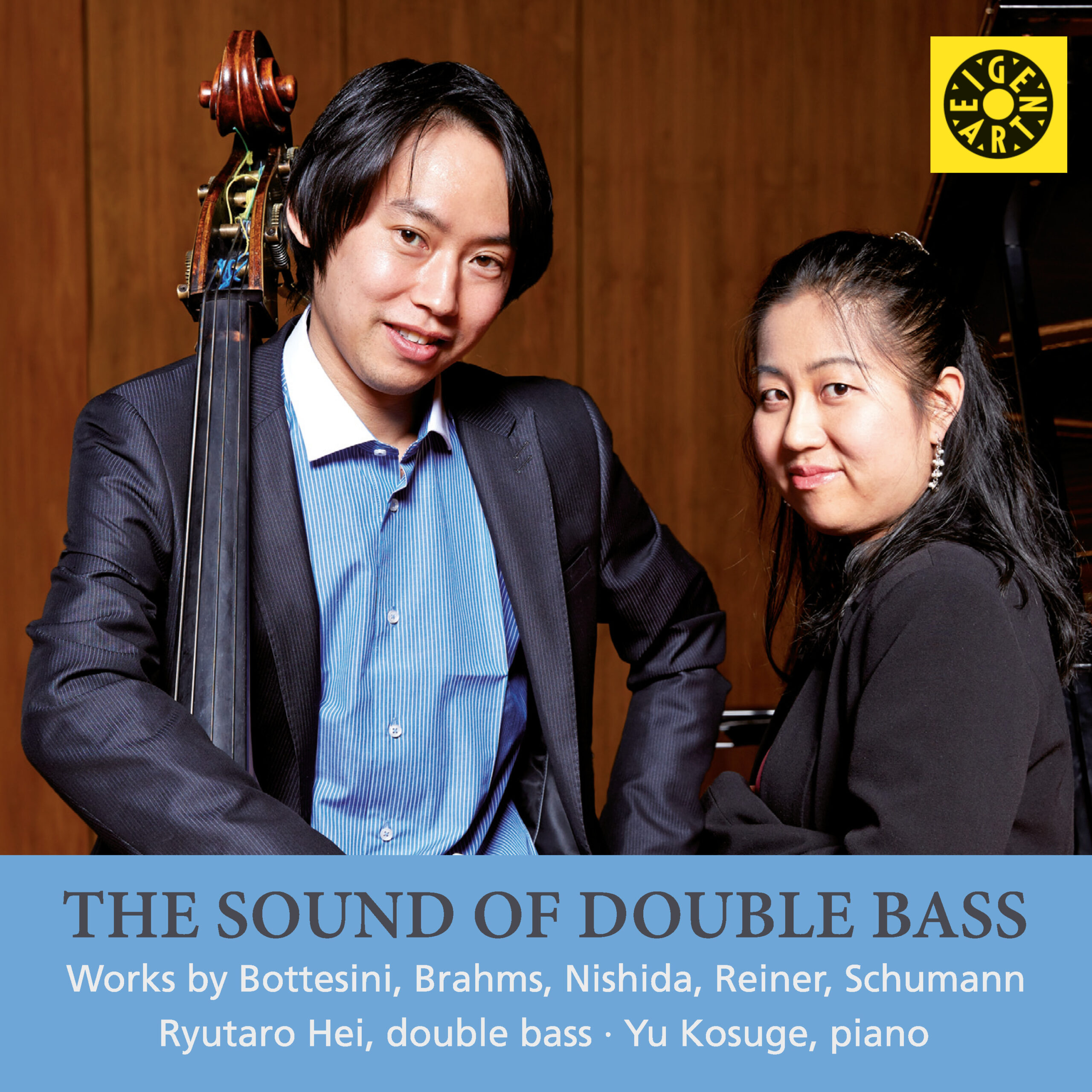
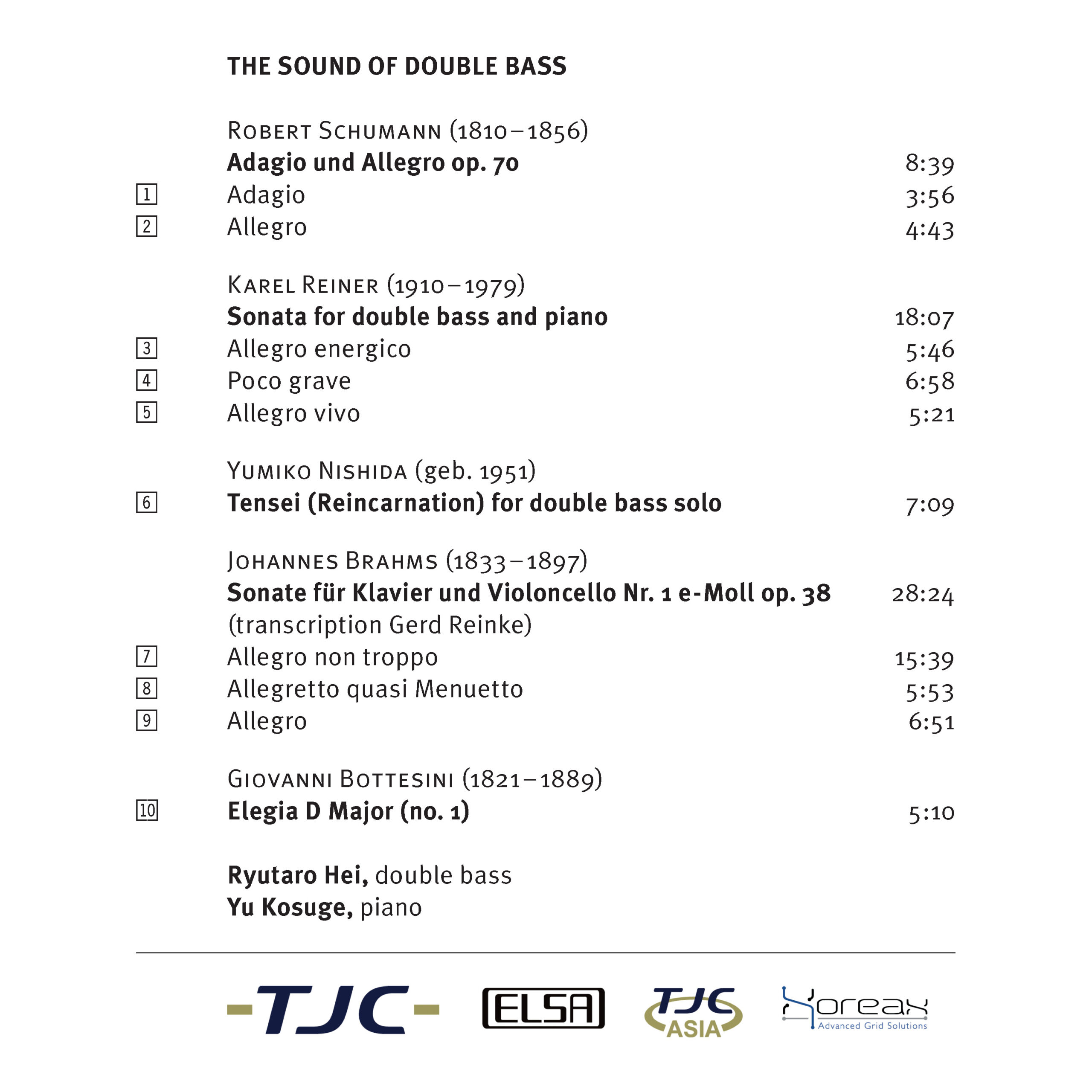
Managing to convey the Adagio and Allegro op. 70 by Robert Schumann clearly on the double bass with piano makes huge demands on the interpreter. Capturing the wit and rhythmic charm, but also the plaintiveness without lamentation in the Double Bass Sonata by Karel Reiner is a challenge on this weighty instrument, which even for the smallest sound requires the greatest physical effort. The same applies to the solo piece "Reincarnation" by Yumiko Nishida. After all, this premiere recording of a rebirth shouldn't be a tough or cumbersome event! The Brahms sonata on the other hand, which everyone has in their head in the original version for cello, mustn't create the impression that something is lost in the transfer from the cello to the double bass. Instead, it needs to add something new to the appeal of an old friend. And that scourge Giovanni Bottesini, who ultimately strikes fear and dread into the heart of every bass player: or almost every bass player. Ryutaro Hei masters every task with bravura, not least thanks to his congenial partner at the piano, Yu Kosuge. A very successful debut on the EigenArt label.
2 reviews for e50 CD / The Sound of Double Bass
You must be logged in to post a review.

Audio –
The "orchestral elephant," as the critic Hanslick once called the double bass, is not generally considered a solo instrument, but merely the foundation of the orchestra. Yet Ryutaro Hei proves that the instrument has many more facets: it can be sonorous, as in Schumann’s Adagio and Allegro; expressive, as in Brahms’ first cello sonata; rhythmic, as in Reiner’s sonata; illustrative, as in Nishida’s Tensei; or virtuosic, as in Bottesini’s Elegy. Pianist Yu Kosuge supports Hei with precision and playful spirit. The exciting dialogue between the two musicians is captured by the recording with remarkable naturalness. A convincing advocacy for the deepest of all string instruments.
Andreas Fritz
Klassik heute –
--> original review
Admittedly, the double bass is hardly the most glamorous solo instrument. It still carries a certain label as an exotic, suitable only as a bass instrument and seemingly not much else. This is especially true given that, after the violas, bassists are probably the orchestral section most often the butt of jokes. That such prejudices are misplaced is impressively proven by this CD. Original literature for the double bass as a solo instrument is naturally limited, but musicians have never let that stop them from performing every conceivable work on their instrument. And so Ryutaro Hei, as the soloist on this recording, has turned to arrangements: Johannes Brahms’ E minor Sonata, Op. 38, originally written for solo cello, for example.
What is already no small feat on the cello becomes a serious challenge on the double bass. Hei must rasp and swirl quite a bit to master the significant technical demands, especially in the outer movements. Technically, he does so with remarkable virtuosity, beyond any doubt. Still, for tonal reasons, the result may be a matter of taste, as the double bass’s timbre is considerably darker and its tone somewhat heavier than that of the cello. Such pieces are likely of greatest interest to connoisseurs, enthusiasts, and bassists; the cello version will remain the musically more rewarding option. Schumann’s Adagio and Allegro, Op. 70, is another arrangement that impressively showcases both the tonal and technical possibilities of the double bass.
More exciting on this CD, however, are the original works for this instrumentation, such as Giovanni Bottesini’s D major Elegy, seemingly tailor-made for the double bass, which fully exploits the instrument’s tonal and sonic range. Bottesini was not without reason one of the most celebrated bassists of his generation. A solo work by Yumiko Nishida also demonstrates more than convincingly the musical potential of this often-underestimated instrument. A true showcase piece for any soloist is the Sonata by Karel Reiner, a work strongly shaped by motoric and rhythmic passages. Here, Hei delivers a masterful performance, technically brilliant and musically absolutely gripping. There is little left of the oft-cited clumsiness of the instrument. Hei is accompanied on this CD by pianist Yu Kosuge, who, though figuratively playing “second fiddle,” does so with such reliability, musical integrity, and technical brilliance that her performance lingers memorably. A rewarding CD, not only for enthusiasts of the unusual or specialist listeners.
Guido Krawinkel