
e39 CD / Theresienstädter Konzert
Description
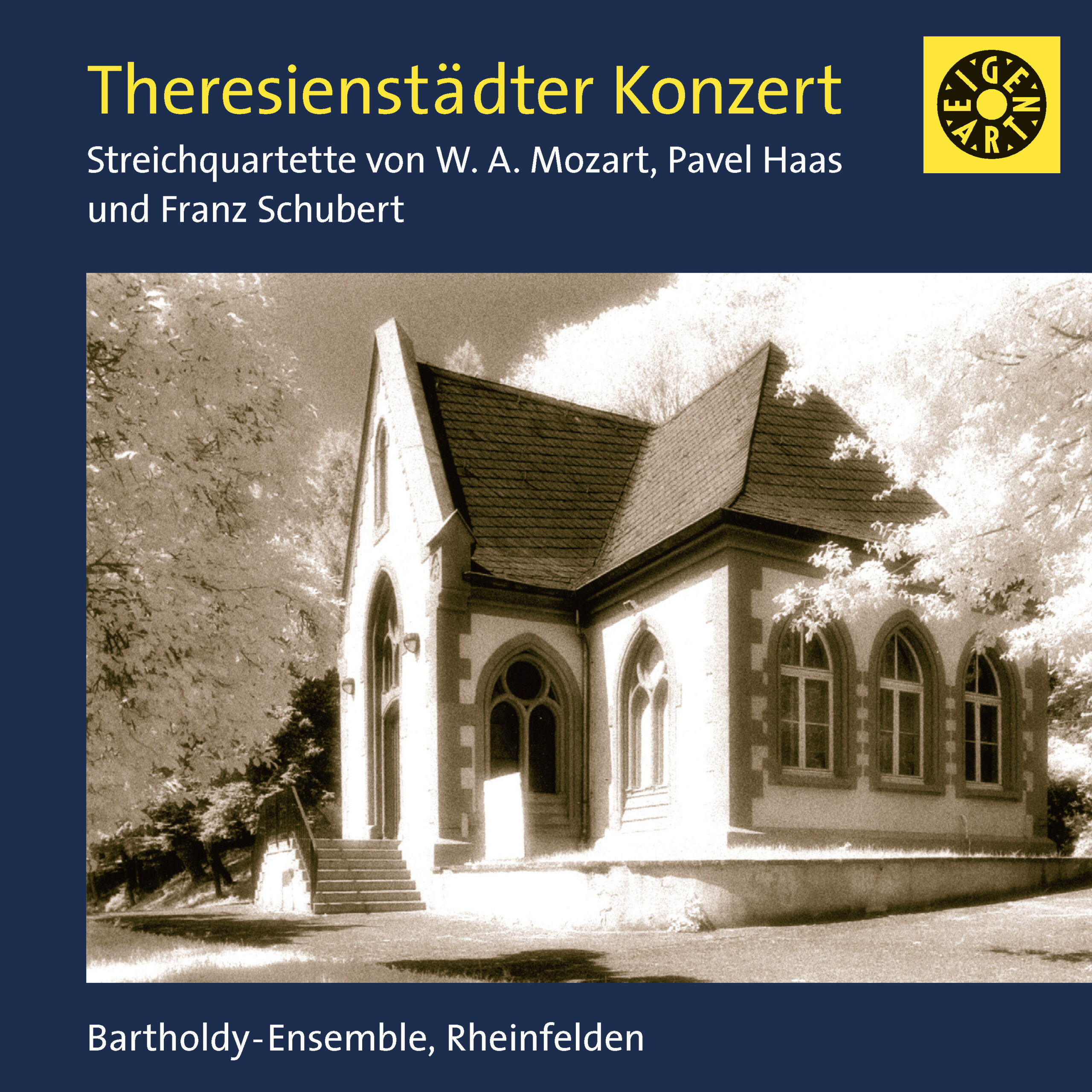
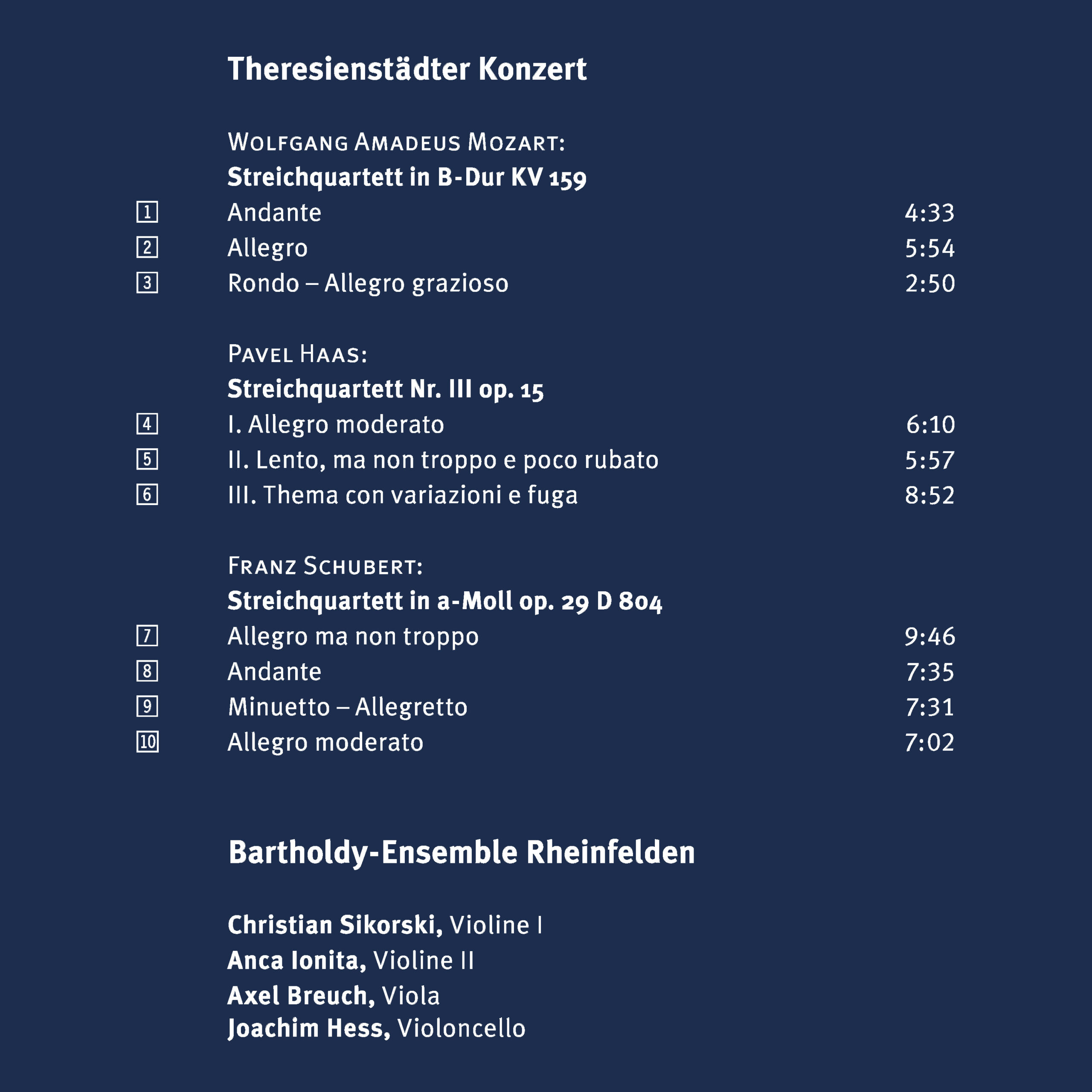
Since November 1999, the “Terezin Concerts” have been held on the morning of the last Sunday before Advent (Totensonntag, dedicated to the memory of the dead) in the “Haus am Münchberg” in Merzig, Saarland. The members of the Bartholdy Ensemble perform works by composers who were persecuted and blacklisted by the National Socialists; the hosts of this event are the Gustav Regler Centre and the Saarland Democracy Foundation. In between two Classical and Romantic masterworks, the four musicians resurrect works by composers who, undeservedly, have still not been adopted as standard concert repertoire. This CD documents one of these concerts. The centre of attention is the impressive Third String Quartet by the Czech composer Pavel Haas. On either side of it there are an early Mozart quartet (K 159) and the famous Rosamunde Quartet D 804 op. 29 by Franz Schubert.
2 reviews for e39 CD / Theresienstädter Konzert
You must be logged in to post a review.
Pizzicato –
Since 1999, the “Theresienstadt Concerts” have been held in Merzig. At the invitation of the Gustav Regler Center, in collaboration with the Stiftung Demokratie Saarland, members of the Bartholdy Ensemble perform not only masterpieces of the Classical and Romantic repertoire but also works by composers persecuted by the Nazis, whose compositions were banned. This CD documents one of these concerts.
The program opens with Mozart’s B-flat major Quartet KV 159, captured in an accurate, very treble-focused recording. A bit more warmth in the sound would have been welcome. However, in the darkly nervous Third String Quartet by the Czech composer Pavel Haas, this technique is advantageous, as it allows the music to emerge with remarkable clarity—enhanced, of course, by the subtle tonal differentiation among the four players. The highly intense interpretation makes this performance an unforgettable experience. The first movement unfolds with rhythmic precision, the Lento conveys a prayer-like Jewish melody with eloquence, and the concluding set of variations is imbued with maximum expressivity by the musicians.
RéF
Badische Zeitung –
On the occasion of its 25th anniversary, the Bartholdy Ensemble Rheinfelden presents a new CD. The recording was made in November 2007 in Merzig, where members of the ensemble perform, as part of the “Theresienstadt Concerts” series, works by composers who were persecuted and banned under the Nazi regime. One of these composers is the Czech Pavel Haas, who was deported to the Theresienstadt concentration camp and died in Auschwitz in 1944. His Third String Quartet, Op. 15, composed in 1937/38, is permeated with folkloric and jazz-like elements, a powerful work that already hints at the impending threat. The musicians, led by primarius Christian Sikorski, realize Haas’s profound musical language and its polymetric structures in a clear, well-illuminated interpretation. Played with deep commitment, rhythmically accentuated, and tonally differentiated, they capture the music’s atmosphere—balancing density and dissolution, elegiac melancholy, and the rigorously intensified fugue of the final movement. Haas’s central work is framed by two masterpieces of the classical-romantic repertoire: Mozart’s B-flat Quartet KV 159 and Schubert’s “Rosamunde” Quartet. A trilingual booklet additionally provides informative notes on the works.
ros