

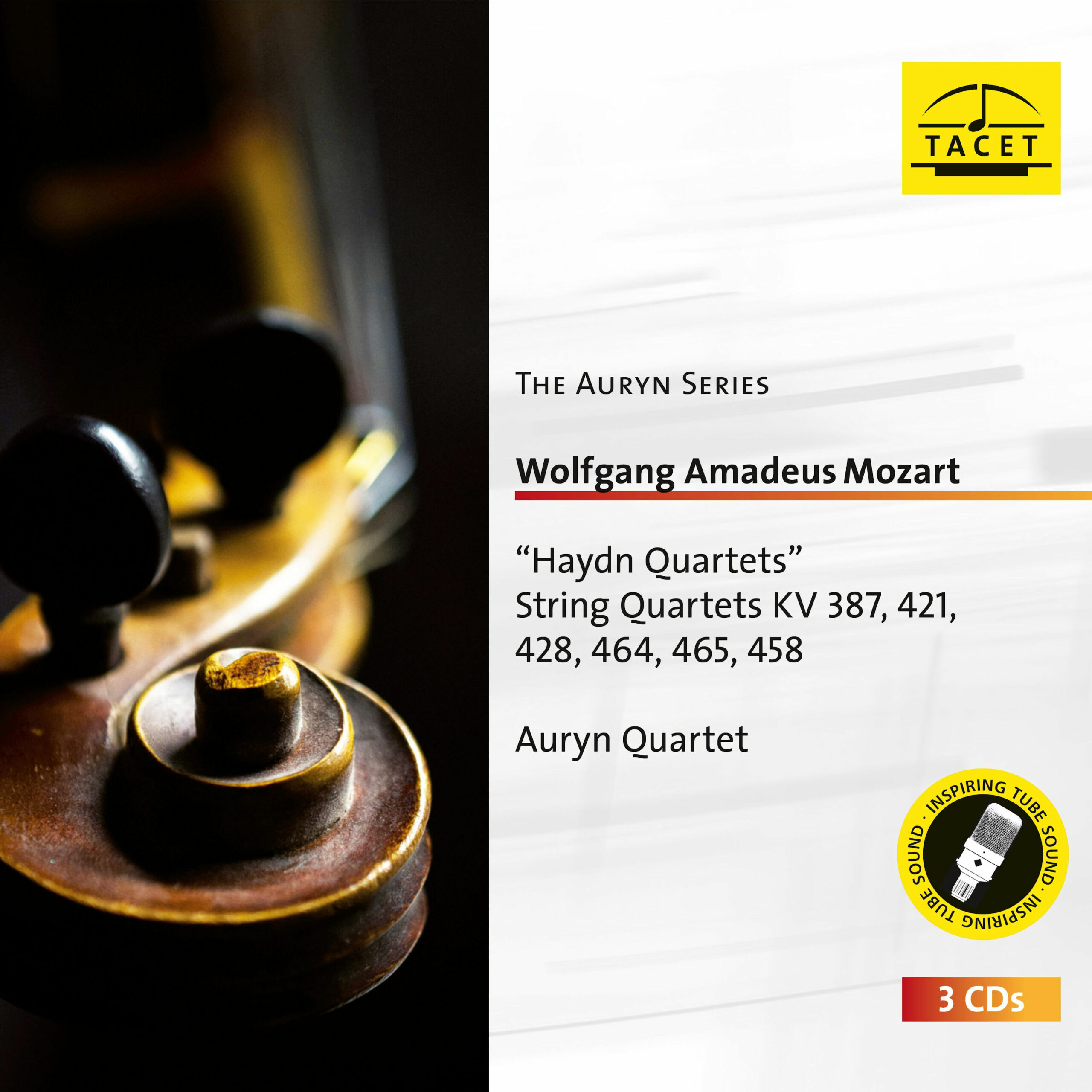
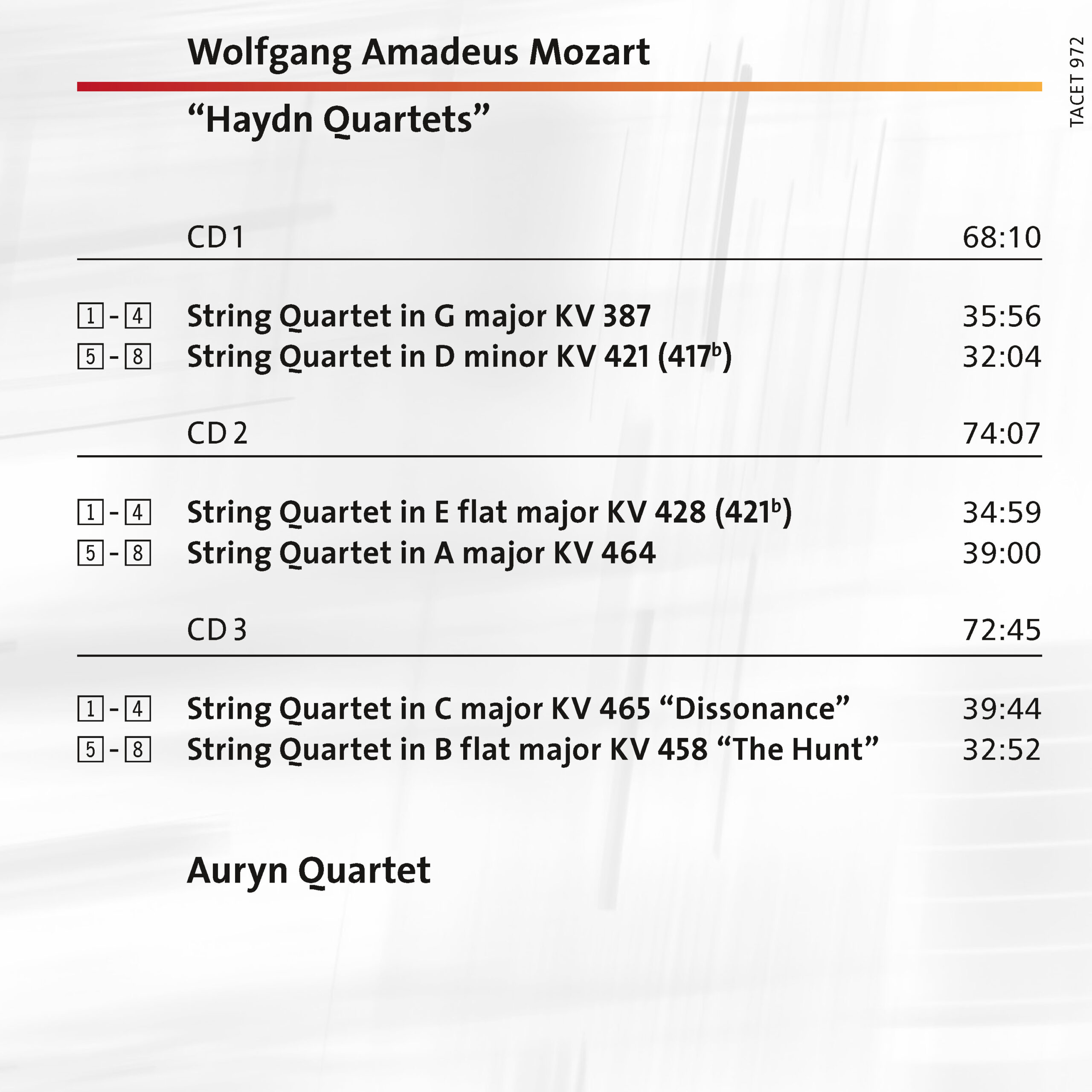
972 CD / Wolfgang Amadeus Mozart: „Haydn Quartets“


Description
String quartets by Wolfgang Amadeus Mozart without historical performance practice - is that even possible nowadays? -Of course it is! At the same time, there is probably no serious classical musician who has entirely escaped its influence in some shape or form. We are not just talking about diligence in choosing "urtext editions" or in the choice of instrument. The changes creep into the smallest details of phrasing which people simply can't do as they used to, even subconsciously. This is borne out by listening to many performances.
Of course the Auryn Quartet is also subject to these influences. If, despite this, their performances seem conventional, then it's deceptive as their playing style is no longer conventional when seen in the light of modern performance practice. They refer back to a playing style that could be termed "historical" in a wholly different way, namely that of a musical generation that has now died out. Their role models and teachers were the Amadeus Quartet and the Guarnieri Quartet. The members of the Auryn Quartet were musically "socialised" in a different era to younger musicians and they choose not to discard the aesthetic sensibilities acquired in their youth as though they were just old-fashioned garments. They love the beautiful "old" string sound and keep this tradition alive, but with the diligence expected of today's musicians. The result is timelessly beautiful music. The new recording of the 6 "Haydn Quartets" by Wolfgang Amadeus Mozart provides an impressive example of this.
6 reviews for 972 CD / Wolfgang Amadeus Mozart: „Haydn Quartets“
You must be logged in to post a review.


image hifi –
(…) The Auryn Quartet plays them [the six quartets] with a homogeneity that is nonetheless differentiated, unfolding a sound of silk and gold. This may be attributable to the exquisite instruments by Stradivari, Guarneri, and Amati, but more likely still to the fact that in a few years’ time the Auryns will be celebrating their fortieth anniversary in the same line-up. Old-fashioned? No, not at all. Yet one may say—without thereby dismissing the efforts of younger ensembles to produce more sharply contoured “statements”—that this ensemble continues to cultivate and preserve that precious quartet style in which the music is allowed to unfold unforced and naturally.
Man keine Zeit kaum schöner verbringen, als dem Auryn Quartett beim Mozartspiel zuzuhören und sich so in Gefühl und Verstand sanft anregen zu lassen.
Heinz Gelking
CD Hotlist –
(...) Most libraries are likely to own recordings of these monumental pieces already, but the account here by the Auryn Quartet is outstanding and would make a worthy addition to any collection.
Rick Anderson
Audio –
(…) Its ensemble playing [that of the Auryn Quartet] is distinguished by great precision, sensitivity, and differentiation; the interpretation does justice to both the lightness and the dramatic force of the works. Added to this, the production scores with a clear, warm sonic image. The finest musical delicacies.
(…) Magisch!
Andreas Fritz
Literaturspiegel –
(…) It is a good thing that the Auryn Quartet has never forgotten Enlightenment humanity. With the experience of an incredible 37 years of playing together, the four gentlemen demonstrate a wise sense of nuance that makes all superficiality fade away and turns their new box set into an iron ration of sound.
Johannes Saltzwedel
Klassik heute –
--> original review
Almost two years have now passed since I first had before me the Auryn Quartet’s initial three-disc set devoted to Mozart—a truly select production of all the string quintets, released by the four gentlemen of the quartet in collaboration with violist Nobuko Imai on their quasi-exclusive label Tacet. At the time, and still today, this release [Klassik-Heute 21898] struck me as a model of a recording successful in every respect, and as an excellent demonstration of what “the true and highest aim of performance should be: quite independently of the means employed, whether historical, historically informed, or modern—not merely to (re)produce beautiful, pure sounds by virtue of impeccable technique and acoustics from the signs that were once written down and fixed by a creative spirit as an expression of himself, but above all to extract from those numbers and figures the very essence of their maker in such a way that this creator once again enters into living contact with us—whether a few years or decades, or entire centuries, now lie between us and his ‘passing.’”
Nothing more and nothing less is what I have to say about the recording of the so-called “Haydn Quartets,” made in 2017. In their handling of these six “fruits of a long and arduous labor,” the Auryns likewise display such naturalness that already in the first movement of the frequently played G-major quartet one senses the course that will be set over the next three and a half hours of pure music: nothing forced, nothing overheated, no superficially effective foolishness or coquettishness appears in these dense, ingenious interweavings of voices; nowhere do I have the impression that I am to be instructed about the composer’s “true character,” about his rebelliousness or even about the proverbial “kick in the backside” with which, a few years before the creation of this half-dozen chamber-music masterpieces, the princely-archiepiscopal employment relationship was permanently and painfully terminated. And yet everything is present: the underlying tensions, the recalcitrance of the minuets, the occasional wild upheaval (“Dissonances”), the arioso dreams of beauty that are consistently moving—yes, even the labor itself, the deliberation, a “wrestling with the material” remarkable by Mozart’s standards … all of this unfolds without exaggeration, requires no race against the clock, and is generated, as it were, so entirely from within itself that the performers can even afford the luxury of observing all the repeats. In other words: the second halves of the sonata-form movements—the developments and recapitulations—are heard twice as well; and anyone who might think this is too much of a good thing may be assured that the author of this eulogy listened to the entire package twice solely for the purpose of this review, and certainly not for the last time. To single out individual details for special emphasis—the glorious bell-like tones of the cello, for instance, in the opening movement of K. 421; the events that arise from a dotted standard figure; the pallid light that falls on the thematic tritone in the second bar of K. 428; the tiny windows through which, in the first Allegro of K. 464, one can glimpse the world of Gustav Mahler as through a camera obscura—these few underlinings alone might already make the whole appear less than perfectly rounded. But such completeness may safely be claimed here. Or, put more objectively: this release is a very serious proposition, because it does not “want” to be something—it simply “is.”
Rasmus van Rijn
Mozart! Die Seiten der deutschen Mozart-Gesellschaft –
Mozart’s six Haydn Quartets, named after their dedicatee, were composed between 1782 and 1785 in response to Haydn’s epoch-making Opus 33. Haydn’s radical innovations—the independence of all voices and the redefinition of formal structures—are taken up by Mozart and heightened, yet they also point even further into the future. Thus the closing fugue of K. 387 may already be regarded as a model for the finale of the “Jupiter” Symphony; certain tone repetitions or shifts into the minor almost anticipate the late Schubert, quite apart from the music-historical significance of the “Dissonance” Quartet K. 465: the entire cycle represents a summit not only within Mozart’s chamber-music output. The Auryn Quartet, playing in an unchanged line-up for more than 35 years, is convincing here in every respect. Perfect in intonation and ensemble, the many—and sometimes unusual—details of the scores (such as extremely rapid dynamic changes) are made audible not only with beguiling sonic beauty, but are always psychologically illuminated as well. Structural coherence and Mozart’s astonishing emotional multidimensionality emerge with a clarity that must seize the listener immediately. Because all repeats are observed, Mozart’s elevation of the coda in the opening movements becomes evident. This recording unquestionably possesses reference quality.
Martin Blaumeiser