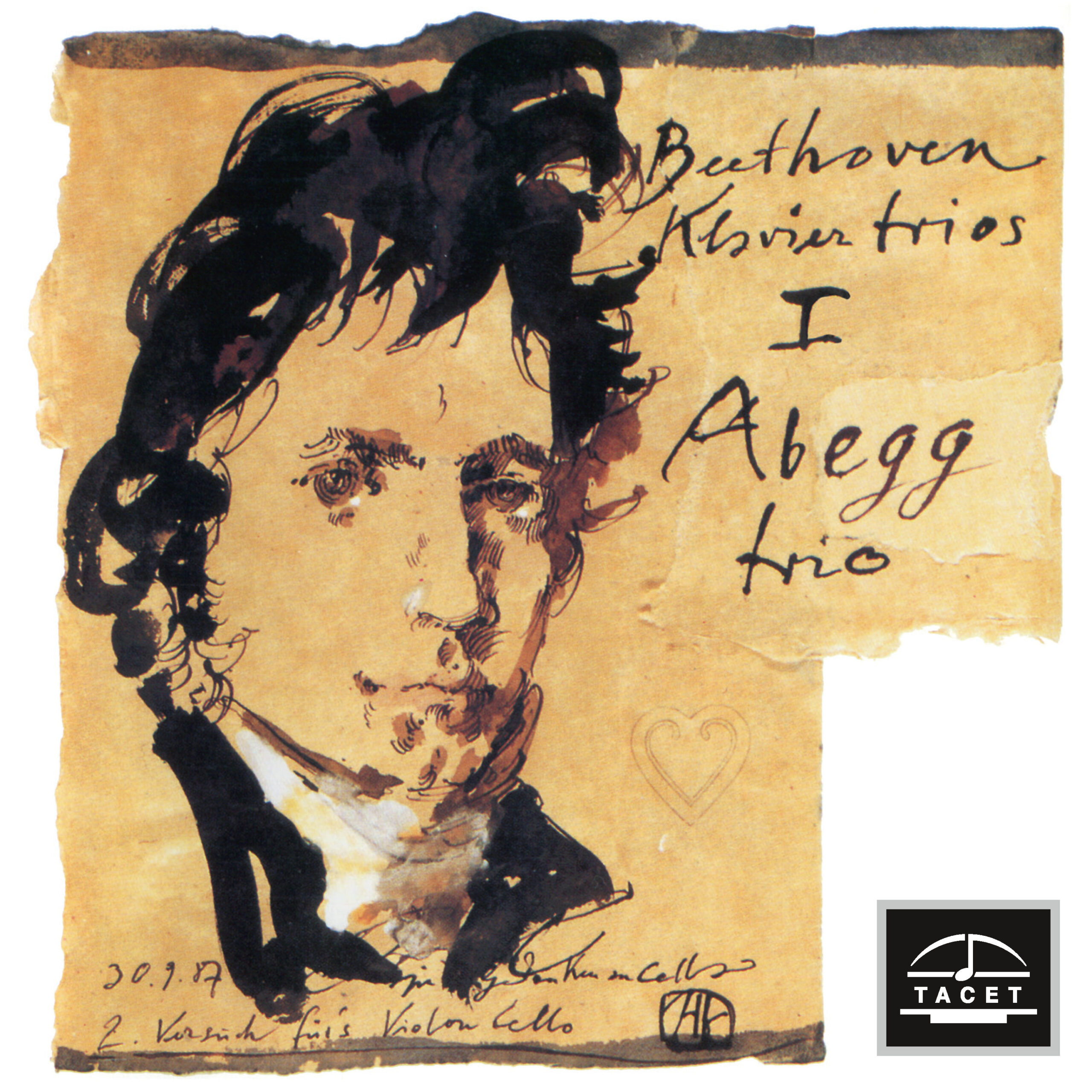
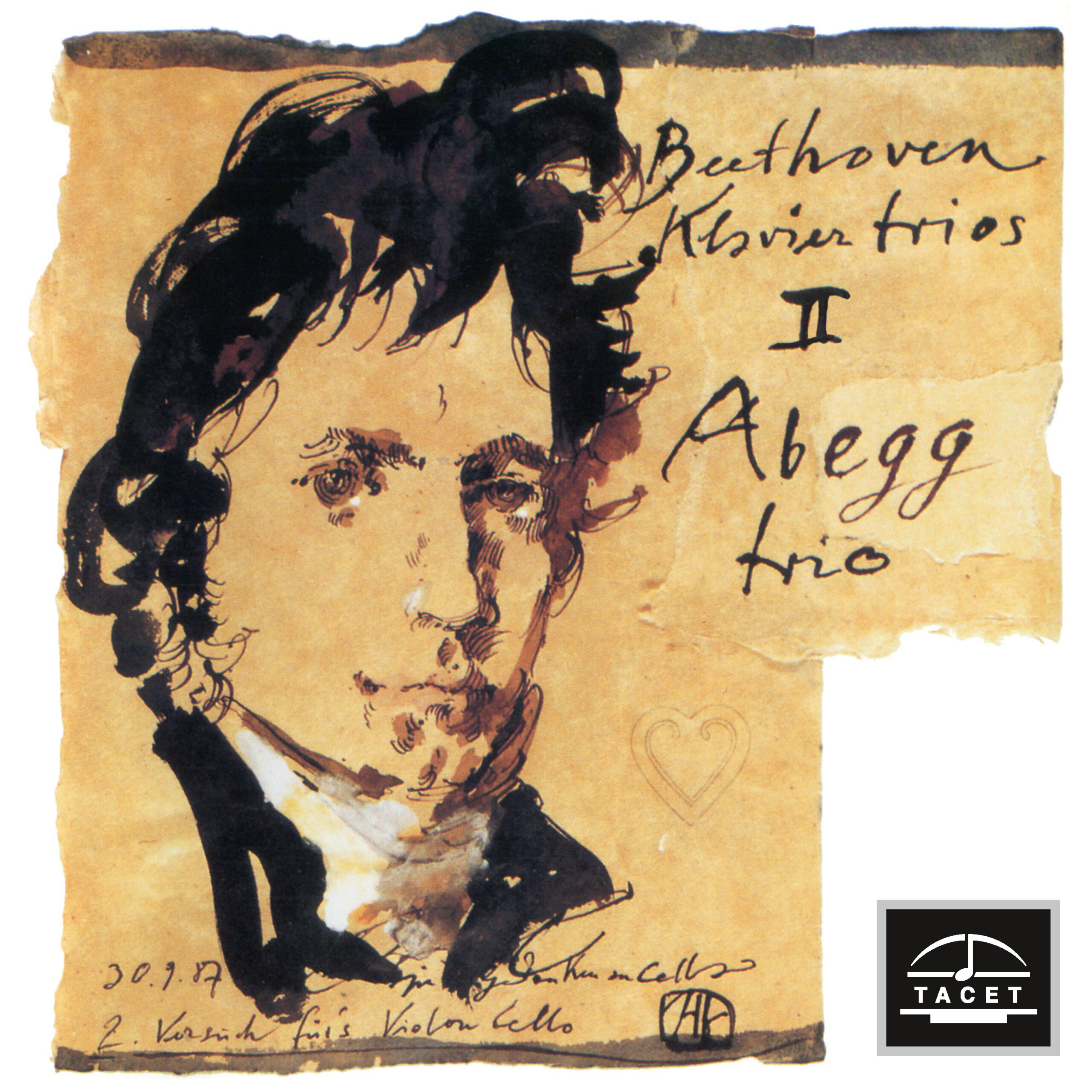
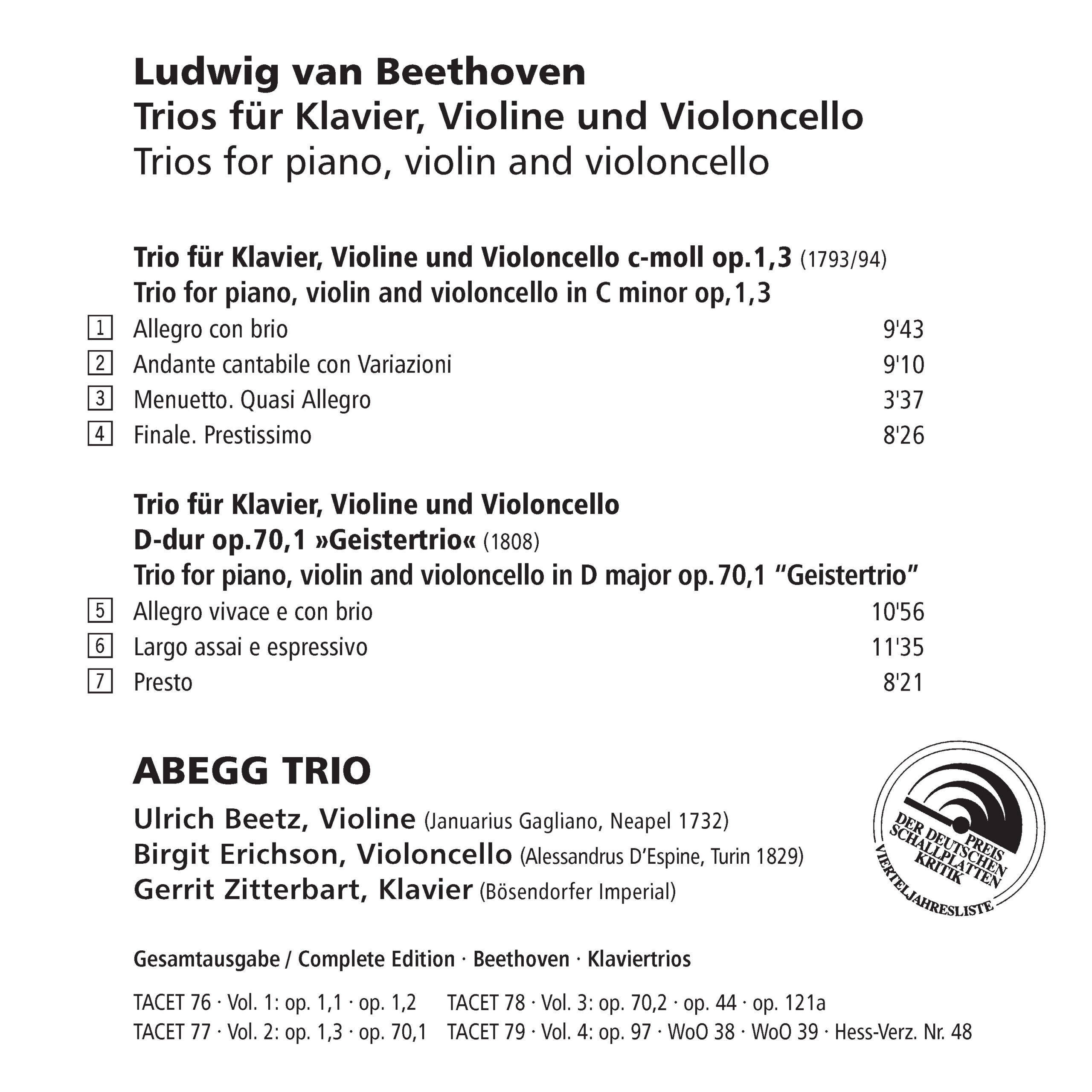
077 CD / Beethoven. Piano Trios Vol. II
Abegg Trio Series Vol. V
Beethoven
Piano Trios Vol. II
Piano Trio in C minor op. 1,3
Piano Trio in D major op. 70,1 „Geistertrio“
Abegg Trio
EAN/barcode: 4009850007708


Description
"Beethoven viewed the three piano trios as his first complete work; you can hear one of them here - in combination with the "Ghost Trio", whose ghostly middle movement was the reason for the title. The [...] Abegg Trio probably offers the most united performance of all the Beethoven Trios on four single CDs. It is powerful, vital playing, yet which always stays controlled, precise and melodious, that makes the performances so attractive. The ensemble sound is very homogeneous and the balance of the instruments outstanding. The commentaries in the booklet are also excellent." (CD-Führer Klassik)
5 reviews for 077 CD / Beethoven. Piano Trios Vol. II
You must be logged in to post a review.
Classics Today –
Reference Recording - "This one"
Beethoven′s E-flat major Piano Trio op. 70 No. 2 is undervalued compared to its immediate predecessor (the popular D major "Ghost" Trio op. 70 No. 1), yet ist four substantial movements are no less potent and expressive. The Abegg Trio mightily impresses with its magically honed, rollicking ensemble work and rhythmic zing...
Jed Distler
CD-Führer Klassik –
Beethoven considered his first fully mature work to be the three piano trios, one of which is featured here—paired with the "Ghost" Trio, whose eerie middle movement inspired its name. The internationally underrated Abegg Trio has delivered what may be the most cohesive complete recording of all Beethoven trios, available on four individually obtainable CDs. Their interpretations are marked by powerful, vital playing that remains controlled, precise, and beautifully toned. The ensemble's sound is remarkably homogeneous, and the instrumental balance is excellent. The accompanying booklet's commentary is also exemplary.
Stereoplay –
Extremely precise, homogeneous, yet powerful and highly virtuosic playing, which aligns more closely with Beethoven the bold visionary than with Beethoven the sensitive melodist (a side the Suk Trio, for instance, embraces more intensely). The sound balance between strings and Bösendorfer piano in Frankfurt’s Festeburgkirche is optimal. A touch more natural reverb would not have gone amiss.
Neue Musikzeitung –
Beethoven Tailor-Made
After endless debates about Beethoven’s original metronome markings—including the most absurd suggestions, such as halving the beat to make his supposedly excessive tempos more “playable”—it’s time to return to solid ground. The Abegg Trio does just that. Since Beethoven left no metronome markings for his piano trios, the ensemble turns to the most reliable witness: Carl Czerny (1791–1857). Czerny, as he himself wrote, “had enjoyed Beethoven’s piano instruction from a young age (beginning in 1801), studied all of his works as soon as they were published—many of them under the master’s direct guidance—and continued to benefit from Beethoven’s friendship and teachings until his final days.”
How fortunate that Czerny, in his 1842 treatise On the Proper Performance of All Beethoven’s Piano Works (Vienna), included not only the sonatas and concertos but also the chamber music for piano. Even more fortunate is that he didn’t stop at metronome markings but provided detailed descriptions of Beethoven’s compositional style and the manner in which his works should be interpreted. This is something we can—and should—follow. What remains puzzling is not just why this approach is so rarely put into practice, but why the entrenched habits of the concert hall seem to carry more weight than the clear, documented instructions of a Beethoven pupil. Could it be that the much-praised pursuit of historical authenticity has a blind spot here of all places? The Abegg Trio, founded in 1976 at the Hanover University of Music and Drama and now justifiably renowned internationally, doesn’t concern itself with the grumbling of chamber music enthusiasts wedded to tradition. Instead, it boldly puts Czerny’s well-founded guidance to the test.
Of course, this requires a certain level of skill. The freshness and vigorous momentum of the faster movements, played more swiftly and lively than usual, demand technical mastery, instrumental control, quick reflexes, and a cohesive yet relaxed ensemble dynamic. But when these conditions are met—as they are with the Abegg Trio—the rewards are immense. The first three trios, Opus 1 by a composer in his early twenties (with Czerny, as the facsimile in the booklet shows, already emphasizing the “more serious and grand character” of the third trio in C minor), benefit greatly from this departure from the stolid, bourgeois Beethoven conventions. Comparisons with recordings by even the most esteemed, concert-seasoned piano trios can be highly instructive. It’s not just the fluid tempos (which a few others occasionally achieve) but the gestural precision, the refusal to sacrifice attack, dynamic contour, or expressive presence that makes the difference: agility paired with refined phrasing, speed combined with intensity. And there’s something else remarkable: The Abegg Trio achieves what is exceedingly rare—a timbral unification between strings and piano by consciously emulating each other’s articulatory qualities. In simpler terms, they shorten bow strokes during rapid figuration while vocalizing the piano’s touch in melodic lines. The secret to their primary impression of seamless unity and musical coherence lies in these technical consequences of truly listening to one another.
One might suspect that what works so well for Opus 1, performed by a relatively young ensemble fully committed to chamber music, could prove less adequate for Beethoven’s later works. But the first two CDs of this set—soon to be completed with two more for a full cycle—dispel that notion with their rendition of the “Ghost” Trio. Not only do the Abeggs, unlike most others, fearlessly play the first movement with all repeats (without losing tension), but they also unfold the titular Largo assai ed espressivo as a vast, vivid scene—full of imagery and color, suffused with breathlike calm and pent-up excitement, from which the final Presto emerges into pulsating reality. Perhaps it was for the best that the Abegg Trio’s early 1980s recordings of the first two trios (for Harmonia Mundi) were not continued at the time. Now, with the benefit of grown experience, they are undertaking the complete cycle anew.
Ulrich Dibelius
Ekkehart Kroher –
There’s no need to sing further praises of Beethoven’s piano trios—their abundance of originality and unmistakable character speaks for itself. Instead, we should talk about the Abegg Trio, which has embarked on the adventure of recording the complete cycle and, in doing so, faces—and rises to—the challenge of formidable competition. From the very beginning, it’s clear with what care, seriousness, tonal culture, and depth of feeling Gerrit Zitterbart (piano), Ulrich Beetz (violin), and Birgit Erichson (cello) approach their task. Of course, their experience performing these trios on stage plays a role, but it alone doesn’t explain the impressive result. The Op. 1 trios, with which the young genius once introduced himself in Vienna, are not overburdened but presented as the unorthodox, uncompromising chamber music they are.
The Abegg Trio’s performance is impeccably clean, thoughtfully accented, and charged with tension. What’s particularly striking is their contemplative quality, which provides a compelling counterpoint to the music’s brilliance and bravura. This is especially true of the “Ghost” Trio, whose slow movement becomes not just the centerpiece but the true highlight. The espressivo of this music, richly differentiated in tone color, breathes organically in its surges and subsidences, lending the interpretation a vitality and tension that is palpable in every sense.
The imagination and contrast in the outer movements further reveal how deeply the Abeggs connect with Beethoven’s music. If their subsequent interpretations maintain this level, we can look forward to a first-rate complete
Ekkehart Kroher