
e26 CD / Beethoven und seine Zeitgenossen. Streichquartette
Description
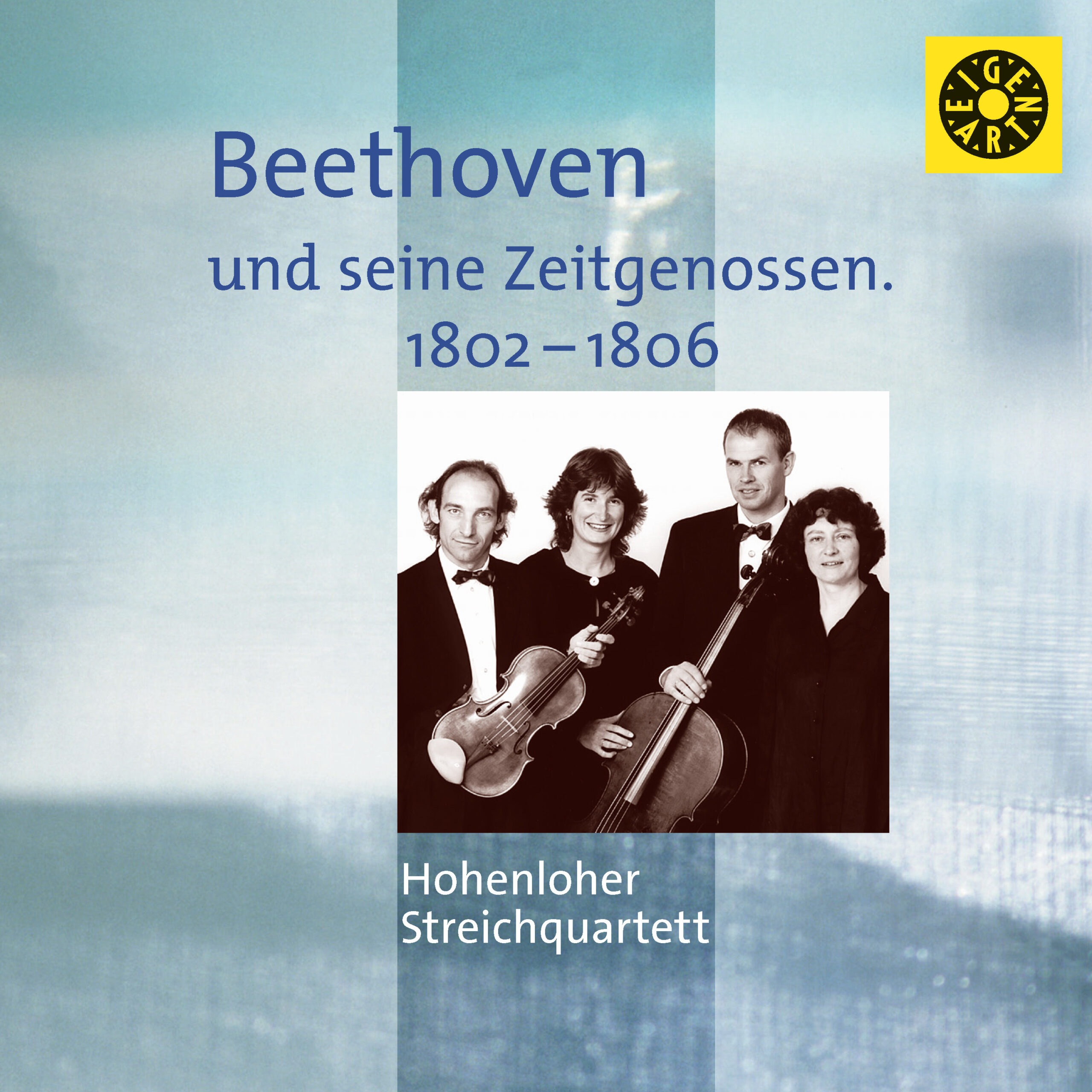
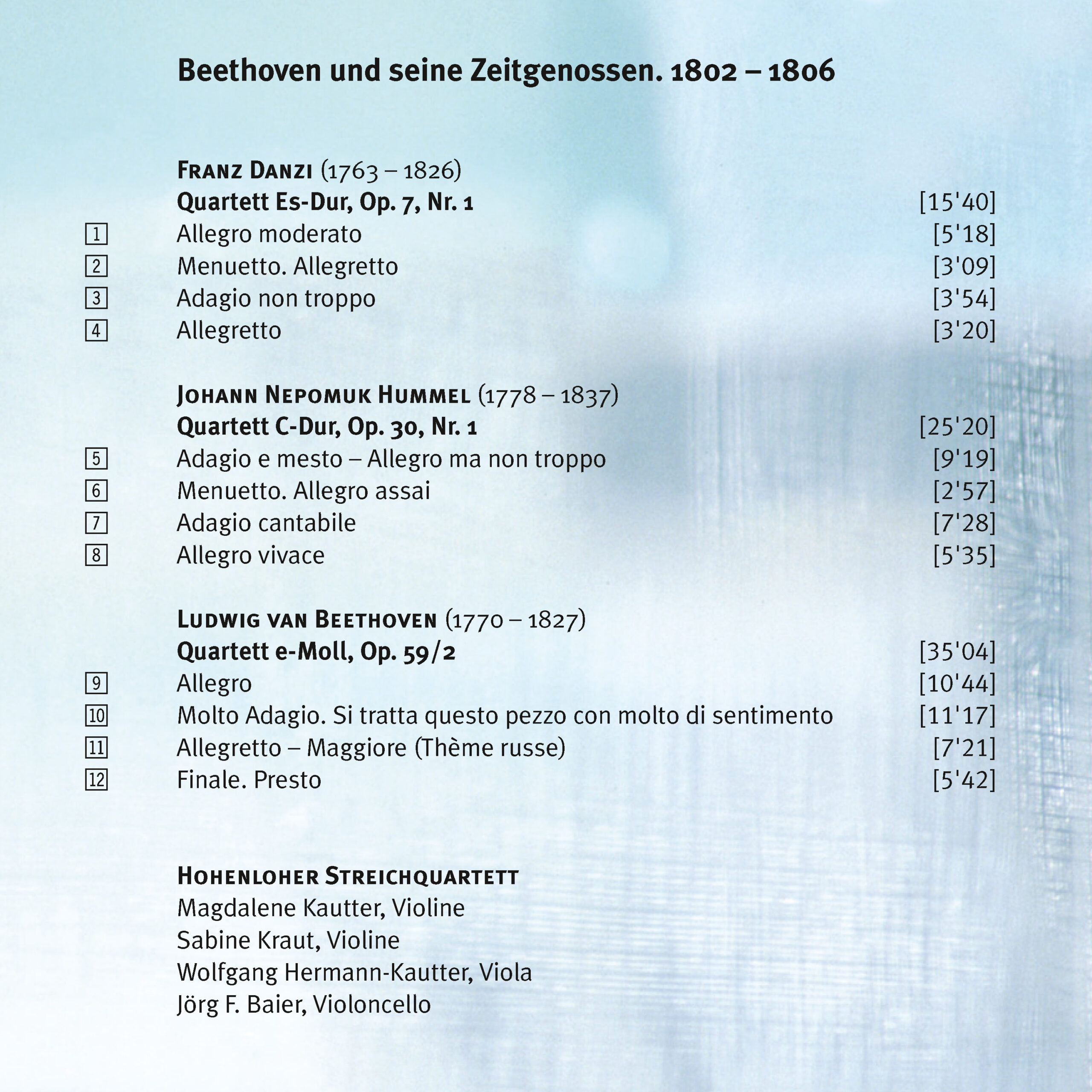
Friends of EigenArt will be familiar with the Hohenlohe String Quartet. A number of qualities of this ensemble are unusual: they risk a tightrope walk between "authentic" and "modern" styles. And they select programmes which at first glance are surprising, but are then convincing: as with this CD. All the works chosen here were written in the short period between 1802 and 1806. So this is a musical snapshot, so to speak, which of course has to include Beethoven.
3 reviews for e26 CD / Beethoven und seine Zeitgenossen. Streichquartette
You must be logged in to post a review.
Fono Forum –
How was one to compose in the shadow of the giant? This question, posed in the booklet text, might well be taken as the motto of the present CD production. It combines a work by Beethoven with two quartets by less renowned composers, written at roughly the same time, at the beginning of the nineteenth century. And it becomes clear that such plants grown in the shade are capable of producing splendid blossoms. Franz Danzi and Johann Nepomuk Hummel not only write with solid craftsmanship, but at times also arrive at a remarkably independent and bold musical language. Danzi does so above all in the slow movement, which for its time contains some daring harmonic progressions. Hummel’s C-major quartet, with its more orchestral, occasionally rugged gesture, shows a closer affinity to the massive sonority of Beethoven’s works, and in the movement entitled “Minuet,” with its very rapid tempo and displaced accents, the character of the presto scherzo is already clearly inscribed. Thus the intelligent program layout retraces the developmental course of the genre, which reaches an important turning point with the “Razumovsky” Quartets.
Yet even the most beautiful concept would remain sterile if it were not borne by such a convincing interpretative achievement as is the case here. The young ensemble, too, whose playing has been captured by Tonmeister Andreas Spreer with gripping directness and naturalness, proves able to hold its own in the shadow of the giants.
Marcus Stäbler
Klassik heute –
Instead of indulging in the fashion for complete recordings, this intelligently assembled production allows an exemplary work—Beethoven’s Second “Razumovsky” Quartet—to come into its own within its historical context. On the one hand, it demonstrates that in the shadow of the titan a wealth of works worthy of hearing was composed; on the other, it makes comprehensible how unusual and at times difficult to grasp Beethoven’s music must have seemed against this background at the time. Moreover, with the three compositions written within a span of four years, it conveys the program of a quartet evening such as might have taken place at the beginning of the nineteenth century. The Hohenlohe String Quartet devotes the same care to Danzi’s deeply felt melodic invention and to Hummel’s surprising turns as to Beethoven’s entirely personal world of expression. The violinists Magdalene Kautter and Sabine Kraut, together with Wolfgang Hermann-Kauter and Jörg F. Baier, avoid exaggeration and play with a subtle vitality that communicates itself immediately, even through the medium of the CD.
Peter T. Köster
Südwest-Presse –
Once again an example of the fact that, alongside the geniuses, there were always highly respectable men composing highly respectable music: “Beethoven and His Contemporaries” is the title the Hohenlohe String Quartet has given to its new and interesting CD. With the so-called Razumovsky Quartets, Beethoven achieved a major breakthrough in 1806, without question. And the Op. 59 No. 2 recorded here is, of course, artistically superior to the String Quartet Op. 7 No. 1 by the later Stuttgart court Kapellmeister Franz Danzi, composed in 1802, and to the String Quartet Op. 30 No. 1 by Johann Nepomuk Hummel, written in 1804. But these works have their own qualities, above all in the lively interpretation by the Hohenlohe String Quartet with Magdalene Kautter and Sabine Kraut (violins), Wolfgang Hermann-Kautter (viola), and Jörg F. Baier (cello).
jük