
e30 CD / Dirk Wietheger, Violoncello
Description
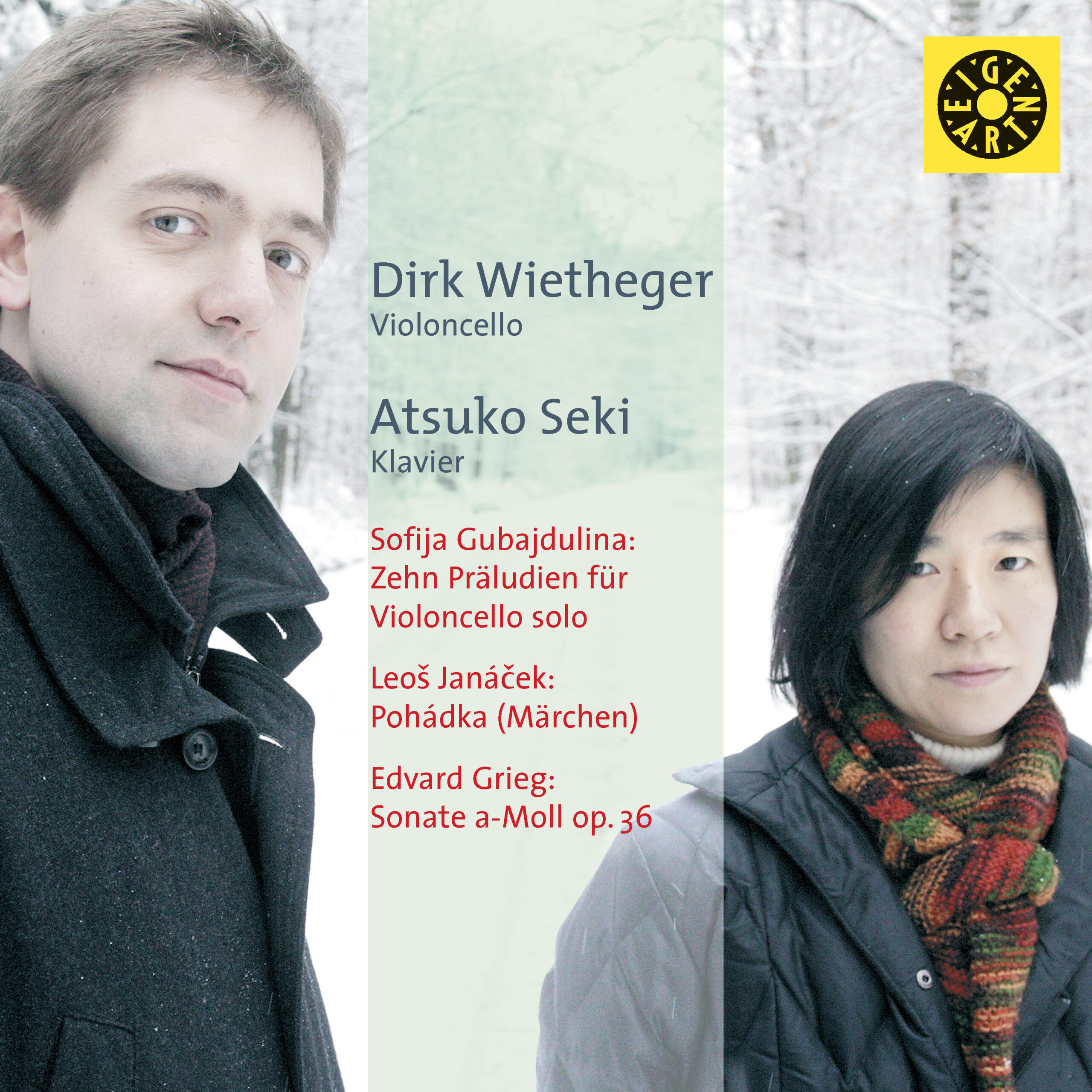
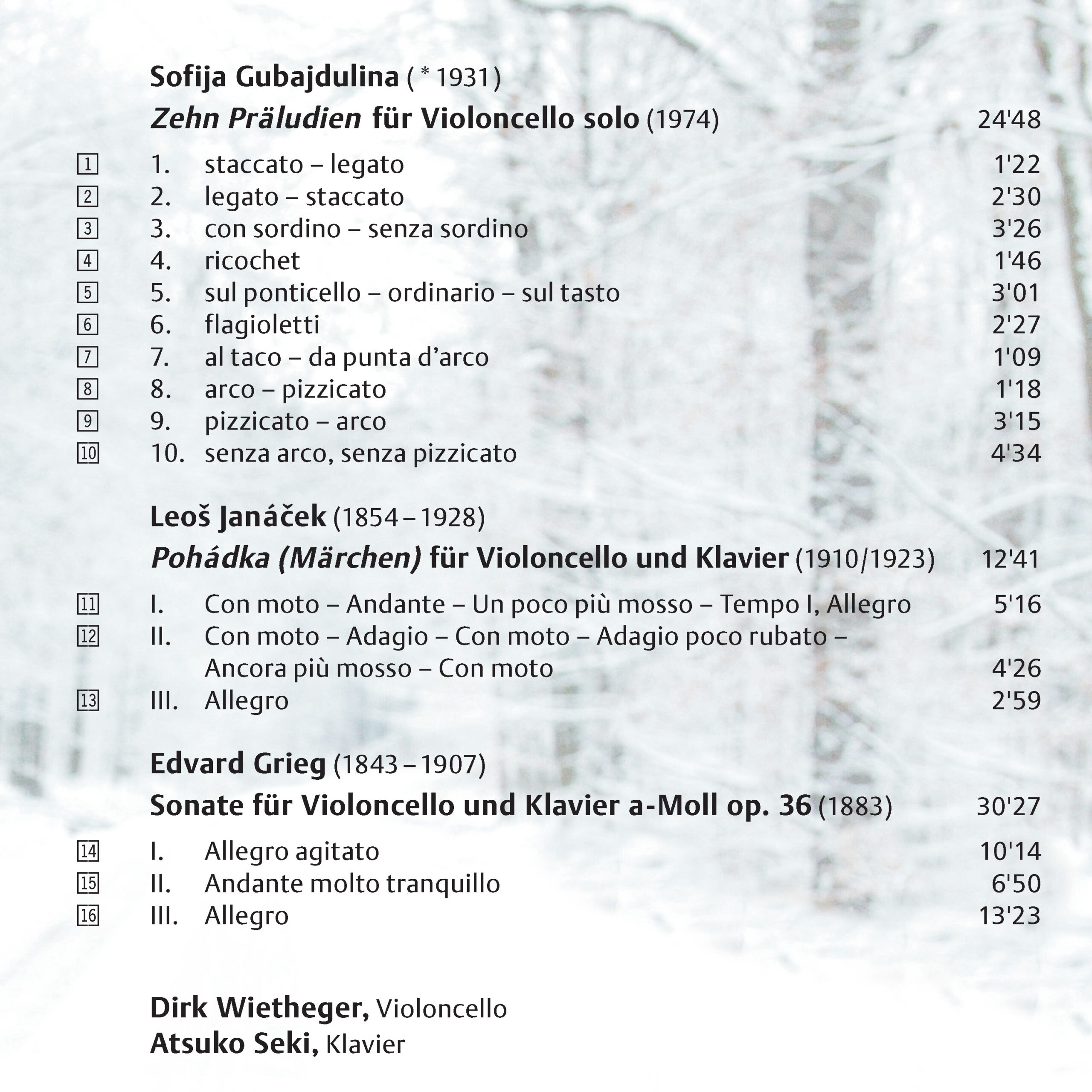
"The EigenArt label gives young, promising musicians a chance to record productions to a technically high standard. This has been particularly successful in the case of Dirk Wietheger (cello) and Atsuko Seki (piano). Their recording presents Sofia Gubaidulina’s Ten Preludes for Cello Solo, Janacek’s Pohadka and the A Minor Sonata by Edvard Grieg. The preludes alone make this CD worth listening to. And on top of that the Sonata is splendidly – because cheekily – played." (Elmshorner Nachrichten, 18.09.2004)
8 reviews for e30 CD / Dirk Wietheger, Violoncello
You must be logged in to post a review.

Classics Today –
While the major labels dilute their slimmed-down classical budgets trying to find artists to market like pop stars, EigenArt and other small outfits seem to make their release decisions on old-fashioned criteria: Do we have a musician worthy of being known, who has made a good recording? EigenArt made the right decision in answering that question with a firm "Yes!" Thirty-three-year-old Dirk Wietheger is a technically solid, artistically accomplished cellist. His tone is not broad and powerful in the manner of Rostropovich, but rather is light and flexible, more like that of Truls Mørk. He is master of the myriad playing techniques thrown at the soloist in the Gubaidulina Ten Preludes, but he also is at home in the romanticism of Edvard Grieg, whose sonata he plays with profound respect for the work′s particularly charming stylistic attributes. He is equally persuasive in the Pohádka (Fairy Tales) by Janácek, successfully knitting together the diverse short parts that make up this mercurial score.
Fine as these latter two performances are, it is the masterly rendition of Gubaidulina′s solo-cello Preludes that makes this disc nearly essential for cello lovers. Although there is a very worthy competitor by Boris Pergamenschikov on ECM, Wietheger′s reading comes across as more spontaneous and emotionally involved than the more cerebral ECM account.
Balances and instrumental sound are true and faithfully captured, from the most whispery bit of ultra-pianissimo in the Gubaidulina Preludes to the full-throated romanticism of the Grieg. Suffice it to say that the sound is so natural that it is transparent, never drawing attention away from the music-making. (...)
Joseph Stevenson
Neue Musikzeitung –
… The cellist Dirk Wietheger, born in Münster in 1972, approaches this material with impressive sensitivity, inviting the listener to thrilling musical experiences through a minimalist style that is at every moment emphatically engaged. Yet this CD offers more than pure minimalism—the exact opposite comes vividly to life, imbued with a deeply felt warmth, when Wietheger records Leo Janáček’s Pohádka and Grieg’s A minor Sonata, Op. 36, together with the Japanese pianist Atsuko Seki for this production. From a single core idea, something grand is developed—a world of complex psychology and glowing emotion challenges the performers, sweeps the listener along—the depth of feeling in this music-making seems scarcely surpassable!
The brilliant recording technique of this CD does the rest, allowing every nuance of sound to unfold with breathtaking clarity. This is thanks to producer Andreas Spreer, who, with his small label EigenArt, makes his extensive technical expertise and keen ear available to young, promising artists.
Stefan Pieper
Neue Musikzeitung –
Cellist Dirk Wietheger possesses a highly vivid, full, and precisely controlled tone. His extensive experience with contemporary music makes him ideally suited to the interpretation of these works of the moderate modern style, as well as Grieg’s wonderfully profound and rather rarely performed cello sonata. Particularly impressive is the logical clarity and transparency of the motivic development achieved by the duo Wietheger/Seki.
Reinhard Schulz
Audiophile Audition –
This extraordinary cello recital features the 32-year-old Wietheger amidst the dazzling pyrotechnical and emotionally diverse demands of Sofia Gubaidulina′s Ten Preludes for cello solo, a 25-minute tour de force that could, in time, become as much a staple for the ambitious cellist′s solo portfolio as the Bach Suites and Kodaly′s solo cello masterpiece. The preludes were composed in response to a request made in 1966 by a professor of cello at the music conservatory in Novosibirsk who found them too modern for his taste. As a result, they were not premiered until 1977, in Moscow, by Vladimir Tonkha to whom they are dedicated. Each prelude focuses on a specific technical challenge or (in eight of them) a pair of contrasting technical challenges (the first, for example, is marked "staccato-legato"). The result is deeply absorbing, and are performed by Wietheger as if he were exploring seductive new musical dimensions.
Wietheger is less impressive in the Janacek and, particularly, the Grieg (a surprisingly tough nut to crack, with a unique combination of conventional and modernist tendencies), where pianist Atsuko Seki dominates inappropriately if very beautifully because of her imposing musical elegance and the lovely sound she draws from her instrument. When Wietheger is alone in the Gubaidulina, he takes center stage. In the Grieg, he struggles to be heard.
Andreas Günther′s conversational liner notes are useful and enjoyable, and Andreas Spreer′s recording is perfectly judged, blending the unforced accuracy of the parent company, Tacet, with a highly musical sense of space. On balance, this is a must have disc for cellists and audiophiles who believe that this royal member of the string family, when heard alone, is one of the ultimate tests of an aspiring sound system.
Laurence Vittes
Jazzthetik –
… Gubaidulina’s otherwise rather austere preludes he fills with vitality and—with appropriate passages—elegiacally, with verve and sheer joy of playing. His glissandi in the second prelude (…) for example, are lively and precise: simply masterful. (…) A highly recommended recording.
Rolf Thomas
Fono Forum –
… Dirk Wietheger, a member of the new-music ensemble Musikfabrik, has put together a program that is as original as it is ambitious. His nuanced performance of Sofia Gubaidulina’s ten preludes, originally conceived as études, highlights his strengths, above all his precise sensitivity to tone color. (…)
A.C.
Klassik heute –
… The CD opens with Gubaidulina’s preludes, composed in 1974. Originally conceived as études, each devoted to a specific playing technique, their primarily pedagogical purpose is still evident in the music. In the interpretation by the cellist Dirk Wietheger, born in Münster in 1972, these ten sometimes very sparse pieces gain precisely the qualities that led to their eventual renaming. Wietheger’s focused, and above all in the quieter passages exquisitely sensitive, playing links the individual movements not only in their original intent as training for modern cello technique, but also shapes them into a school of listening. His bow strokes and pizzicati are executed with surgical precision, thereby opening the space between the notes. (…)
Robert Spoula
Elmshorner Nachrichten –
The EigenArt label gives young, promising musicians a chance to record productions to a technically high standard. This has been particularly successful in the case of Dirk Wietheger (cello) and Atsuko Seki (piano). Their recording presents Sofia Gubaidulina’s Ten Preludes for Cello Solo, Janacek’s Pohadka and the A Minor Sonata by Edvard Grieg. The preludes alone make this CD worth listening to. And on top of that the Sonata is splendidly – because cheekily – played.
pen