
e53 CD / Ferdinand. Works for violin solo
Description
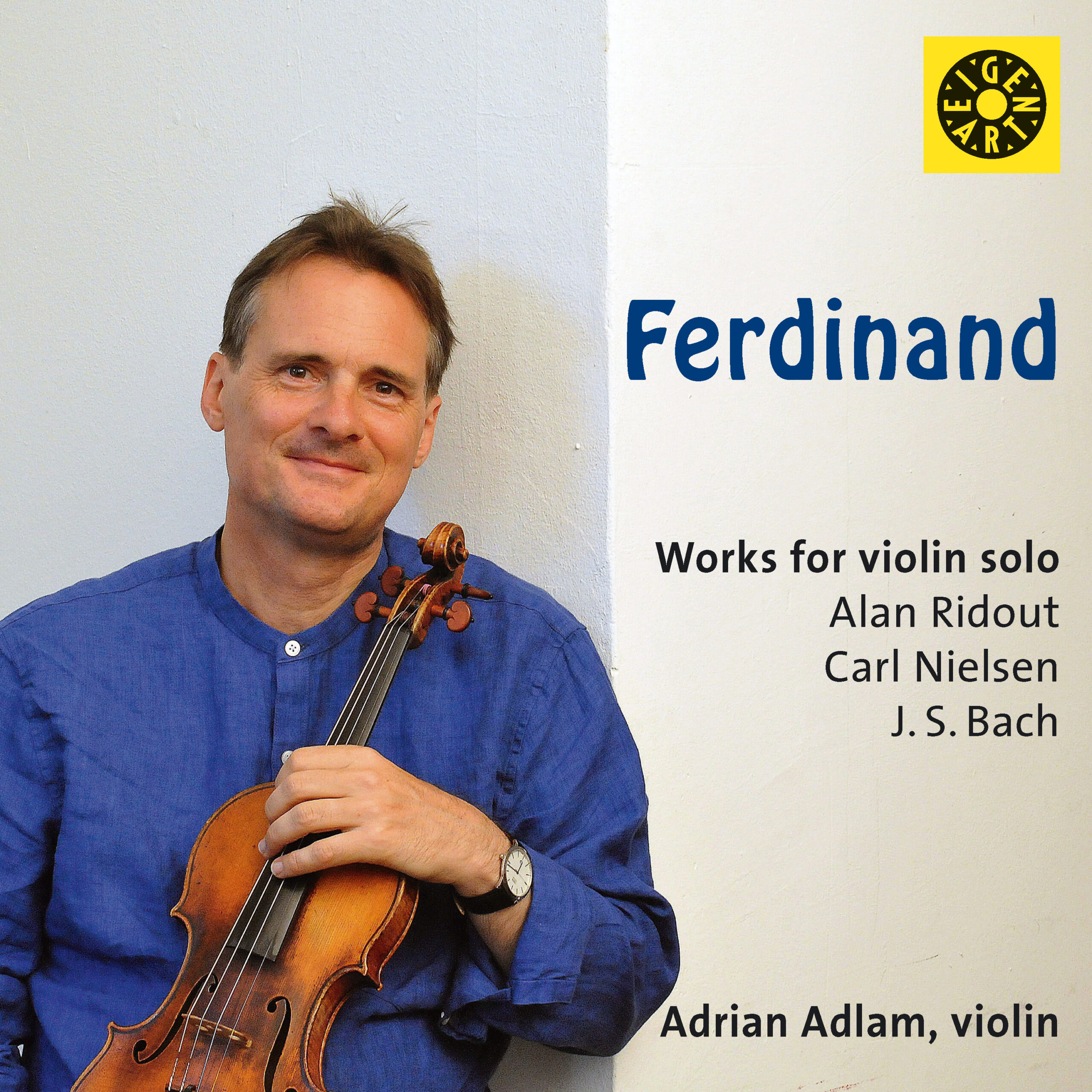
Ferdinand? Is that the man with the violin? No, that is Adrian Adlam. He is peace-loving, just like the protagonist of the eponymous piece - a bull, who doesn't want to enter the bullring. The children's book behind it was written during the Spanish Civil War and was banned by Mussolini and Hitler because of its cleverly packaged criticism. To stand on stage alone with the violin, is reminiscent of the ancient tradition of storytelling: the narrator, too, had only his own voice which he used to captivate people. Adrian Adlam possesses the exceptional gift of conveying a story on several different levels at once. He speaks and plays at the same time, thus bringing both adults and children under his spell. And so the artistic director of the International Freden Music Festival once again displays his versatile virtuosity, as he does throughout the whole CD: Ridout stands alongside Nielsen, who stands alongside Bach. All lone heroes!
2 reviews for e53 CD / Ferdinand. Works for violin solo
You must be logged in to post a review.

Pizzicato –
--> original review
In Adrian Adlam one encounters an outstanding violinist who may not be immediately familiar to everyone and who spent part of his youth in Luxembourg. After holding several concertmaster positions in Europe and in the UK, and pursuing a wide-ranging career in chamber music, he has found a role at the “Fredener Musiktage,” which he founded together with the violist Utz Köster of the Luxembourg Philharmonic, that allows him to commission and perform contemporary music as a curator and artistic director.
His playing is characterized by a supple, flowing, and warm tone. This is evident, for example, in the Chaconne concluding Bach’s Second Partita, which he performs in a continuous, seamless manner. He shapes broad musical arches and long legato lines, taking care to employ smooth motions so that technical noises are largely avoided.
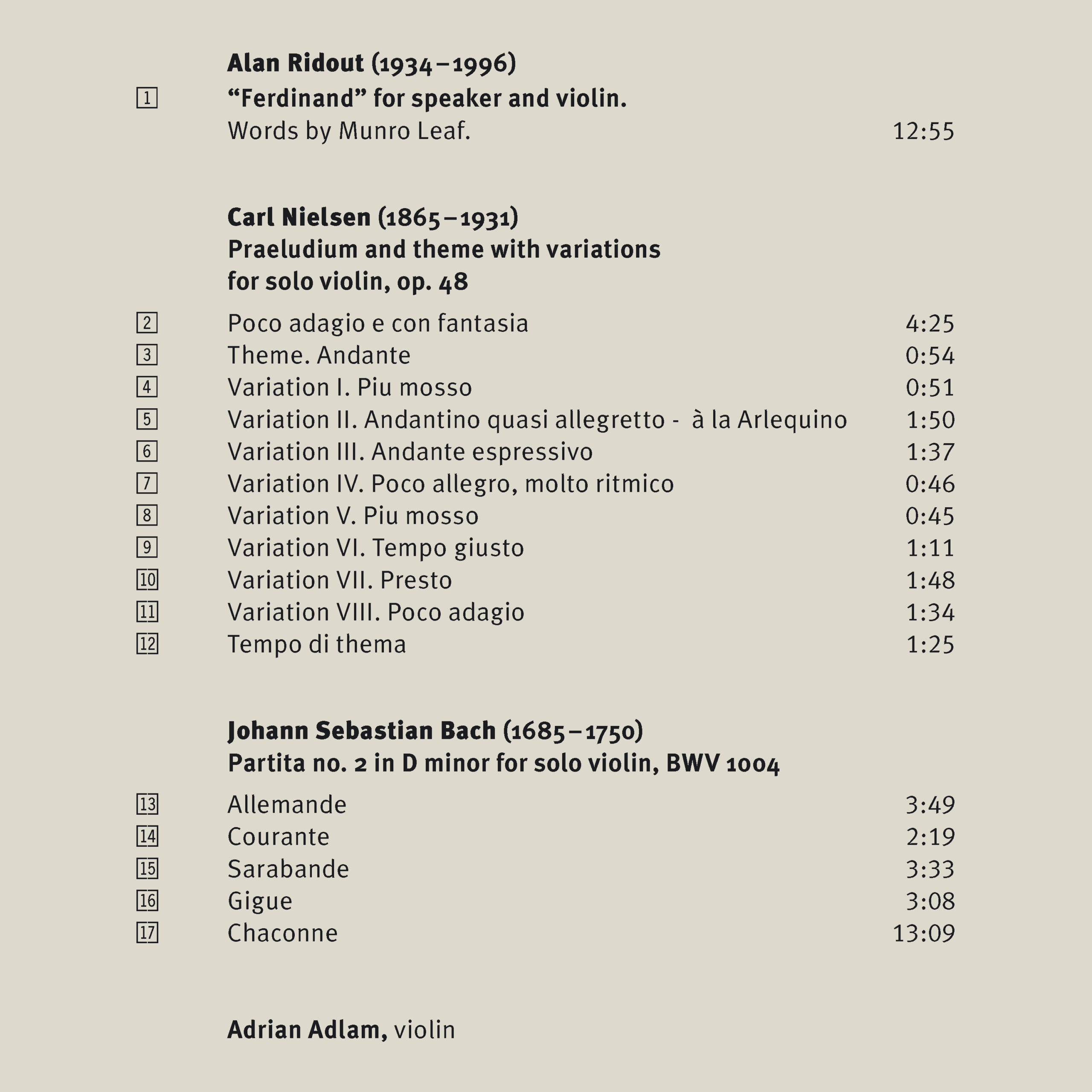
The recording opens with a technically demanding musical fable. Alan Ridout set to music a text by Munro Leaf, the little story of Ferdinand the Bull. Ferdinand sits dreamily in the meadow, sniffing flowers, while the other young bulls test their strength in rough play. When the bullfighters arrive to select animals for the arena, Ferdinand behaves wildly because he has been stung by a bee. In the arena, however, he reveals his true nature again, distracted by the flower-adorned hats of the ladies. So he returns to the meadow, and if he has not died, … The book, incidentally, was banned by the Nazis as communist pacifist propaganda. Here a speaking voice joins the solo violin, in this recording that of the violinist himself. The piece is both vividly narrated and performed with a touch of witty refinement.
The third work for solo violin is Carl Nielsen’s Prelude and Theme with Variations. This recording had already been released in a different context in 2004 and was awarded a “Pizzicato Supersonic.” Like his other violin works, Nielsen composed it for his son-in-law Emil Telmányi. The technical demands point on the one hand to compositional models such as Bach and Paganini, and on the other to virtuosi of the time such as Ernst and Wieniawski. Some of the variations are downright diabolical, either because they lead the listener up the garden path or because the sheer density of notes at breakneck speed threatens the performer with finger-twisting—though, of course, no such danger exists for Adlam.
Uwe Krusch
Klassik heute –
--> original review
At first the title of this CD, Ferdinand, is somewhat disconcerting. It suggests music for children rather than a recording of works for solo violin. But one should not be put off by such a feint, for the music on this disc, recorded by the violinist Adrian Adlam, is well worth hearing. The title refers to the famous children’s book by Munro Leaf, who, in the character of the young bull Ferdinand, created a touching and persuasive plea for tolerance and peace. The composer Alan Ridout took this book as the inspiration for music intended to be combined with a spoken reading.
This is indeed done here, although the speaker is unfortunately not identified. The result, in any case, is a piece that is both entertaining and deeply affecting, since Ridout’s music does not merely illustrate the text but also comments on it, complements it, and enriches it: a highly recommendable work, not least because Adrian Adlam leaves absolutely nothing to be desired musically. Also included on the CD are Carl Nielsen’s Op. 48 and Johann Sebastian Bach’s Second Partita. Here Adlam ventures onto territory that is, as it were, mined, for the benchmark—especially in Bach’s partitas—is extremely high given the competition.
Yet the violinist certainly has no need to hide. He plays “his” Bach with a virtuoso brilliance that seems entirely natural, never overemphasizing, but allowing the music to shine with organic ease. Nothing sounds precious or mannered; on the contrary, everything is grounded and, in the best sense, unadulterated. Above all, however, Nielsen’s not-so-often-heard variations are compelling in Adlam’s thoroughly convincing interpretation. Here violinistic virtuosity and deeply felt expression come together, raising this attractive music to a new artistic level.
Guido Krawinkel