
977 LP / Maurice Ravel: Ma mère l’Oye, Pavane, Le Tzigane
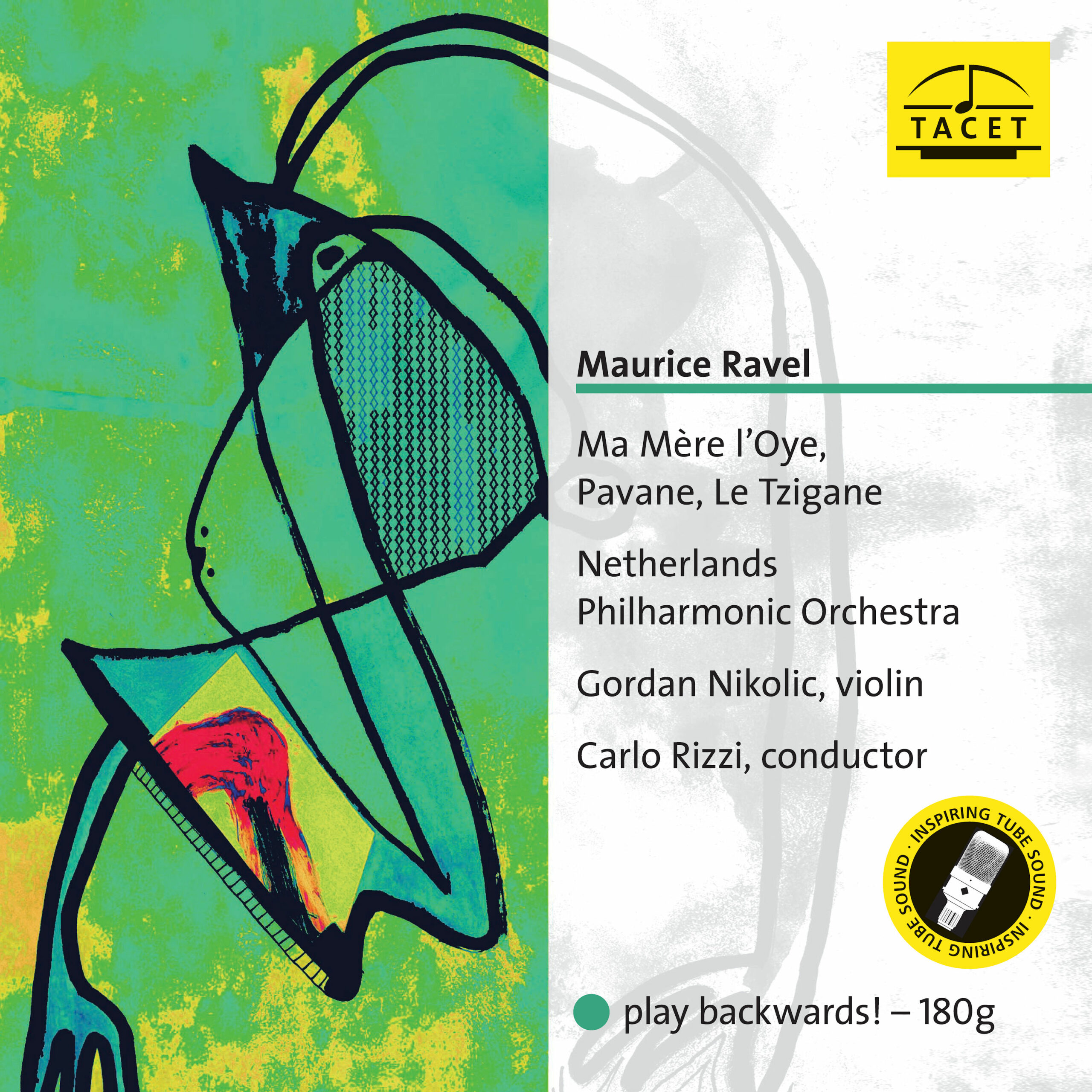
Maurice Ravel
Ma mère l’Oye, Pavane, Le Tzigane
Netherlands Philharmonic Orchestra
Carlo Rizzi, conductor
Gordan Nikolic, violin
play backwards!
Inspiring Tube Sound – 180 g
EAN/barcode: 4009850097716
Description
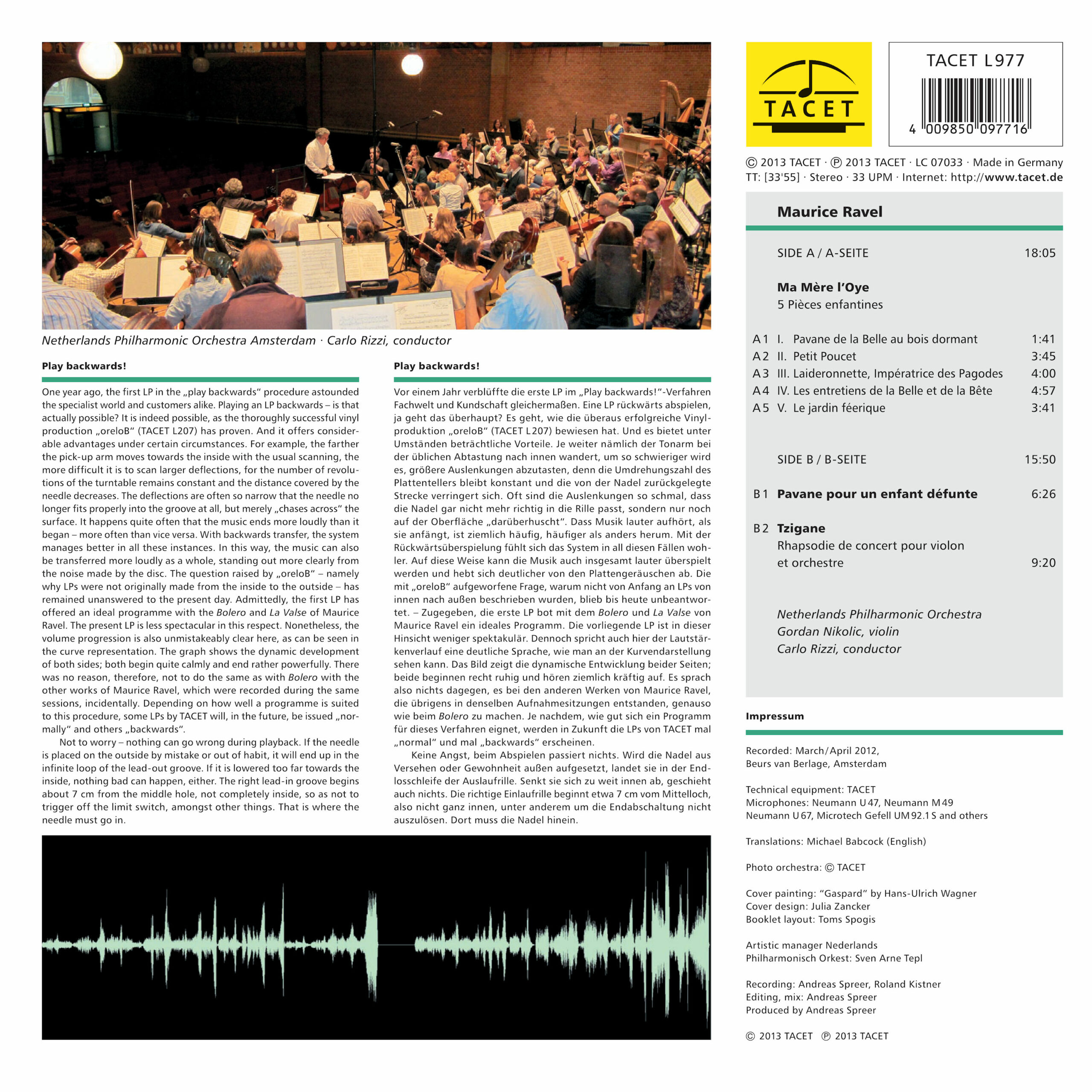
One year ago, the first LP in the "play backwards" procedure astounded the specialist world and customers alike. Playing an LP backwards - is that actually possible? It is indeed possible, as the thoroughly successful vinyl production "oreloB" (TACET L207) has proven. And it offers considerable advantages under certain circumstances.
The question raised by "oreloB" - namely why LPs were not originally made from the inside to the outside - has remained unanswered to the present day. Admittedly, the first LP has offered an ideal programme with the Bolero and La Valse of Maurice Ravel. The present LP is less spectacular in this respect. Nonetheless, the volume progression is also unmistakeably clear here.
There was no reason, therefore, not to do the same with the other works of Maurice Ravel as had been done with Bolero, all of which, incidentally, were recorded during the same sessions with the fabulous Netherlands Philharmonic Orchestra. Gordan Nikolic really gets the dance floor vibrating with his interpretation of "Le Tzigane", and Carlo Rizzi carries us off into the wonderful dream world of Maurice Ravel with the fairytales of Mother Goose.
Depending on how well a programme is suited to this procedure, some LPs by TACET will, in the future, be issued "normally" and others "backwards".
4 reviews for 977 LP / Maurice Ravel: Ma mère l’Oye, Pavane, Le Tzigane
You must be logged in to post a review.
Ähnliche Produkte
-
241
- Sold out
- Inspiring Tube Sound, Vinyl LPs



Stereoplay –
A large sticker lays down the rules: “play backwards!” With selected TACET LPs, recording engineer and company founder Andreas Spreer pursues a bold, idiosyncratic path: instead of letting the stylus travel from the outside inward, he starts the tonearm near the label and moves it in reverse. Why? Because the outer region of an LP offers the potential for greater dynamic range. Ravel’s Boléro has already been released by TACET as a showcase example. What we have here instead is a luxuriating immersion in Ravel’s impressionistic tone painting—conceived in the score as the finest blend of colors. If there is such a thing as poetic mastery in sound engineering, this is where it becomes an event.
Fidelity Magazin Nr. 26 –
Article by Winfried Dulisch (in German language) über den Rückwärtsschnitt im „Fidelity Magazin“ als PDF-Dokument.
With the kind permission of FIDELITY Verlag GmbH.
vinylkatalog.de –
--> original review
With impressive accuracy, the Milanese Carlo Rizzi traces the fairy-tale, childlike qualities in Ravel’s music. The most filigree, almost extremely fragile-sounding crystals of tone emerge. The magical worlds of sound in the setting of Charles Perrault’s fairy-tale collection Tales of My Mother Goose, and the floating, melancholic sonorities of the Pavane pour une infante défunte (whose very title is already music), have rarely been evoked with such perfection—Rizzi’s recording can confidently be placed alongside the best of the past sixty years. Gordan Nikolić, also the soloist in the Mother Goose Suite, rounds things off by perfectly combining Hungarian paprika with French-impressionistic refinement: an exceedingly delicate performance of the highly virtuosic Tzigane! The sound image of this Tacet recording, too, has reference status; the inside-out vinyl cut particularly benefits the dynamics of Tzigane. (2013)
Janis Obodda
Stereo –
In STEREO 4/13 we introduced TACET’s “oreloB”. Ravel’s Boléro is not actually played backwards, but it is cut from the inside outward, so that the tonearm is set down close to the label and comes to rest in what would normally be the lead-in groove. TACET’s head, Andreas Spreer, chose this unusual method because Boléro begins extremely quietly and builds toward an extended fortissimo. With conventional playback, this climax would lie in the inner grooves, where space is compressed and both dynamics and resolution are limited—an absurd situation. In the “backwards” mode, by contrast, the climax can spread out in the outer area of the record, which offers significantly more room.
A similar situation applies to the five fairy-tale miniatures of Ma mère l’Oye. Here too, the spectral analysis shown on the cover reveals that the loudest passages occur at the end of the final movement, the enchanting “Fairy Garden.” And Tzigane, the second work on side B, is far more dynamic than Ravel’s deliberately restrained and even Pavane pour une infante défunte, which therefore appears on the inner grooves. Thus, the reverse tracking here is far more than a gimmick. Added to this is a very homogeneous, spacious, and dynamically effortless recording, made primarily with vintage Neumann tube microphones. The musical interpretation of these vividly pictorial compositions by the Netherlands Philharmonic Orchestra under Carlo Rizzi is thoroughly convincing, making this flawlessly pressed 180-gram disc much more than an analog curiosity.
Matthias Böde