
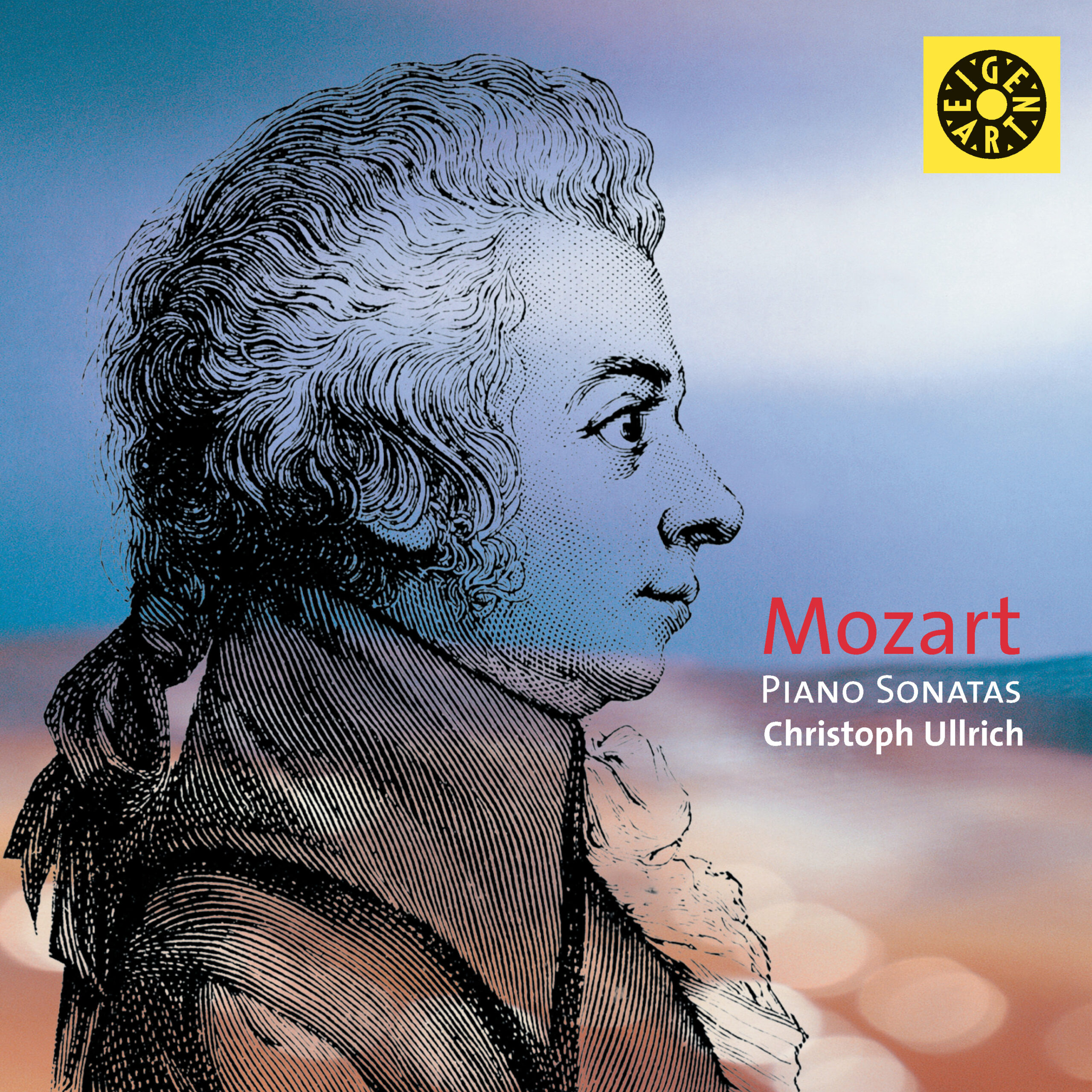
e34 CD / Mozart: Piano Sonatas Vol. 1 / Christoph Ullrich
Description
“Do we want to hear Mozart played on a modern grand piano? If it’s played by Frankfurt pianist Christoph Ullrich, then the Steinway is not only OK – Mozart’s piano music sounds great on it! Ullrich plays with polished dynamics and sharply contoured clarity – transparent but not made of glass. He differentiates deliberately by parts which he contrasts with each other, and in the Fantasy in C Minor K 475 he shows how he the masters the art of the perfectly calculated pause: after it the Fantasy really seems to anticipate Beethoven in a mysterious way and to have been written with knowledge of Bach’s Preludes. [...] The sound quality of the CD is excellent: Andreas Spreer of TACET recorded it.” (Heinz Gelking)
4 reviews for e34 CD / Mozart: Piano Sonatas Vol. 1 / Christoph Ullrich
You must be logged in to post a review.
image hifi –
Do we want to hear Mozart played on a modern grand piano? If it’s played by Frankfurt pianist Christoph Ullrich, then the Steinway is not only OK – Mozart’s piano music sounds great on it! Ullrich plays with polished dynamics and sharply contoured clarity – transparent but not made of glass. He differentiates deliberately by parts which he contrasts with each other, and in the Fantasy in C Minor K 475 he shows how he the masters the art of the perfectly calculated pause: after it the Fantasy really seems to anticipate Beethoven in a mysterious way and to have been written with knowledge of Bach’s Preludes. [...] The sound quality of the CD is excellent: Andreas Spreer of TACET recorded it.
Heinz Gelking
SWR Plattenprisma –
The thing with truly great musical careers is that they’re unpredictable: why one musician achieves it and another does not often defies explanation. Chance surely plays a role, as does the ability to meet the right people at the right time. The Frankfurt pianist Christoph Ullrich—so far, at least—has not yet made that very big career, even though he certainly has the talent for it. It is almost a hobby for him to develop new program concepts and, more generally, to select works in such a way that they illuminate one another. His discography—and, by extension, his repertoire—is by no means small; some time ago, for example, he came to public attention with his recording of the great Schubert sonatas. Now his first Mozart CD has appeared, and here again he offers a personal and convincing perspective on the works he interprets. He plays the two F major sonatas, KV 332 and KV 533, not as entertaining Rococo pieces, but with a pronounced interest in the forward-looking perspective inherent in these works. He plays them with the kind of thoughtfulness usually reserved for Beethoven or Schubert—almost as a prelude to a distinctly Romantic musical language. One can also hear in this recording that the technical prerequisites of piano playing—finger dexterity, touch, and control—are superbly in place. But at a certain pianistic level, that goes without saying; other qualities of this CD therefore come more sharply into focus: the vividness and depth of Ullrich’s playing, the aforementioned emphasis on Mozart’s modernity, and the intelligent booklet notes written by Ullrich himself. All in all: a Mozart full of beauty and profound depth.
Stephan Hoffmann
Piano News –
I listened to Christoph Ullrich’s Mozart CD, as usual taking notes, and suddenly noticed that a particular set of words kept slipping onto the page: I wrote “cantabile” and “singing,” and during the C minor Fantasy I even jotted down “Don Giovanni.” No doubt: Ullrich has a remarkable gift for Mozart’s flowing melody; under his hands, these pieces become miniature operas. Only when this became perfectly clear to me (and you really have to take my word for it) did I read the booklet notes written by the pianist himself. And lo and behold: I had (something that doesn’t always happen with critics) precisely grasped the performer’s intent. Ullrich, for example, describes the first movement of Sonata KV 332 as an “opera scene for piano,” and notes that even in the second movement “it seems opera has been the model.” One can only underline this observation, and Ullrich translates this insight with compelling conviction. Moreover, the programming sequence is interestingly conceived: including the two large F major sonatas alongside the middle section of the C minor Fantasy has a certain appeal—the sonatas reveal themselves as playful, luminous works, while the Fantasy stands as a great dramatic monolith, concentrating the entirety of Mozart’s piano writing. (…)
Oliver Buslau
Frankfurter Rundschau –
Wiser, Sadder
To listen to or play Mozart is one of the few ways not just to pass time, but to transform it, to dissolve it almost as in a chemical process. For all the earthly pleasure one might think to find, it is aware of death. It speaks of things we cannot know.” Rarely does one hear a musician speak about music with such unedited honesty. Christoph Ullrich, the Frankfurt pianist with unusually vivid words and tones, has written a wonderful essay in the booklet of his new CD about Mozart’s music and the impossibility of fully doing it justice. For, as he writes: “Mozart’s music demands instruments we do not know, skills we do not have.”
He writes this, and immediately contradicts himself, for on this CD it is clear that Christoph Ullrich possesses very much of that ability. One seldom hears a Mozart so calm, veiled, yet at the same time so lucid and knowing. He sounds like Schubert—always a song in himself, yet always more than that—perhaps filtered through the listening experience of Ullrich’s previous CDs, on which he played Schubert’s sonatas with astonishingly composed seriousness.
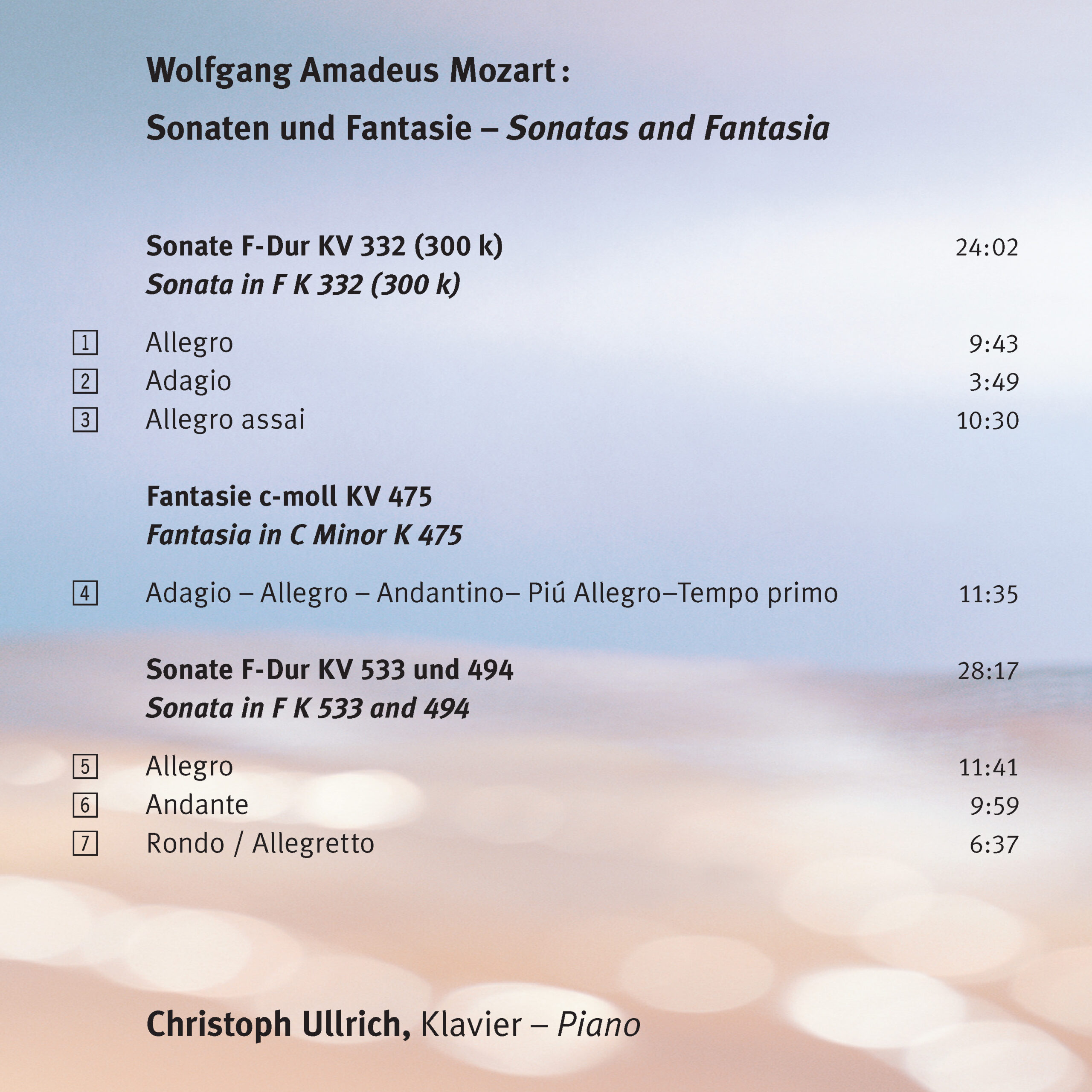
From Mozart, he has recorded the well-known F major Sonata KV 332 and the C minor Fantasy KV 475, complemented by a very rare work: the retrospectively assembled “modular” sonata from KV 533 and 494, a later, more daring Mozart, especially suited to the introspective pianist Christoph Ullrich. Even knowing that it could not have been so, Mozart here sounds as if he were an old, wise man, wiser than us all—and somehow sadder in the process.
ick