
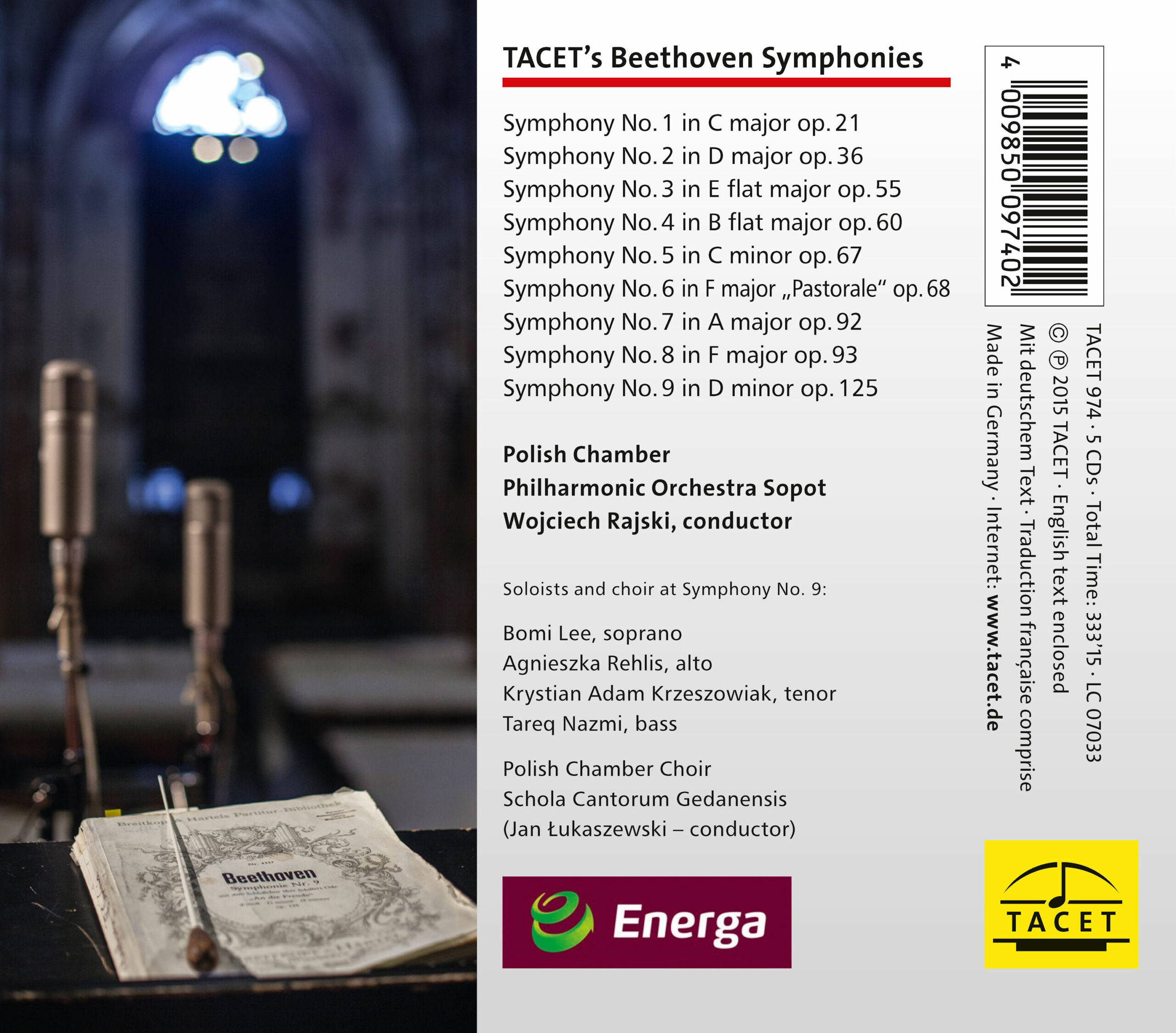
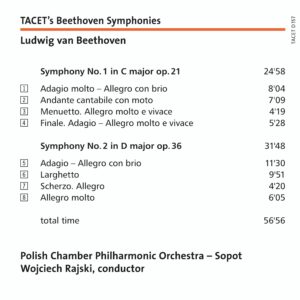
974 CD / TACET’s Beethoven Symphonies: nos. 1 – 9

Description
A Beethoven cycle that's fun from the first note to the last! Wojciech Rajski guides us through the utterly inexhaustible wealth of ideas, energetic and sensitive, humorous and dancelike, with dazzling elegance. And he brings out details that have not been heard before. Indulgence without pathos.
Die Reihe entstand in einem Zeitraum von 10 Jahren. Sie begann 2005 in Sopot (Polen) und endete nun mit der 9. Sinfonie im Sommer 2015 in der Johanneskirche von Danzig. Die ursprünglich treibende Kraft für das ganze Projekt lag im Wunsch nach der ersten Aufnahme der Beethoven-Sinfonien im Real Surround Sound. Deshalb erschien bisher noch keine CD, stattdessen SACDs bzw. DVD-Audios. Doch Rajskis Beethoven verfügt über musikalische Qualitäten, die den „normalen“ CD- und Stereohörern unmöglich vorenthalten werden können. Also hier eine Box mit neuen Stereoabmischungen aller Aufnahmen auf 5 CDs. Im Frühjahr 2016 gibt’s dann zum krönenden Abschluss sowohl die heiß ersehnte finale 9. Sinfonie auf SACD und LP als auch den gesamten Zyklus auf Blu-ray im TACET Real Surround Sound.
5 reviews for 974 CD / TACET’s Beethoven Symphonies: nos. 1 – 9
You must be logged in to post a review.
American Record Guide –
--> original review
Chamber orchestra recordings of Beethoven symphonies using modern instruments are nothing new. Many claim to expose all kinds of theretofore unheard detail—which is not always worth the price in weight and texture loss. These performances are worth that price because they are so enjoyable, even uplifting, and much of what they do is revelatory. The interpretations are fast, exuberant, and full of life. Conductor Rajski is not given to lingering, underlining, or rubato. Rhythms are boldly sprung, sharply turned, and often snappy or whiplike in quickness and effect. The group is on a hair trigger, and ist response is exemplary, even amazing sometimes. The pulse seems vertical, but that is deceptive because a good deal of lyricism goes with it. Our Overview of Beethoven’s string quartets notes that Beethoven is “tough”, and that comes through as well.
Several of these readings throw an interesting light on a symphony, most notably the Sixth. This Pastorale has ist dark moments, perhaps an escape into nature where the stresses of life are not forgotten. The storm is truly violent because those driving strings come through more clearly than ever. Meteorologists often refer to storms as engines, and this one offers a good argument for that.
The Eroica’s blunt opening chords are followed by fast, clipped downbeats with plenty of lift. There is weight, but spring and motion are more prominent. The Funeral March is strong, bright, and bold, as if eschewing excess sentiment in life and wishing none in death. The climax is stormy. III is vigorous, with crisp triple rhythm in the woodwinds and horns that sound like hunting horns. The usual character of the finale remains, with suitable differences between variations, though “reflective” never applies. The horn variation is stunning, and the rush to the end is brilliant.
The Fifth is fast—springy and rhythmic in the faster passages and lyrical in the relaxed ones. The horn calls are urgent, and the occasional ability of these performances to sound big is welcome. The fast tempos work well, and Rajski maintains a good relationship between them. The horns are very impressive in III, as are the furious strings in the fugue, and the violins are as soft as I have heard in the transition to IV. Sometimes the textures are organ-like in IV.
Beethoven was clearly looking forward in the Ninth, so this was a bad time for the no vibrato affectation. It sort of works in the eerie violin writing in the opening, but when it pops up later, it is not to advantage, e.g., a passage near ist end that anticipates Bruckner but sounds frail here. But this is an excellent Ninth anyway, exuberant with eloquence and verve, and the fast tempo really works. The bubbly Molto Vivace is light and deft. The Adagio sings and sounds fresh at the fast tempo. If the violins are thin when they accompany the winds in the horn solo, so be it. This is still a wonderful Adagio. The finale is almost rollicking sometimes, with some interesting balances and emphases on harmonies. It opens dramatically, with the cellos exceptionally eloquent, and the way the tune passes up the string choir is impressive. The vocal contributions are well scaled, and the small choir does ist job well. This Ninth is a true “ode to joy”.
The First and Second go as expected, with the Second reflecting backward and looking forward with a touch of darkness at the same time. The opening to the Fourth is as dark as I have heard it, quite a feat for a chamber orchestra. My only complaint about the high-spirited Seventh is the too-heavy accents in the opening.
Most of the problems here are occasional and probably the result of “period” influence: a few tempos that are too fast and hurried, exaggerated accents, and that minimal vibrato that sometimes helps make a small violin section too bright. At least there are none of those HIP swells.
The Polish Chamber Philharmonic strings sound small even for a chamber orchestra, and more bass would be welcome, but there are advantages to that small size. The recording in stereo is excellent, with fine staging, detail, and tone quality; and I have seen comments raving about the sound on a surround system. Tacet says these recordings were made on equipment run by vacuum tubes. Readers familiar with tube amplifiers often associate them with a dark warm sound, but many modern tube designs produce sound as clear as their solid state counterparts, and that is the case here. Thomas Seedorf’s notes take a historical approach and are worth reading even if you know these works well.
If, like me, you prefer large orchestra Beethoven, it may take a hearing or two before you truly appreciate this set. But give it a chance. It is infectious.
© 2016 American Record Guide
Roger Hecht
Literaturspiegel –
From lyrical to powerful, and at times with resplendent brass fanfares, this cycle achieves an immediacy that goes straight to the heart.
Johannes Saltzwedel
ClicMag –
It is true that Beethoven’s Symphonies—just before Schubert’s—have become the primary focus of historically informed reinterpretations. Since Gardiner, Hogwood, Harnoncourt, and Brüggen, period instruments have been restored to these works, and Jonathan Del Mar’s edition has set the textual record straight—“progress” that has never stopped me from returning tirelessly to Schuricht, Furtwängler, Böhm, Barshaï, Toscanini, Leibowitz, or Wyn Morris.
Arriving in this context, almost on the heels of Paavo Järvi’s complete cycle with the Deutsche Kammerphilharmonie Bremen, the box set now released by Tacet risked going unnoticed. That would be an injustice, for the recording—so vivid, so present—is likely the finest the cycle has enjoyed to date. But there is more.
Wojciech Rajski and his musicians of the Polish Chamber Philharmonic Orchestra approach the cycle with a remarkably unified vision. All of Beethoven—his furia, his invention, his forward-looking spirit—is embodied from the very First Symphony. This powerful musical language only grows richer, expanding like a living organism that will burst forth in a Ninth Symphony-World of irresistible power and momentum.
What is the secret of this lofty, imperious, quintessentially Beethovenian art? It lies in the driven tempos, alla breve—just listen to the Funeral March of the Eroica!—which never forget to sing. But also in an art of attack that most symphonic ensembles have lost, and a rhythmic preeminence unheard since Toscanini. And there is clarity everywhere, carrying the discourse, propelling the phrasing, making Beethoven the most ardent heir of the Enlightenment.
Recorded in the limpid natural acoustics of Sopot’s Stella Maris Church, and captured with stunning detail and dynamic presence, these symphonies resound as a bold renewal of Beethoven interpretation. Let us hope the overtures will follow.
Jean-Charles Hoffelé
© 2015 ClicMag
___________________________________________
Original Review in French language:
C’est entendu, les Symphonies de Beethoven sont devenues juste avant celles de Schubert l’enjeu premier des relectures historiquement informées, depuis Gardiner, Hogwood, Harnoncourt, Brüggen, leur instrumentaire d’époque leur a été rendu, côté texte l’édition de Jonathan Del Mar a remis les choses d’aplomb … des « progrès » qui ne m’ont jamais empêché de revenir inlassablement à Schuricht, Furtwängler, Böhm, Barshaï, Toscanini, Leibowitz ou Wyn Morris.
Arrivant dans ce contexte, et quasiment dans le sillage de l’intégrale de Paavo Järvi avec la Deutsche Kammerphilharmonie de Brême, le coffret aujourd’hui édité par Tacet risquait de passer inaperçu. Cela serait une injustice car la prise de son si vive, si présente est probablement la meilleure dont le cycle ait profité à ce jour. Mais il y a plus.
Wojciech Rajski et ses musiciens du Polish Chamber Philharmonic Orchestra abordent le cycle avec une volonté de l’unifier assez inédite. Tout Beethoven, sa furia, son invention, ses prospectives, se trouve incarné dès la Première Symphonie, cette langue si puissante ne fait ensuite que s’enrichir, croître, fabuleux organisme vivant qui éclatera littéralement dans une Neuvième Symphonie-Monde d’une puissance et d’un élan irrésistibles.
Secret de cet art altier, impérieux, si beethovénien ? Des tempos cravachés, alla breve—écoutez seulement la Marche funebre de l’Héroïque !—qui n’oublient pourtant jamais de chanter. Mais aussi un art de l’attaque que les formations symphoniques ont pour la plupart perdu, une prééminence des rythmes pas entendue depuis Toscanini. Et cette clarté partout qui emporte le discours, entraîne les phrasés, fait Beethoven le plus ardent héritier des Lumières.
Enregistrées dans la limpide acoustique naturelle de l’Église Stella Maris de Sopot, et captées avec une finesse de détails et une présence dynamique clouantes, ces symphonies sonnent haut et fort un renouveau de l’interprétation beethovenienne. Espérons que les Ouvertures suivront.
Jean-Charles Hoffelé
© 2015 ClicMag
Audio –
Another complete recording of the Beethoven symphonies? But what a recording! Technically, this production is of the finest caliber: captured with historic tube microphones, the sound is distinguished by its naturalness, transparency, sensuality, and warmth. Musically, too, the result is convincing: the Polish musicians strike the perfect balance between classical and bold interpretation. The tempos are often brisk, yet always appropriate. In the Ninth, the vocal soloists and choir also deliver a flawless performance. Another plus is the informative booklet. A highly recommendable alternative to the established complete recordings.
Andreas Fritz
Pizzicato –
--> original review
Freude, schöner Götterfunken
Wojciech Rajski concludes his Beethoven cycle, begun in 2005, with the 9th Symphony, recorded in the summer of 2015 at St. John’s Church in Gdańsk. Until now, we have only had SACDs of the symphonies in magnificent “Real Surround Sound.” This box set contains stereo mixes of all the recordings, but Tacet has announced the release of the 9th Symphony on SACD and LP, as well as the entire cycle on Blu-ray in Tacet’s “Real Surround Sound.” Audiophile listeners should be patient, as the transistor-free recordings of Beethoven’s symphonies in “Surround Sound” are something truly extraordinary.
Sitting in the middle of a Beethoven symphony guarantees a new listening experience and is by no means unnatural. Above all, the wind instruments have a completely different sound; they stand out more individually in the discourse and have something much more personal to say than in the overall sound one hears in a concert. In the final movement of the 7th Symphony, for example, where the orchestra plays fortissimo, the physical vibration adds another dimension to the experience of sound.
Even in stereo, the recording quality is already outstanding, with sound that fascinates through its balance and transparency.
Rajski conducts the symphonies with his characteristic drive in the outer movements and a keen sense for lush wind colors in the slow movements. He places great emphasis on pulsating, richly accented, transparent, and always thrilling music-making, yet allows Beethoven’s symphonies to flow naturally. This is where the compelling power and a rarely heard richness of sound come from—qualities we admired so much in the first eight symphonies when they were released individually.
The Ninth, the only new recording in this box set, does not deviate from the path taken by its predecessors. Powerful, straightforward, yet detailed music-making characterizes the first two movements. Time and again, one notices details that sound “new.”
Rajski shapes the third movement in a completely unpretentious yet profoundly lyrical manner. The beginning of the finale is extraordinary: it is brilliant how Rajski arranges Beethoven’s forces here and builds up the tension that ignites all the lights in the choral finale. There is no false solemnity here, just joyful, carefree exuberance. While the choir may sound less homogeneous and polished than higher-level choirs in other recordings—so what? Here, they sing with full lungs and great enthusiasm, and that is worth something too.
Remy Franck